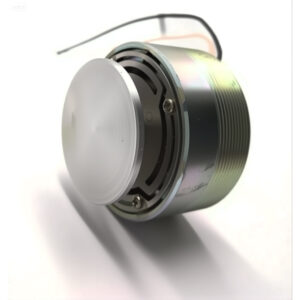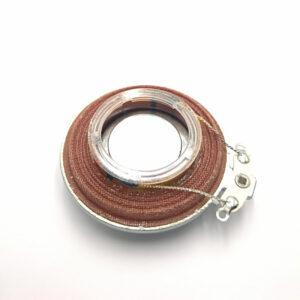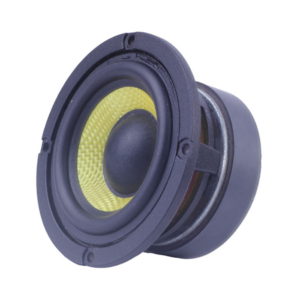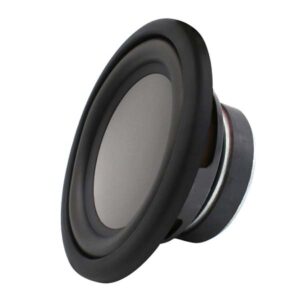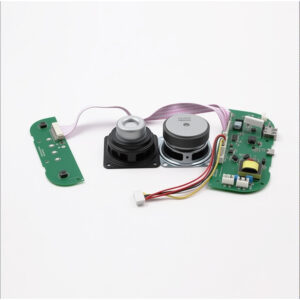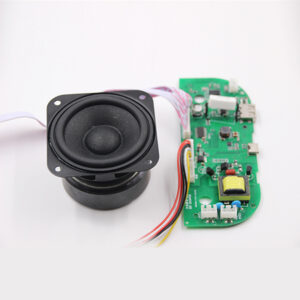
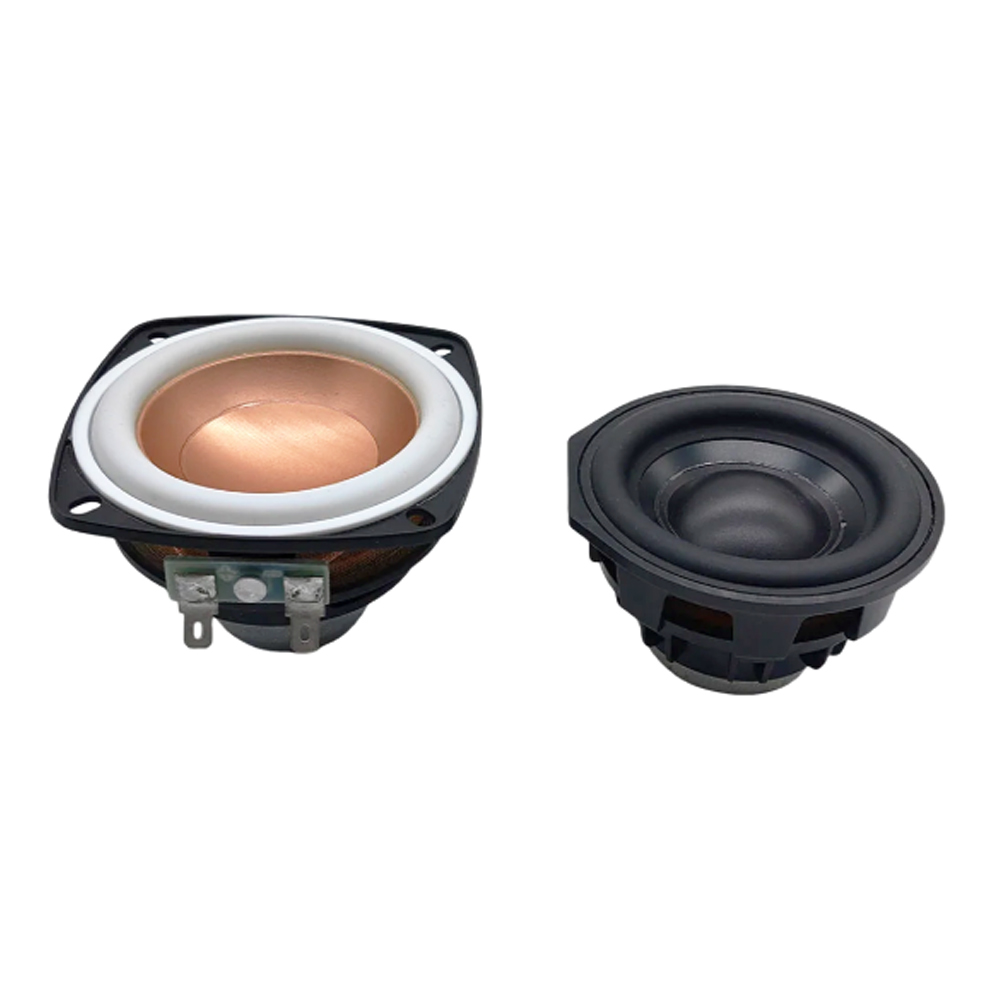
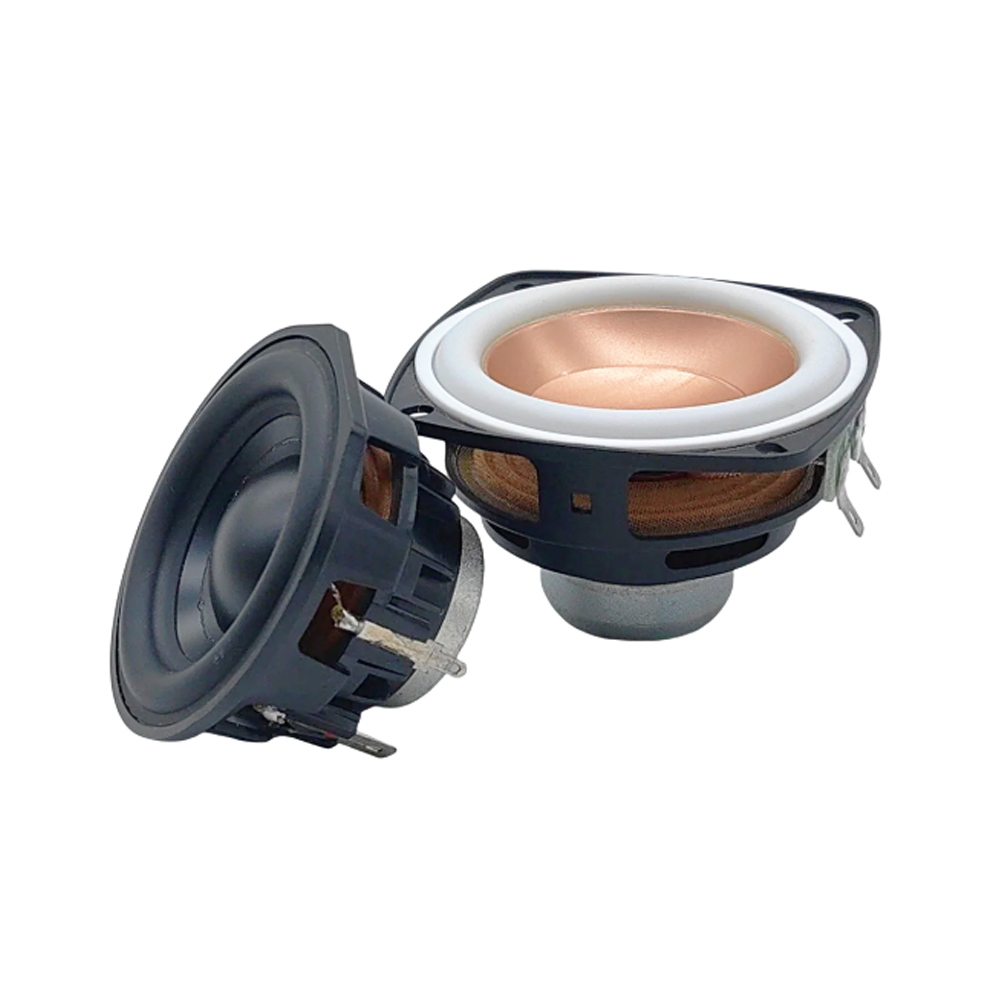
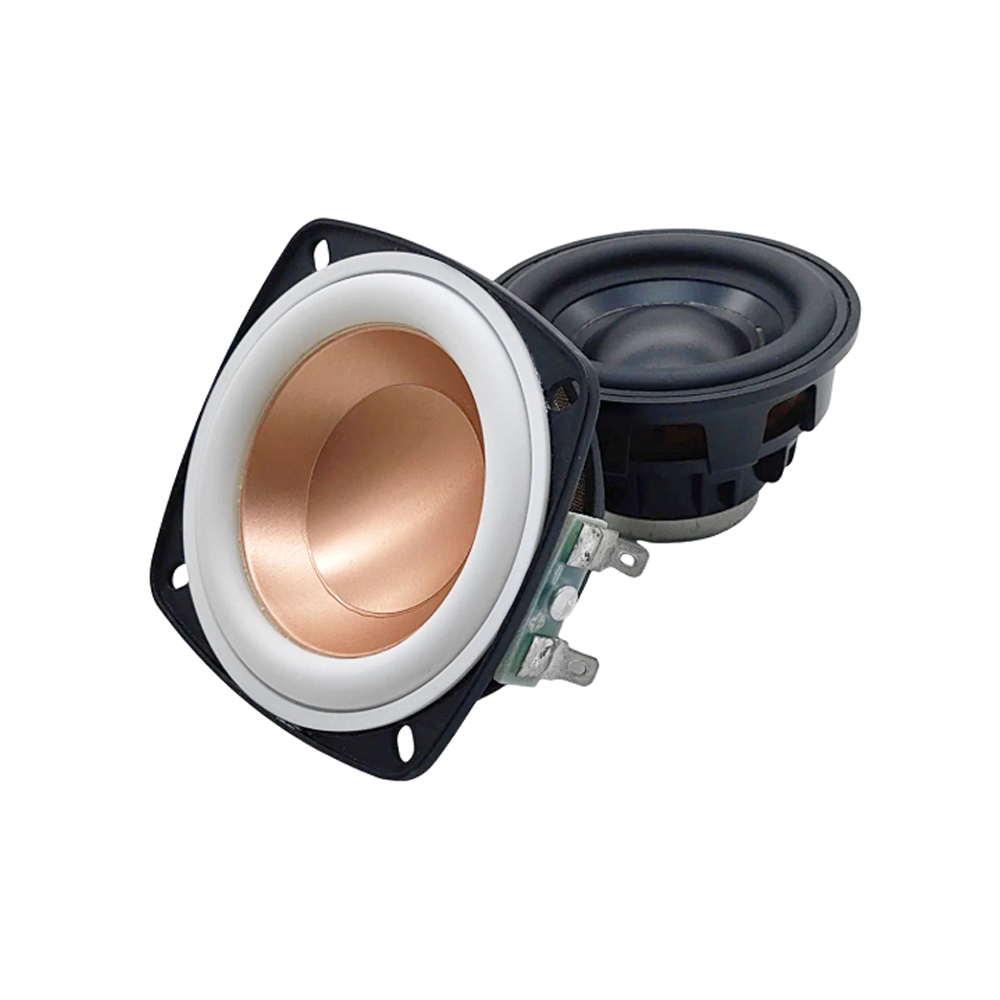
A full range speaker rated 4, 6, 8, 16, 32 or 64 Ω / 0.5–100 W for portable consumer audio, with tooling, tuning and termination open to the project rather than fixed at a catalogue value (ZEH-P2225).
Overview
The trade-off in a crossover-less design is that the same cone must move enough air for the bass and stay light enough for the treble. ZEH-P2225 uses a compact diaphragm with a low-mass voice coil so that mid-band efficiency is preserved, and the surround is chosen to damp the cone’s first breakup mode. Rated at 0.5–100 W, the driver is limited thermally above its rated band; a high-pass filter at or below the tuning frequency protects it from excursion damage in small sealed boxes. Sensitivity is quoted per IEC 60268-5 as dB SPL at 1 W / 1 m, which allows direct comparison between impedance variants only after correcting for the 2.83 V convention.
Specifications
| Model | ZEH-P2225 |
|---|---|
| Product type | Full Range Speaker (custom build) |
| Rated power | 0.5–100 W |
| Nominal impedance | 4 Ω / 6 Ω / 8 Ω / 16 Ω / 32 Ω / 64 Ω |
| Termination | Solder pads, lead wires or connector — to drawing |
| Customisation | Termination, dimensions, housing and tuning to your drawing |
| Compliance | RoHS 2011/65/EU and REACH; declarations with each shipment |
Design notes for portable consumer audio
Portable products trade bandwidth for size and battery life. A full-range driver in a Bluetooth speaker or a pair of headphones is expected to deliver 100 Hz–15 kHz from a small cavity, and the amplifier’s rail is usually the limiting factor rather than the driver. The practical design question is efficiency: a 4 Ω load extracts more output from a 3.7 V rail than an 8 Ω one, but it also doubles the current and shortens runtime, so the impedance is chosen together with the battery and the DSP’s limiter settings.
Typical applications
- Portable Bluetooth speakers
- Headphones and headsets
- Soundbars and TV audio
- Gaming and VR audio
Customisation and verification
The build is defined by your drawing rather than by a stock list. Impedance, termination, magnet grade, diaphragm material and housing are fixed at sample approval, then held by a controlled BOM so that a later order does not drift acoustically. Units are 100 % swept, sensitivity-binned where the product needs it, and packed with the test data for the lot.
FAQ
Do I need a crossover for a full-range driver?
Usually only a first-order high-pass at or below the box tuning to limit excursion, plus optional baffle-step correction. A full crossover at 3–4 kHz defeats the purpose of a single driver.
Why is 4 ohm louder than 8 ohm on the same amplifier?
For a fixed output voltage a 4 Ω load draws twice the current, so the amplifier delivers about 3 dB more power. The driver itself is not more efficient; sensitivity in dB/W/m is comparable.
What enclosure volume does ZEH-P2225 need?
Between 0.5 and 2 litres sealed for the compact class, depending on the target cut-off. Send us the internal dimensions and we will return a simulated response before tooling.
Related pages
full-range speakers · ZEH-P2215 · ZEH-P2209 · 4 Ohm vs 8 Ohm Speakers Full Engineering Guide