ZEH does not hand you a catalogue speaker and wish you luck. Engineering starts with your target curve and ends with a signed tuning report — the driver, the enclosure and the filter set are reviewed together, because that is the only way the datasheet numbers survive contact with your product’s plastic shell.
Sensitivity you can measure at IEC conditions. An alignment worked out on your real net volume. Filters voiced on prototypes, not guessed in a spreadsheet.
Most audio problems are born in the gaps between suppliers — the driver house blames the enclosure, the enclosure house blames the circuit. ZEH runs all four disciplines under one engineering desk, so nothing falls between them.
Specification
Your brief becomes a measurable acoustic spec — sensitivity, low-frequency roll-off, distortion budget and excursion limits you can sign.
Driver Match or Custom
Catalogue match where it works; a custom motor system where it does not. Every T/S claim is verified on our impedance bench before it reaches your project.
Enclosure Co-design
Net volume, wall stock, seals, grille and baffle reviewed against the driver's measured data — before any mould steel is cut.
Measurement & Tuning
Frequency response, impedance and distortion sweeps at several power levels, then voicing and filter notes until the curve holds where your product needs it.
How a Tuning Engagement Runs
Every stage has defined inputs, defined work and a defined deliverable — you always know what you are approving before money moves to the next phase.
Stage
What you bring
What ZEH does
What you receive
1. Requirement definition
Product brief, SPL target, size, power and cost limits
Translate into a measurable spec: sensitivity, −3 dB point, THD budget, excursion limits
Signed-off acoustic spec sheet
2. Driver selection or custom design
Catalogue datasheets or a target curve
T/S parameters verified on the impedance bench; catalogue match or custom motor layout
Measured T/S datasheet + recommendation
3. Enclosure & acoustic path review
CAD, net volume, wall stock, seals, grille
Alignment math (fc / Qtc / f3), leakage and baffle review, DFM comments for the plastics team
Alignment note + enclosure DFM report
4. Prototype & tuning
3D-printed, CNC or soft-tool samples
FR / impedance / THD sweeps at 1, 5 and 10 W, voicing, crossover or DSP filter notes
Before/after curve comparison + filter settings
5. Design review & handover
Pilot-run samples
Failure review, tolerance stack, freeze of end-of-line limits for the production line
Tuning report + EOL screening limits
PROTOTYPES THAT ANSWER QUESTIONS
Three Prototype Routes, Chosen by the Question
Each prototype route answers a different question, so we do not spend your budget on samples that cannot tell you anything new.
01
3D-printed enclosures — form and fit within days — right for checking acoustic path, seal geometry and assembly order before any tooling spend.
02
CNC-machined samples — real wall stock and material damping — right for verifying resonance behaviour that a light print cannot reproduce.
03
Soft-tooling pilot cavities — pre-production parts in the production resin — right for freezing tolerances, texture and EOL limits ahead of the steel.
Suspension parts soften as they run in: T/S parameters drift measurably over the first 10–20 hours. We re-verify parameters after break-in, so the alignment you approve is the alignment production will deliver. Full validation lives on the quality & testing page.
TRY THE ALIGNMENT MATH
What the Numbers Mean
This is the same first-pass math our engineers run when your mechanical team fixes a volume and asks what the bass will do. Three numbers decide everything:
01
fc — system resonance — the driver’s free-air fs, raised by the air spring inside your enclosure.
02
Qtc — system damping — 0.707 is the Butterworth maximally-flat alignment; above ~1.1 bass turns boomy, below ~0.5 it thins out.
03
f3 — the −3 dB point — where your product’s bass response effectively ends — the number marketing quotes and reviewers check.
Small-signal model only. It gets a project started; the final alignment is confirmed by measurement on real prototypes. Need the vented or passive-radiator version? That is part of the engagement, not a web form.
Sealed Enclosure Alignment Check
Small-signal model: fc = fs·√(1+Vas/Vb), Qtc = Qts·√(1+Vas/Vb). The −3 dB point follows the second-order response of the system Q. Qtc ≈ 0.707 is the Butterworth maximally-flat alignment; above ~1.1 bass becomes boomy, below ~0.5 overdamped. Verify T/S parameters by measurement before finalising tooling — they drift 10–20 hours after assembly as suspensions break in.
What We Keep Hearing — and What We Do About It
1
“The datasheet said 85 dB, the samples measured 81.”
ZEH response: every published claim is re-measured at defined IEC 60268-5 conditions before your tooling money moves — spec and reality reconciled in week one, not after the moulds are cut.
2
“Bass disappeared once the driver went into the customer’s plastic shell.”
ZEH response: the alignment is worked on your real net volume and leakage paths from stage 3, and fc / Qtc / f3 are reviewed with your mechanical team — not discovered at EVT.
3
“A buzz appeared at high volume three months after launch.”
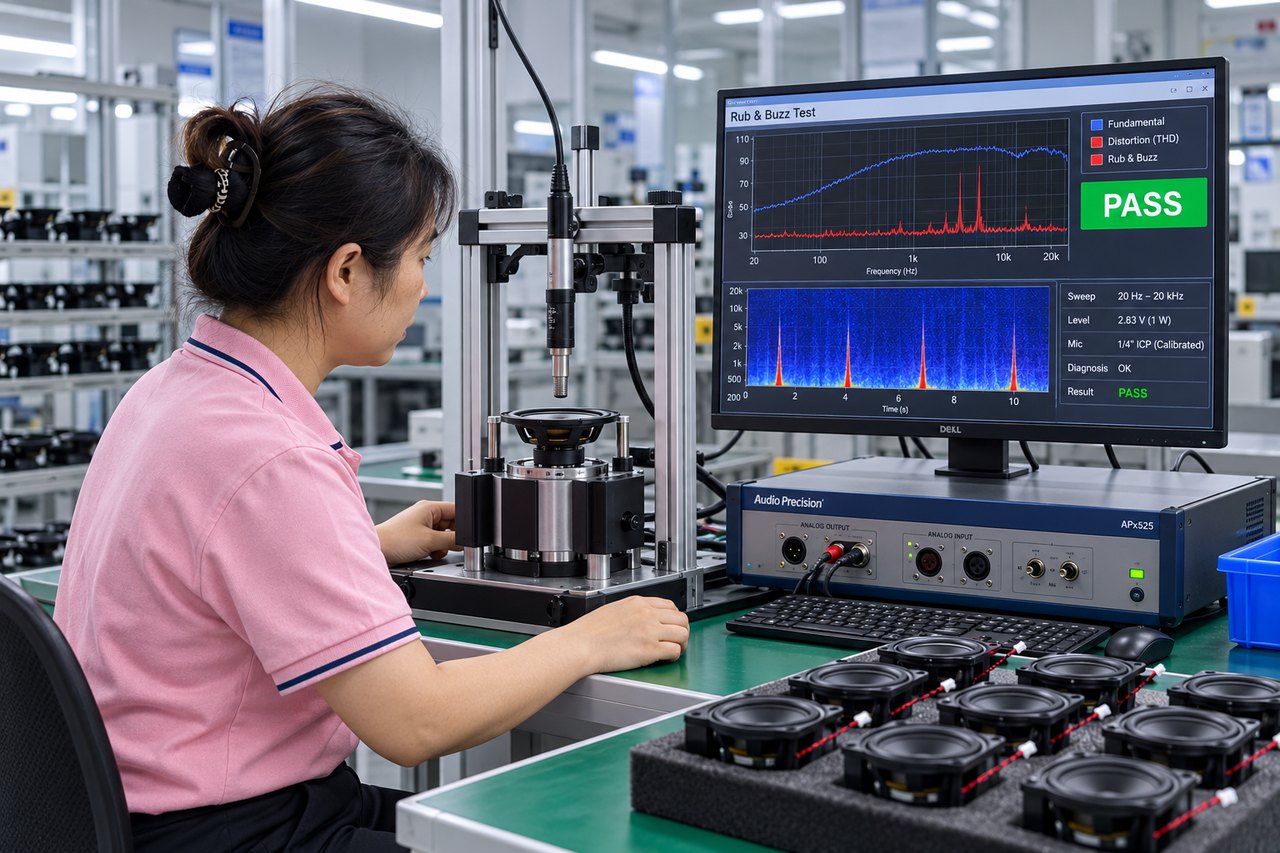
ZEH response: Rub & Buzz screening and excursion headroom review sit inside the tuning loop, and the frozen EOL limits catch the same signature on every production unit.
What We Measure, in Plain Terms
Frequency response & SPL
Swept sine, log-periodic — near-field for the lows, spliced with far-field for the full curve.
Impedance & T/S parameters
The impedance curve yields fs, Qts and Vas — verified, not copied from a catalogue.
THD & Rub & Buzz
Distortion tracked at 1, 5 and 10 W so you see where the headroom really ends.
Sensitivity & power handling
Level and endurance under IEC 60268-5 conditions, quoted the same way every time.
Polarity & phase
Checked per driver and per system — the classic cause of vanishing bass in multi-driver products.
Engineering time is only worth paying for if it ends in documents your own team can act on. Every engagement closes with all four packs.
Curves & Data
Before/after frequency-response comparison
Impedance and THD plots at 1 / 5 / 10 W
Raw sweep data files
Datasheets
Measured T/S parameters per driver revision
Sensitivity quoted at IEC 60268-5 conditions
Excursion limits for your DSP team
Engineering Notes
Alignment & enclosure DFM report
Crossover / DSP filter settings
Grille and seal review comments
Production Handover
Signed tuning change log
EOL screening limits for the line
Tolerance stack for pilot approval
START THE REVIEW
Send the Target Curve First
The fastest way to a useful reply is a target curve, a CAD step file or the product you want to improve — any one of the three. An acoustic engineer, not a salesperson, answers with the first-pass alignment and a prototype plan.