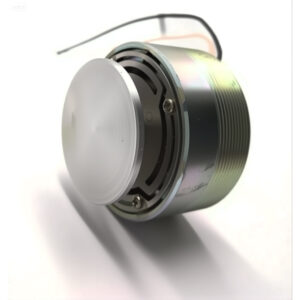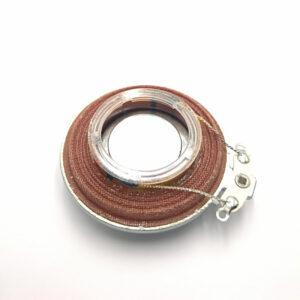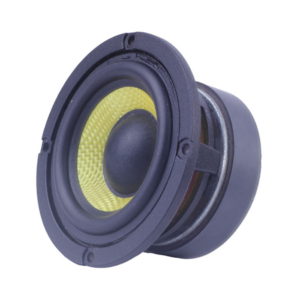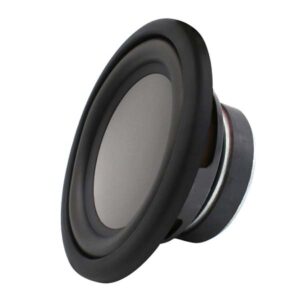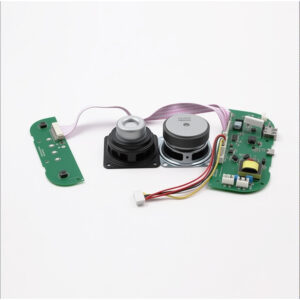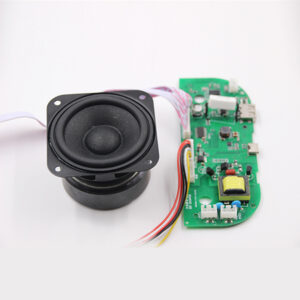
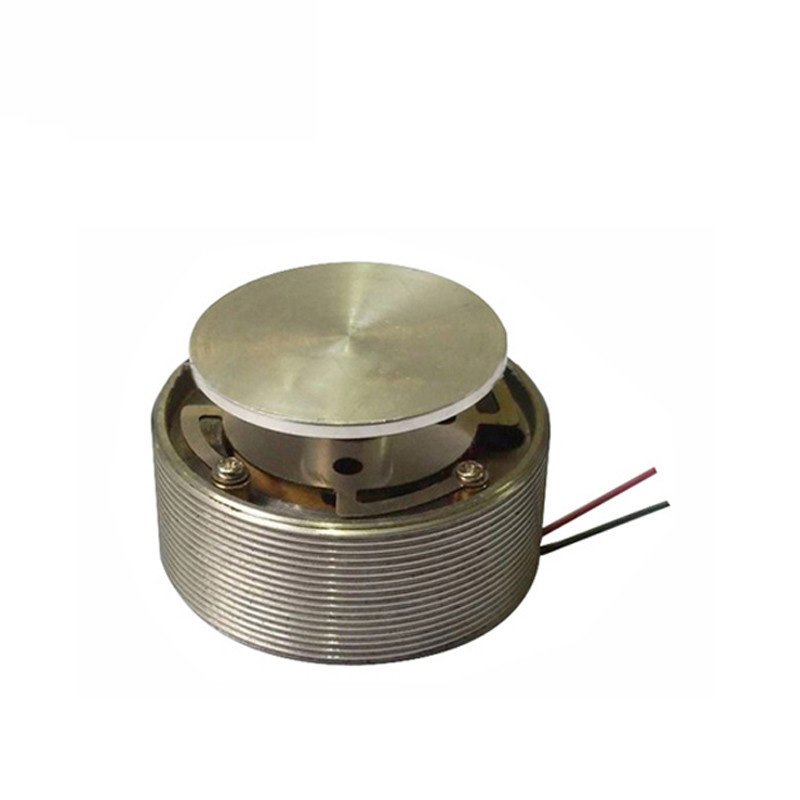
44 mm round exciter at 8, 4, 6, 16, 32 or 64 Ω / 10–100 W for portable consumer audio, supplied as a custom build with your connector, lead length and mounting detail (ZEH-379).
Overview
An exciter drives a panel instead of a cone, so the radiator is the product housing. ZEH-379 is a 44 mm exciter rated 10–100 W at 8, 4, 6, 16, 32 or 64 Ω, bonded to a rigid panel; output below 200 Hz depends almost entirely on panel stiffness and damping, not on the exciter. The mass of the exciter must be small relative to the panel, otherwise the assembly behaves as a mass-loaded piston and efficiency collapses.
A 44mm frame with a 8, 4, 6, 16, 32 or 64 Ω coil draws roughly 1.8 A from a 3.7 V rail at full drive, which fixes the supply and limiter settings before acoustics are considered. The cavity behind a 44mm part is normally 0.3–2 cm³; send the housing drawing and the tuning is confirmed before tooling.
Specifications
| Model | ZEH-379 |
|---|---|
| Product type | Exciter (custom build) |
| Nominal size | 44 mm, round frame |
| Rated power | 10–100 W |
| Nominal impedance | 8 Ω / 4 Ω / 6 Ω / 16 Ω / 32 Ω / 64 Ω |
| Termination | Solder pads, lead wires or connector — to drawing |
| Customisation | Termination, dimensions, housing and tuning to your drawing |
| Compliance | RoHS 2011/65/EU and REACH; declarations with each shipment |
Design notes for portable consumer audio
Portable products trade bandwidth for size and battery life. A surface exciter in a Bluetooth speaker or a pair of headphones is expected to deliver 100 Hz–15 kHz from a small cavity, and the amplifier’s rail is usually the limiting factor rather than the driver. The practical design question is efficiency: a 4 Ω load extracts more output from a 3.7 V rail than an 8 Ω one, but it also doubles the current and shortens runtime, so the impedance is chosen together with the battery and the DSP’s limiter settings.
Typical applications
- Portable Bluetooth speakers
- Headphones and headsets
- Soundbars and TV audio
- Gaming and VR audio
Customisation and verification
Every unit is built to a drawing: impedance, lead length, connector series, mounting bosses and the rear-cavity gasket are project-specific. Samples from existing tooling are typically ready in 7–10 days, and new tooling adds 25–35 days. Production parts are checked with a frequency sweep and an impedance curve against the approved sample, and the inspection record travels with the shipment.
FAQ
Why does my panel buzz at high volume?
The panel is being driven at a structural mode. Add damping, stiffen the mounting points, or raise the high-pass filter to 150 Hz.
What adhesive should be used?
Structural acrylic or epoxy for metal panels, and a high-tack double-sided tape for painted plastics. Surface energy below 34 mN/m needs a primer.
Can ZEH-379 be used on glass?
Yes, with a compliant adhesive and a rigid frame; glass is stiff but heavy, so output below 250 Hz will be limited by mass.
Related pages
vibration exciters · ZEH-P4330 · ZEH-P354 · High Audio Frequency Speaker Design Guide