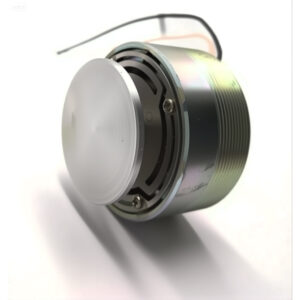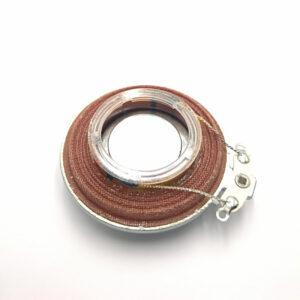
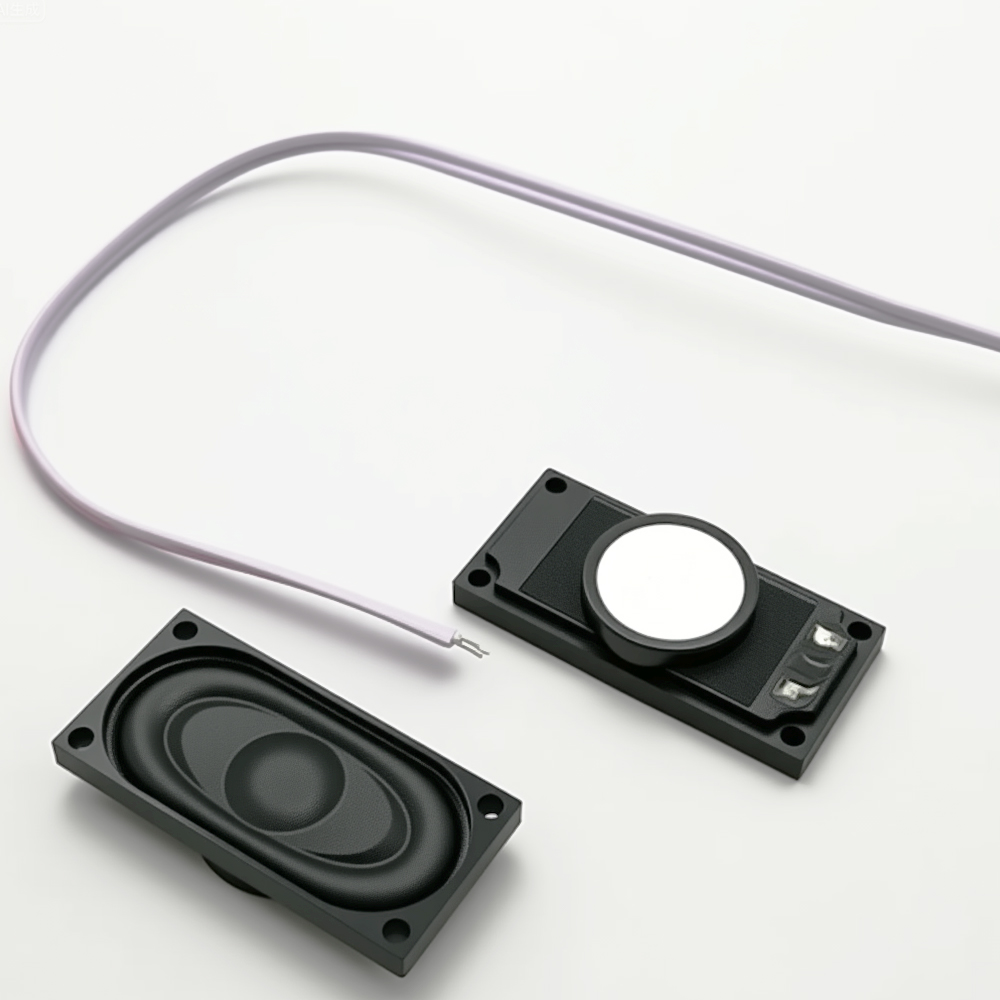
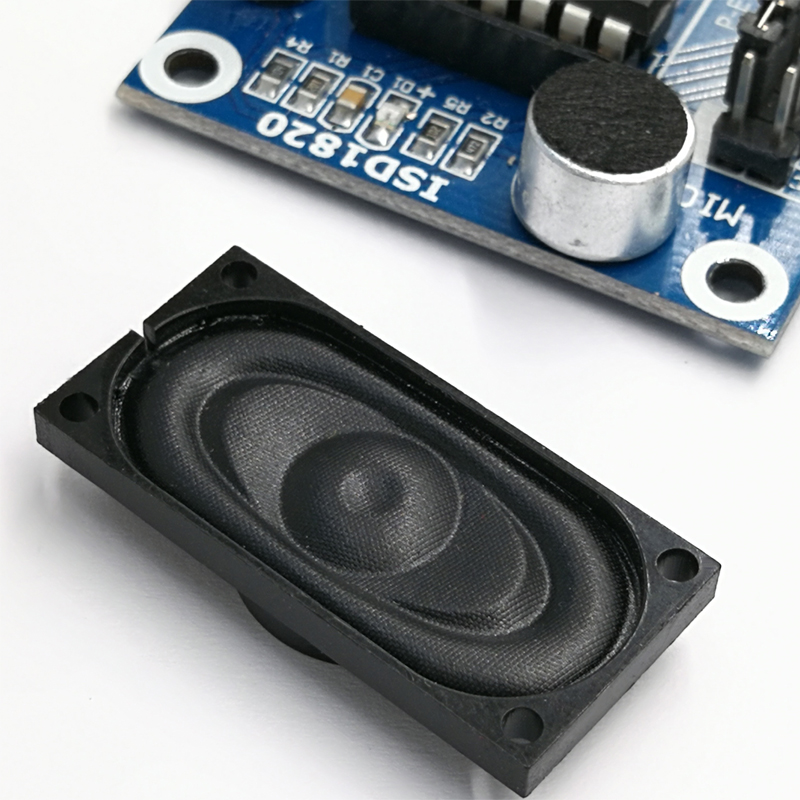
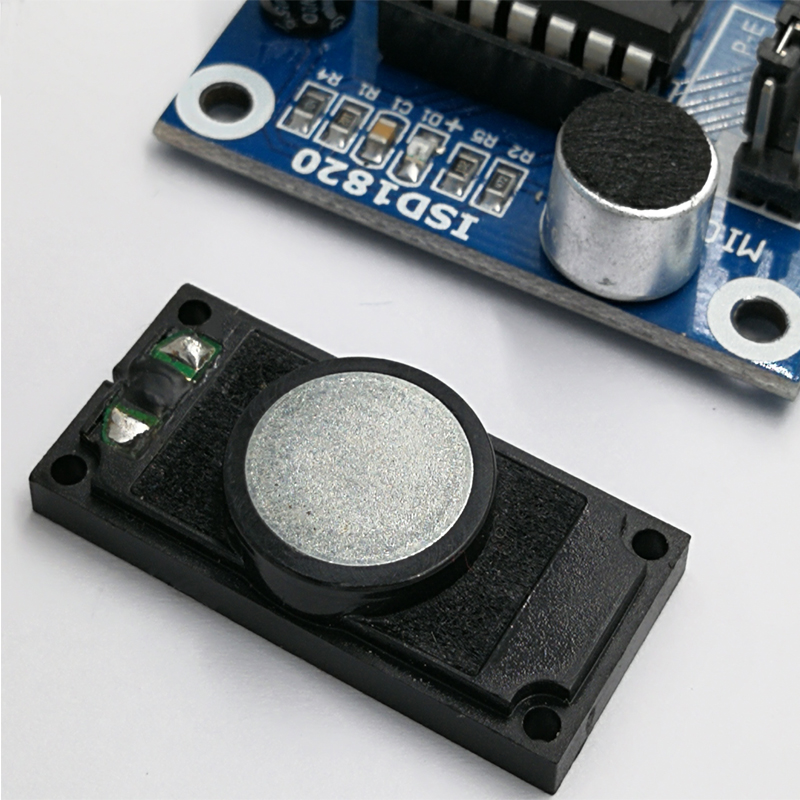
35 × 16 mm micro speaker at 8, 4, 6, 16 or 32 Ω / 1–100 W for wearable and tablet products, supplied as a custom build with your connector, lead length and mounting detail (ZEH-P3025).
Overview
In this size class the rear cavity, not the driver, sets the low-frequency limit. A 35 × 16 mm unit such as ZEH-P3025 is usually tuned so that the sealed back volume behind the diaphragm lifts output in the 400–900 Hz band; enlarging that cavity by even 0.3 cm³ flattens the hump but costs roughly 2–3 dB of sensitivity above 1 kHz. Excursion is only a few tenths of a millimetre, so the rated 1–100 W figure is set by voice-coil heating rather than by mechanical travel, and short bursts above rating will not bottom the coil but will raise Re and shift sensitivity over time. Measurement follows IEC 60268-5: characteristic sensitivity is quoted at 0.1 W at 10 cm for this class, which is not comparable with the 1 W / 1 m figure used for hi-fi drivers.
A 35x16mm frame with a 8, 4, 6, 16 or 32 Ω coil draws roughly 1.8 A from a 3.7 V rail at full drive, which fixes the supply and limiter settings before acoustics are considered. The cavity behind a 35x16mm part is normally 0.3–2 cm³; send the housing drawing and the tuning is confirmed before tooling.
Specifications
| Model | ZEH-P3025 |
|---|---|
| Product type | Micro Speaker (custom build) |
| Nominal size | 35 × 16 mm |
| Rated power | 1–100 W |
| Nominal impedance | 8 Ω / 4 Ω / 6 Ω / 16 Ω / 32 Ω |
| Design feature | Slim-profile design |
| Termination | Solder pads, lead wires or connector — to drawing |
| Customisation | Termination, dimensions, housing and tuning to your drawing |
| Compliance | RoHS 2011/65/EU and REACH; declarations with each shipment |
Design notes for wearable and tablet products
Wearables and tablets have almost no back volume, so the driver is chosen for excursion per cubic millimetre rather than for sensitivity on a baffle. A built-in micro speaker in a watch, a band or a tablet edge is usually sealed against sweat and dust with a membrane, and the membrane’s acoustic loss becomes part of the tuning budget. Bone conduction and exciter-based designs avoid the cavity problem entirely, at the cost of bandwidth above 4 kHz.
Typical applications
- Smart watches and bands
- Tablets and 2-in-1 devices
- Hearing aids and earbuds
- AR glasses and wearables
Customisation and verification
Every unit is built to a drawing: impedance, lead length, connector series, mounting bosses and the rear-cavity gasket are project-specific. Samples from existing tooling are typically ready in 7–10 days, and new tooling adds 25–35 days. Production parts are checked with a frequency sweep and an impedance curve against the approved sample, and the inspection record travels with the shipment.
FAQ
What is the difference between a micro speaker and a receiver?
A micro speaker is optimised for music and voice playback across a wide band, while a receiver (earpiece) is tuned for speech intelligibility in a narrow band at lower excursion. Both can share a 35 × 16 mm footprint, but the receiver needs a smaller back volume and a higher resonance.
Can the lead wires and connector be changed?
Yes. Lead length, wire gauge, stripping length, tinned ends, Molex or JST connectors, and pad-only termination are all tooling-independent options on ZEH-P3025; the acoustic design is unaffected as long as the added mass stays off the diaphragm.
How is the rear cavity volume specified?
Give us the internal volume available behind the mounting face and the target low-frequency cut-off. We then recommend a gasket height and, if needed, a felt or mesh damping layer so the assembly meets the curve in your enclosure rather than on an open baffle.
Related pages
built-in micro speakers · ZEH-P3030 · ZEH-P3035 · Small Speaker Acoustic Design Principles