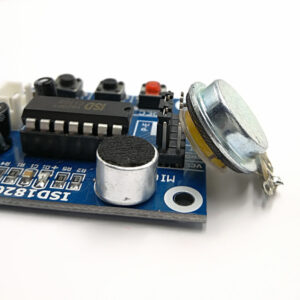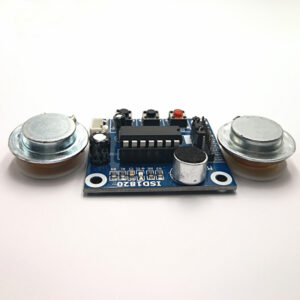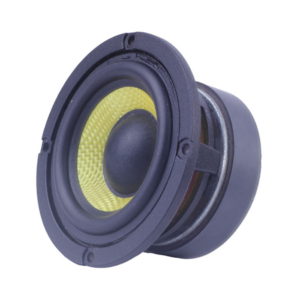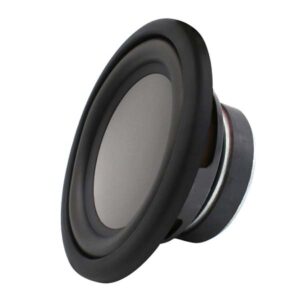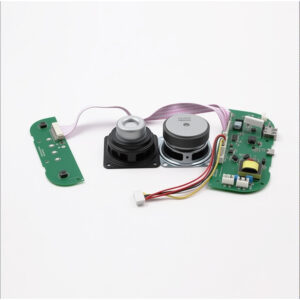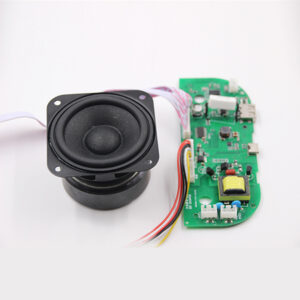
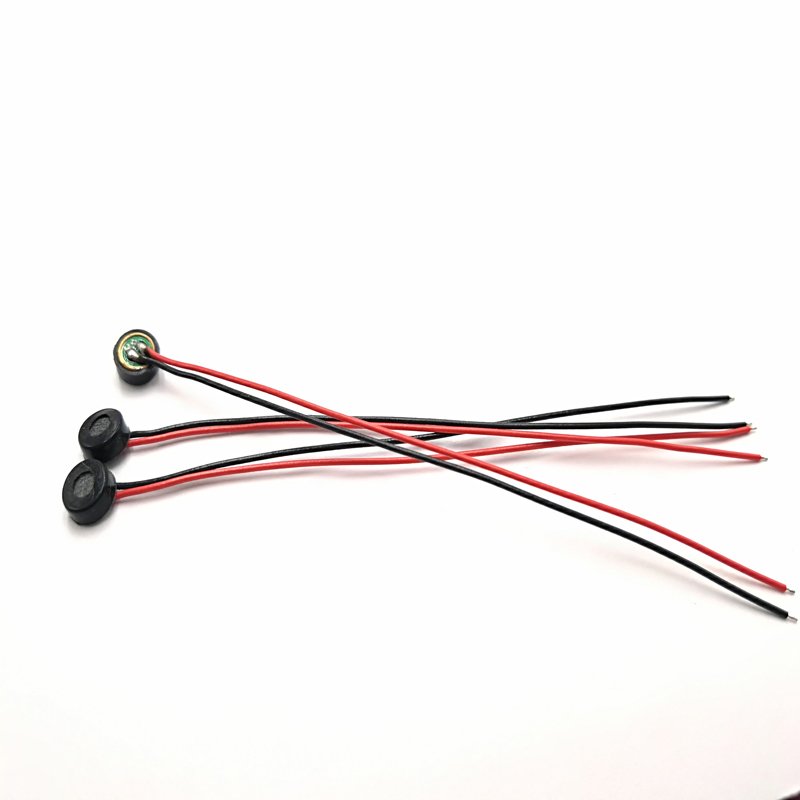
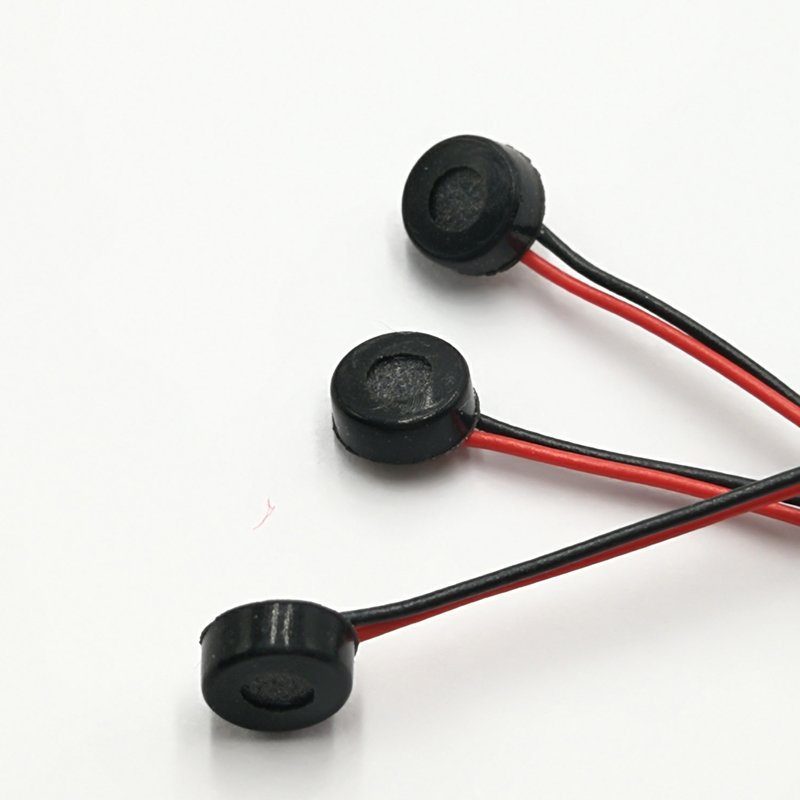
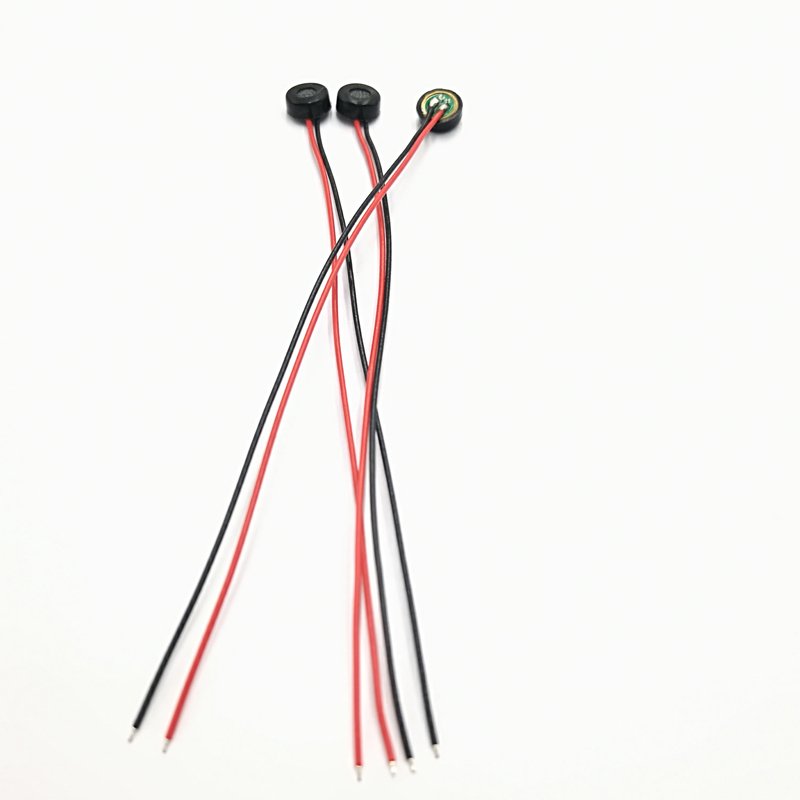
The electret microphone (ZEH-MIC-4015-00120) is an omnidirectional capsule for smart-home and voice products, with the sensitivity bin and the port geometry defined by your drawing rather than by a stock part.
Overview
An electret condenser microphone pairs a permanently polarised diaphragm with a JFET impedance converter, which is why it needs only a bias resistor and 1–10 V rather than a 48 V phantom supply. ZEH-MIC-4015-00120 is a compact omnidirectional capsule with a nominal sensitivity of −38 dB (0 dB = 1 V/Pa at 1 kHz), a 2.2 kΩ output impedance and a current draw under 0.5 mA. Sensitivity spread between units is the parameter that decides whether a product needs binning: ±3 dB is normal, ±1 dB requires selection.
Sensitivity is binned before packing; a 3 dB spread between capsules in a stereo pair is audible as an image shift, so arrays are supplied from a single bin.
Specifications
| Model | ZEH-MIC-4015-00120 |
|---|---|
| Product type | Electret Microphone |
| Directivity | Omnidirectional |
| Output | Analogue (JFET buffered) |
| Sensitivity | −38 dB ±3 dB (0 dB = 1 V/Pa, 1 kHz) |
| Supply | 1–10 V via bias resistor |
| Termination | Solder pads or lead wires — to drawing |
| Customisation | Termination, dimensions, housing and tuning to your drawing |
| Compliance | RoHS 2011/65/EU and REACH; declarations with each shipment |
Design notes for smart-home and voice products
Always-on voice products need a transducer that stays linear at conversation distance and does not colour speech. A electret condenser microphone in a smart speaker or a wall panel is mounted into a moulded cavity whose volume is fixed by the industrial design, so the tuning is done by the cavity and the gasket rather than by the driver alone. Far-field capture depends on signal-to-noise ratio at the port, and playback quality depends on how much the housing resonates — a 2 mm wall will buzz at 300–500 Hz long before the driver runs out of excursion.
Typical applications
- Smart speakers and displays
- Voice-assistant wall panels
- Doorbells and intercoms
- Robot vacuum voice prompts
Customisation and verification
Every unit is built to a drawing: impedance, lead length, connector series, mounting bosses and the rear-cavity gasket are project-specific. Samples from existing tooling are typically ready in 7–10 days, and new tooling adds 25–35 days. Production parts are checked with a frequency sweep and an impedance curve against the approved sample, and the inspection record travels with the shipment.
FAQ
What does −38 dB sensitivity mean?
It is the output voltage for a 1 Pa (94 dB SPL) input at 1 kHz, referenced to 1 V. −38 dB equals about 12.6 mV/Pa.
Can ZEH-MIC-4015-00120 run from a 3.3 V rail?
Yes. The capsule needs 1–10 V through a bias resistor; 3.3 V is inside the range, and sensitivity falls only slightly at the low end.
How do I reduce wind noise?
Use a rear-sealed capsule with a defined front port, add a mesh or foam windscreen, and high-pass the signal below 100 Hz in the DSP.
Related pages
electret condenser microphones · ZEH-MIC-4013-001 · ZEH-MIC-4015-002003 · Custom Microphone Supplier: From Design to Delivery for Consumer Elect