
An AI speaker is defined by its microphone path, not by its loudspeaker. The array has to hear a wake word at 5 m in a room with a television playing, which means 65-70 dB SNR capsules, an acoustic overload point above 120 dB SPL, and beamforming that rejects the loudspeaker's own output by 20-30 dB.
With custom speaker manufacturer, the difference between a sample and a shipment is the test record, so each section below names the check that produces it.
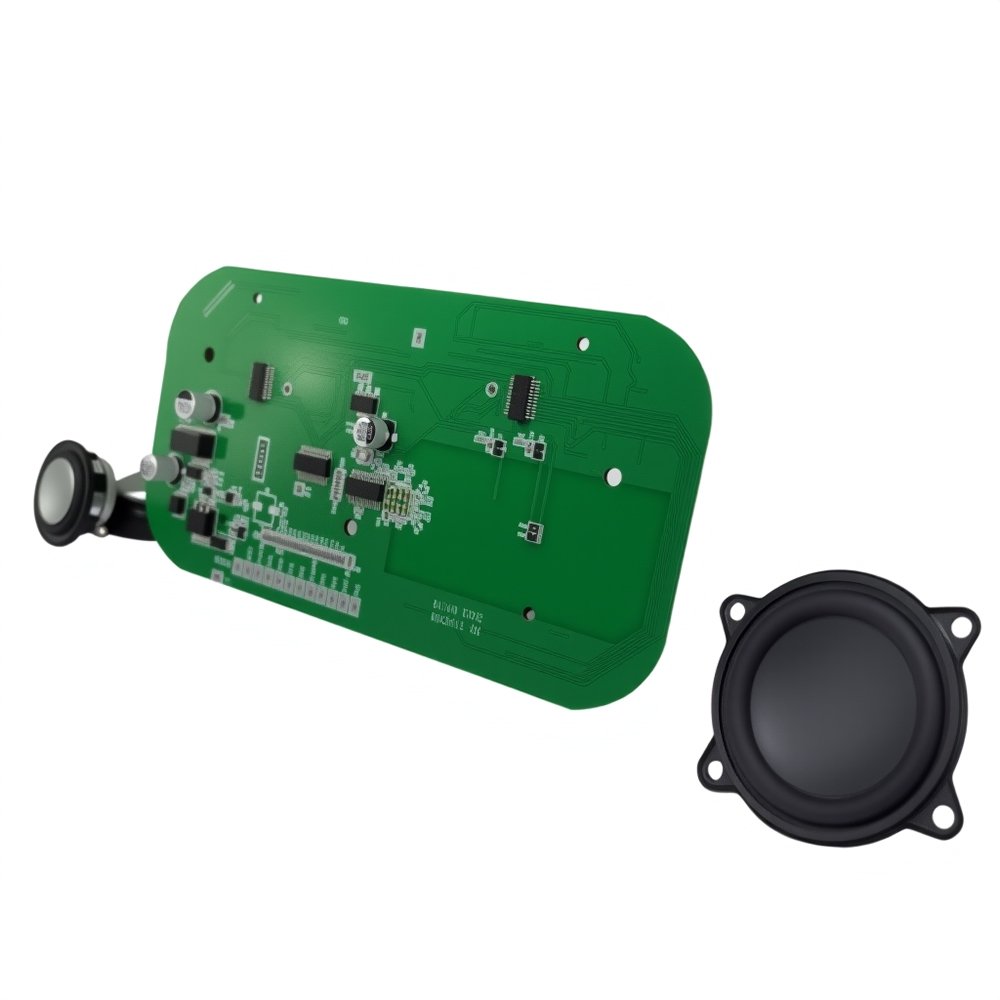
If you are launching a smart home device, partnering with a custom smart home speaker manufacturer that understands acoustic engineering is not optional. It is the difference between a product that plays sounds and one that delivers a genuinely premium audio experience.
At Zehsm , we work with brands that want more than a generic audio module. We build custom speakers for smart home products with a clear focus on acoustics, voice assistant integration, and manufacturability. This starts with an honest conversation: what should the speaker sound like, where will it live, and how much space and budget do we have to work with?
Why Acoustic Design Matters More Than You Think
A smart home speaker is not a traditional hi-fi speaker. It cannot be placed in a listening room with perfect speaker placement. It sits near walls, inside cabinets, or on glass shelves. It has to deliver clear voice playback while the onboard microphone listens for commands. And it has to do all of this in a compact, aesthetically pleasing enclosure.
That is why acoustic design needs to happen early. Too many companies start with an enclosure design, then try to fit a speaker inside. That usually ends with poor bass, harsh treble, or a speaker that sounds “boxy” no matter how good the components are.
A professional custom speaker manufacturer will set measurable targets before the first prototype is built. These targets guide driver selection, port tuning, DSP correction, and enclosure damping.
| Performance Parameter | Recommended Target | Why It Matters |
|---|---|---|
| Frequency response | 60 Hz – 20 kHz | Gives music depth and makes voice assistants sound natural |
| Total harmonic distortion (THD) | <1% at average listening level | Keeps speech clear and reduces listener fatigue |
| Maximum continuous SPL | ≥85 dB at 1 meter | Ensures the speaker can fill a living room without strain |
| Voice recognition SNR | >10 dB | Allows the microphone to separate wake words from music playback |
These targets are not universal specifications. But they are strong starting points for any smart home device that wants to compete on audio quality.
The R&D Process: Turning Sound into a Product
The true value of a manufacturing partner is not in the assembly line. It is in the research and development process that happens long before mass production. A serious R&D team will simulate the speaker’s acoustic behavior before cutting any physical parts. Modern acoustic simulation tools help engineers see pressure distribution inside the enclosure, detect port noise, and locate unwanted resonances early.
At this stage, the goal is to reduce the number of physical prototypes while still gathering real-world data. After simulation, the team builds sample units and measures them in an anechoic chamber. The measured frequency response, distortion, impedance, and off-axis performance are then compared against the intended target curve.
Then comes DSP tuning. For smart speakers, this is where the product either performs or fails in everyday use. Tuning is not about making the speaker sound “good” on one song. It is about managing the way sound reflects off walls, avoiding frequency masking near the microphone, and maintaining a natural voice reproduction for virtual assistants.
The R&D effort is also important because the market is getting more competitive. New brands are entering the space, and buyers are increasingly choosing speakers based on sound quality—not just smart features.
Echo cancellation, noise suppression and privacy
Echo cancellation needs a reference of what the speaker is playing. Take the reference from the amplifier input, not from the microphone, and align it in time to within one sample; a 1 ms misalignment reduces the cancellation by 10-15 dB. The result should be measured as echo return loss enhancement at several volumes, not asserted.
Enclosure Materials and Acoustic Trade-offs
One of the most underrated areas in custom speaker design is enclosure material. For a small smart home device, the enclosure is not just a cover. It is part of the acoustic system. A thin plastic shell can vibrate and add midrange coloration. A stiff metal housing can reduce cabinet resonance but may create harsh high-frequency reflections if it is not damped internally.
Choosing the right material depends on your target price, weight, and visual design. A good manufacturer will test multiple materials and recommend the best compromise.
| Material | Acoustic Strengths | Common Trade-offs |
|---|---|---|
| ABS/PC plastic | Low cost, easy to mold, durable | Can resonate if not reinforced internally |
| Aluminum | High rigidity, premium finish, good heat dissipation | More expensive, needs internal damping |
| Wood composite | Low resonance, warm tonal character | Heavier and difficult to form into compact shapes |
| Glass or acrylic | Transparent aesthetic, clean modern look | Hard surface, problematic internal reflections |
The enclosure material often matters as much as the driver itself. A custom speaker manufacturer with access to different materials can help you decide where to invest your budget—and where to save.
What to Look for in a Custom Speaker Manufacturer
If you are searching for a custom speaker manufacturer for your smart home product, look beyond the production capacity. Ask about in-house acoustic testing, anechoic chamber capabilities, DSP tuning experience, and whether the team has previously worked on smart speakers with voice assistant integration.
A mature R&D partner will also ask questions about your target market, product size, price point, and certification requirements. That is a good sign. It means they are thinking about your product as a system, not just a speaker assembly.
At Zehsm, we offer acoustic design services that cover simulation, prototyping, tuning, and manufacturing. Our R&D team can help you define realistic acoustic targets from the beginning and work through every iteration until the product sounds exactly the way it should. If you are ready to move forward, feel free to contact our engineers with your project idea.
SoC, codec and integration
Audio integration is where cost hides. An I2S codec with a Class D amplifier and a common clock avoids resampling; two independent clocks drift and the echo canceller has to track the drift, which costs CPU and adds artefacts. Specify the clock tree and the sample-rate chain before the schematic review.
FAQ
How many microphones does an AI speaker need?
Two are enough for a near-field product; four to six are typical for a 5 m far-field device that must reject its own output. The geometry and the port design matter more than the count.
What SNR should the microphones have?
65-70 dB for a far-field array, with an acoustic overload point above 120 dB SPL so that the capsule does not clip when the speaker is playing.
Can wake-word detection run on the main processor?
It can, but the standby power is 10-50 times higher. A dedicated low-power DSP that wakes the SoC keeps standby in the milliwatt range, which matters for battery products.
Related reading
- Top Trends in Custom Speaker Covers for Smart Home Devices
- Small Speakers for Smart Home Devices Manufacturers
- Future of Smart Audio Devices
More on Bluetooth Audio.
