
The trade is thermal and financial. NdFeB loses strength above its grade-dependent operating temperature, from 80 degrees C for N grades to 150 degrees C for SH grades, and it corrodes without a nickel or epoxy coating. Ferrite tolerates 250 degrees C and costs a fraction per kilogram, so a woofer with space for a large magnet often uses ferrite by design.
This guide treats ndfeb speakers superior as a specification problem: what to measure, what to write on the drawing, and what to verify before the first carton ships.
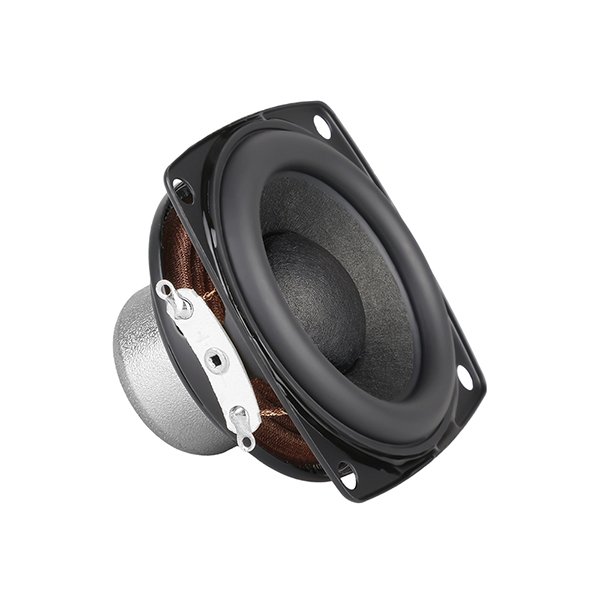
The Core Difference: Material Science and Magnetic Strength
The fundamental superiority of NdFeB magnets begins at the atomic level. Composed of neodymium, iron, and boron, these rare-earth magnets generate a magnetic field strength (expressed as maximum energy product or BHmax ) that is vastly greater than that of traditional strontium or barium ferrite (ceramic) magnets.
| Property | NdFeB (N52 Grade) | Ferrite (Strontium, Grade 8) | Unit |
|---|---|---|---|
| Remanence (Br) | 14,800 | 4,300 | Gauss |
| Coercivity (Hc) | 12,300 | 3,200 | Oersteds |
| Max Energy Product (BHmax) | 52 | 3.5 | MGOe (Mega-Gauss Oersteds) |
| Relative Cost | High | Low | – |
For a given magnetic flux requirement in a speaker’s voice coil gap, an NdFeB magnet can be substantially smaller and lighter . This allows for radical redesigns of speaker topology. Engineers can create more compact motor structures with reduced magnetic circuit losses, or they can use similarly sized magnets to achieve much higher flux density, leading to greater driving force (BL product).
Acoustic Performance Advantages: Precision, Speed, and Control
The high magnetic strength of NdFeB translates directly into tangible acoustic benefits that are critical for high-fidelity sound reproduction.
1. Superior Transient Response & Detail Retrieval: The increased BL product (Force Factor) means the speaker motor exerts greater control over the diaphragm. The cone can start and stop with exceptional precision, dramatically improving transient response. In musical terms, this means the sharp attack of a plucked guitar string, the precise strike of a drum, and the intricate details of complex orchestral passages are rendered with lifelike clarity and speed. Ferrite systems, with their lower magnetic strength, often exhibit a slightly “slower” or more sluggish character in comparison.
2. Reduced Distortion and Improved Linearity: A stronger, more stable magnetic field in the voice coil gap minimizes modulation distortion. As the voice coil moves in and out of the gap, variations in the magnetic field strength can cause non-linear distortion. The potent and focused field of an NdFeB magnet maintains better consistency over the coil’s travel, especially in short-throw designs like tweeters and midrange drivers. This results in lower Total Harmonic Distortion (THD) and Intermodulation Distortion (IMD), preserving the purity of the original signal.
3. Enhanced Efficiency and Dynamic Range: The efficiency (sensitivity) of a speaker is directly linked to the strength of its magnetic circuit. NdFeB drivers typically exhibit higher sensitivity, meaning they convert more electrical power into acoustic output. This provides a wider dynamic range—the difference between the softest and loudest sounds—with less strain and power requirement from the amplifier. The result is effortless, dynamic playback that captures the full emotional impact of a recording.
Cost, supply and the ferrite alternative
Ferrite is not obsolete. A 12 inch woofer with a 1.2 kg ferrite magnet costs less than the equivalent neodymium motor and tolerates a hot voice coil; the penalty is weight, which matters in portable systems and barely matters in a fixed installation. The choice is a system decision: weight, efficiency, cost and thermal environment together.
Thermal Stability and Long-Term Reliability
A common historical critique of early NdFeB magnets was their susceptibility to demagnetization at high temperatures. However, modern grades (denoted by suffixes like M, H, SH, UH) have been specifically engineered for enhanced thermal stability. High-coercivity (Hc) NdFeB grades can now withstand operational temperatures well beyond the points experienced in even the most demanding speaker applications.
In contrast, while ferrite magnets are inherently thermally stable, their lower magnetic strength is a fixed limitation. The advanced thermal management in contemporary NdFeB magnets, often coupled with intelligent motor design (e.g., copper caps on pole pieces to reduce power compression), ensures that today’s high-end NdFeB drivers maintain their performance specifications reliably over time and under load.
System-Level Benefits and Design Flexibility
The compact size and light weight of NdFeB magnets offer profound advantages at the loudspeaker system level.
1. Reducing the moving mass of the driver assembly is a primary goal for improving high-frequency extension and agility. This is why NdFeB is virtually ubiquitous in high-performance tweeters and midrange drivers.
2. They can implement more sophisticated crossovers, bracing, or damping within the same enclosure volume. For multi-driver arrays, the reduced weight of each driver improves cabinet rigidity and reduces resonant coloration. It also allows for the creation of high-performance, compact bookshelf or even in-wall speakers that would be impossible with bulkier ferrite magnets.
3. Environmental and Manufacturing Considerations: It’s important to note that the mining and processing of rare-earth elements (neodymium) have environmental impacts. The industry has made strides in recycling and more sustainable practices. From a manufacturing perspective, the strength of NdFeB allows for precision engineering with tighter tolerances, contributing to higher consistency and quality control in production.
Market Adoption and Real-World Applications
The proof of NdFeB’s superiority is evident in the marketplace. Leading brands like Bowers & Wilkins (in their Diamond series), KEF (Meta technology), Dynaudio, and Focal (beryllium tweeters with NdFeB motors) have built their flagship models around advanced NdFeB motor systems. The driver is no longer just a component; it’s a key part of the brand’s performance identity.
For the critical listener, the difference is often audible in A/B comparisons: a sense of effortless clarity, a “blacker” background with notes emerging more distinctly, and a three-dimensional soundstage with precise imaging. While ferrite magnets remain a perfectly valid and cost-effective solution for many good-quality speakers, the summit of acoustic performance is now firmly occupied by designs using the power of Neodymium.
Flux, gap geometry and sensitivity
Sensitivity follows the flux in the gap and the length of wire in it. Doubling the gap flux raises the force factor by 2 and the sensitivity by 6 dB, which is why a neodymium motor can reach 100 dB at 1 W where a ferrite motor of the same size reaches 94 dB. The gap must be narrow, typically 0.8-1.2 mm, and the voice coil must stay centred through the excursion.
FAQ
Why are neodymium speakers lighter?
The magnet needs about one-eighth the volume for the same gap flux, so the motor structure and the chassis shrink with it. A 1 inch neodymium compression driver typically weighs 0.3 kg against 2 kg for a ferrite equivalent.
Does neodymium sound better than ferrite?
Not by itself. The motor's flux and linearity set the sound; a well-designed ferrite motor can match a neodymium one. Neodymium buys weight and, at the same size, sensitivity.
What temperature can a neodymium magnet take?
80 degrees C for N grades, 100 for M, 120 for H, 150 for SH and 180 for UH. Specify the grade and the maximum operating temperature; an unspecified 'neodymium' magnet may be an N grade that loses flux in a sealed housing.
Related reading
- Box Speakers for Commercial Audio Systems
- Why 4 Ohm Speakers Are Dominant in Car Audio Systems
- How to Wire Multiple 8 Ohm Speakers for Commercial Audio
More on Speaker Design.
