
The audible difference between two speakers usually sits in three places: the 2-5 kHz region where the ear is most sensitive, the crossover overlap where two drivers share the band, and the directivity index, which decides how much reflected energy reaches the listener. Each can be measured before a sample is approved.
The notes below apply to high-fidelity loudspeaker components, with the measurement conditions and production checks that decide whether a claimed figure survives a shipment.
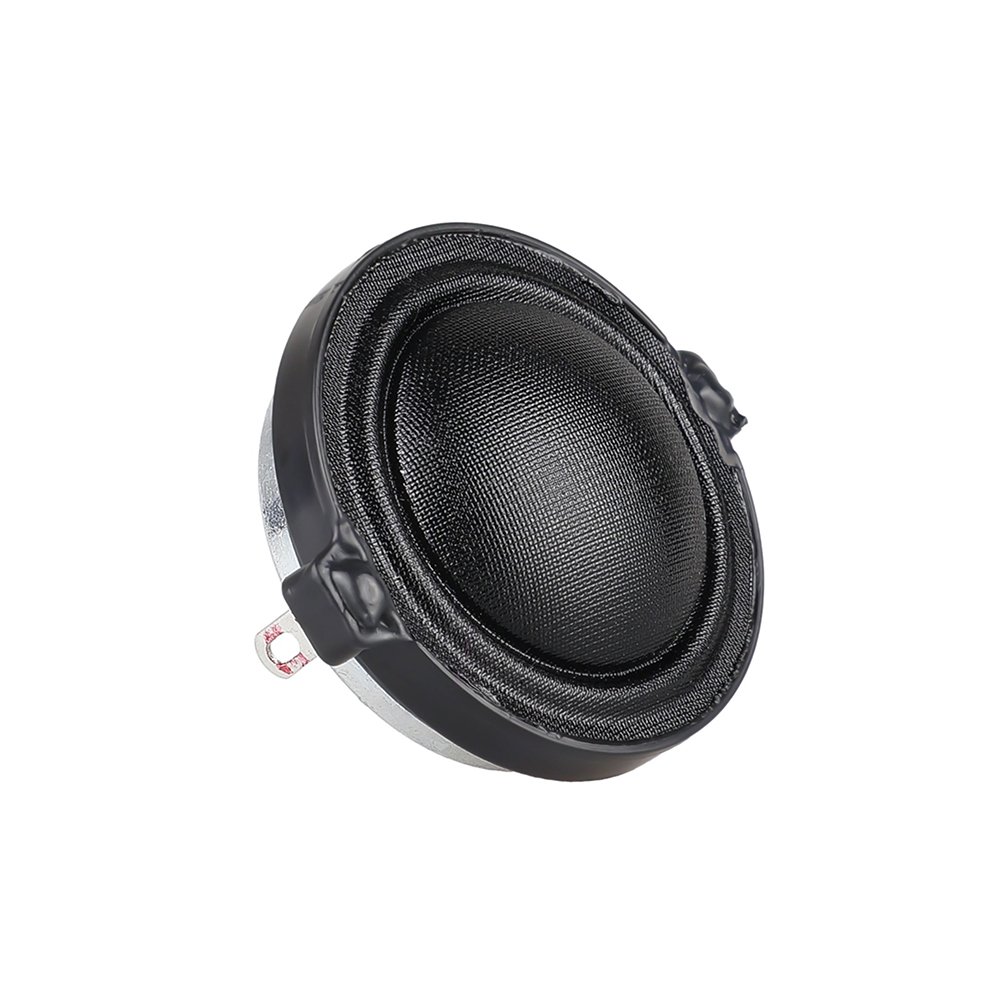
The Heart of the Sound: Driver Units and Their Technology
The drivers are the transducers that actually move air to create sound waves. A typical speaker system uses multiple drivers, each specialized for a specific frequency range.
Tweeters handle the high frequencies (typically from around 2,000 Hz to 20,000 Hz and beyond). Their design prioritizes speed and precision. Common types include:
Midrange Drivers are responsible for the critical vocal and fundamental instrument range (approx. 300 Hz – 5,000 Hz). They often use cones made from treated paper pulp, polypropylene, or woven composites, seeking an ideal balance of stiffness, low mass, and internal damping to avoid “coloring” the sound.
Woofers reproduce the low frequencies (from about 40 Hz to 1,000 Hz). Their challenge is to move large volumes of air efficiently. Key factors include:
- Cone Material: Stiff yet lightweight materials like aluminum, carbon fiber, or advanced composites prevent flexing and distortion at high excursions.
- Motor System: A powerful magnet structure (often using neodymium for higher strength-to-size ratios) and a large, linear voice coil ensure control and authority over the cone’s movement.
- Suspension: The surround (outer edge) and spider (center) must allow for long, linear travel while precisely centering the voice coil.
Recent Trend (2023-2024): There is a significant shift towards the use of Boron, Graphene, and Nano-Cellulose composites in diaphragms. These materials offer unprecedented stiffness-to-weight ratios, pushing breakup modes (where the cone distorts) far beyond the audible range, resulting in cleaner, more detailed sound.
| Material | Typical Use | Key Characteristics | Sonic Tendency |
|---|---|---|---|
| Treated Paper Pulp | Midrange, Woofers | Natural damping, cost-effective, moderate weight | Warm, natural, smooth |
| Polypropylene | Midrange, Woofers | Good damping, moisture resistant, consistent | Neutral, forgiving, sometimes limited detail |
| Aluminum/Magnesium | Tweeters, Woofers | Very stiff, lightweight, can exhibit resonances | Detailed, precise, potential for brightness |
| Beryllium | Tweeters, High-End Woofers | Extremely stiff & light, expensive, toxic to machine | Exceptional detail, speed, and extension |
| Kevlar/Carbon Fiber | Woofers, Midrange | High stiffness, strong, distinctive visual pattern | Fast, articulate, controlled |
| Graphene Composite | All Drivers (Emerging) | Exceptional stiffness & damping, very lightweight | Highly detailed, low distortion, transparent |
The Neural Network: Crossover Networks and Internal Wiring
The crossover network is the brain that directs the appropriate frequency ranges to each driver. In a passive speaker (the most common hi-fi type), this is a network of capacitors, inductors, and resistors placed inside the cabinet.
- Capacitors block low frequencies and pass high frequencies. High-quality film capacitors (e.g., polypropylene) are preferred for their low signal loss and non-linear characteristics over cheaper electrolytic types.
- Inductors (coils) do the opposite, passing lows and blocking highs. Their core material (air, iron, or ferrite) affects efficiency and potential saturation-induced distortion.
- Resistors attenuate the signal to balance driver output levels.
A well-designed crossover ensures tight acoustic blending between drivers (so you hear one coherent speaker, not separate sources), protects drivers from frequencies that could damage them, and corrects for phase irregularities. First-order (6dB/octave), second-order (12dB/octave), and fourth-order (24dB/octave) slopes offer different trade-offs between crossover simplicity, driver protection, and phase coherence.
High-purity, oxygen-free copper (OFC) wiring with appropriate gauge minimizes resistance and signal loss. Quality binding posts or terminal plates ensure a secure, low-resistance connection to your amplifier.
Horns, waveguides and directivity
A horn trades efficiency for directivity. A compression driver with a 1 inch throat on a 60 by 40 degree horn can produce 110 dB at 1 m with a few watts, but its throat distortion rises with level and its coverage narrows with frequency. For a long-throw installation the 60 by 40 pattern is chosen so that the rear seats still receive direct sound at 20 m.
The Foundation: Enclosure Design and Damping
The cabinet is far more than a housing; it is an acoustic component. Its primary job is to prevent the sound waves from the rear of the driver from canceling out the waves from the front (which is especially critical for bass frequencies).
- Sealed (Acoustic Suspension): Airtight box. Provides tight, accurate, and well-controlled bass with good transient response. Less efficient, requires more amplifier power.
- Ported (Bass Reflex): Uses a tuned port (tube) to reinforce low-frequency output. Increases efficiency and extends bass reach but can make bass less precise than a well-designed sealed box.
- Passive Radiator: Similar to ported but uses a passive, unpowered driver instead of a port. Offers port benefits without potential air turbulence noise.
- Transmission Line: A long, damped pathway within the cabinet for rear driver energy. Aims to produce very deep, clean bass but is complex and large.
Construction and Materials: To avoid coloration, the cabinet must be as inert as possible. High-Density Fiberboard (HDF) or Medium-Density Fiberboard (MDF) are standards due to their density and lack of resonant grain. High-end designs use laminated panels, constrained-layer damping (viscoelastic materials between rigid layers), or advanced composites like Aluminum-Sandwich panels . Internal bracing (lattice, matrix, or pillar braces) is critical to break up panel resonances.
Damping Materials: Acoustic absorbent materials like fiberglass, wool, or synthetic foams are placed inside to damp standing waves within the cabinet and absorb the rear radiation from drivers, preventing internal reflections that muddy the sound.
The Interface: Terminals, Spikes, and Finishes
Bi-wiring or bi-amping terminals, with separate posts for highs and lows, allow for more advanced system configurations by separating the crossover networks.
Spikes and Feet: These decouple the speaker from the floor, preventing energy loss and blurring of bass. They also allow for precise leveling to ensure proper driver alignment relative to the listener.
Finish: Beyond aesthetics, the finish (real wood veneer, high-quality piano lacquer, automotive-grade paint) can involve many layers of sealing, sanding, and polishing. A premium finish protects the cabinet and is a sign of overall build quality and pride in craftsmanship.
Industry Insight: The integration of DSP (Digital Signal Processing) and amplification is a major trend in “active” high-fidelity speakers. Companies like KEF, Genelec, and Dutch & Dutch are leading with designs where the crossover is handled digitally, and each driver is powered by a dedicated, perfectly matched amplifier. This allows for unprecedented control over parameters like phase, timing, and EQ, often including room correction to adapt the speaker to its environment.
Reading a response curve properly
Off-axis measurements decide whether the speaker works in a room. A 25 mm dome typically widens its directivity above 8 kHz, while a 25 mm compression driver on a 90 by 60 degree horn holds it down to 2 kHz. The mismatch at the crossover, not the on-axis response, is what makes a speaker sound different when the listener moves.
FAQ
What smoothing should a published response curve use?
State it explicitly: 1/24 octave is close to what the ear resolves in a room, while 1/3 octave hides narrow peaks. A curve without distance, level and smoothing is not comparable with any other curve.
Why cross a tweeter no lower than one octave above resonance?
Below that point the diaphragm travel and distortion rise quickly, and a 2 kHz crossover on a 900 Hz tweeter leaves margin for high-level transients without exceeding Xmax.
Does a flat on-axis curve guarantee good sound?
No. Directivity, the crossover's phase behaviour and low-frequency room interaction matter as much; a flat curve measured at 1 m can still sound uneven at the listening position.
Related reading
- What Are the Benefits of High Impedance in 8 Ohm Speakers?
- High Sensitivity vs. High Loudspeaker Power: Which Matters More?
- What Software is Used for Professional Speaker Design and Simulation?
More on Speaker Design.
