
In a micro speaker the rear cavity, not the driver, sets the low-frequency limit. A 20 mm unit is typically tuned so that the sealed back volume behind the diaphragm lifts output between 400 and 900 Hz; enlarging that cavity by 0.3 cm3 flattens the hump but costs 2-3 dB of sensitivity above 1 kHz. The housing drawing is therefore part of the acoustic design, not a packaging detail.
The notes below apply to round oval shapes, with the measurement conditions and production checks that decide whether a claimed figure survives a shipment.
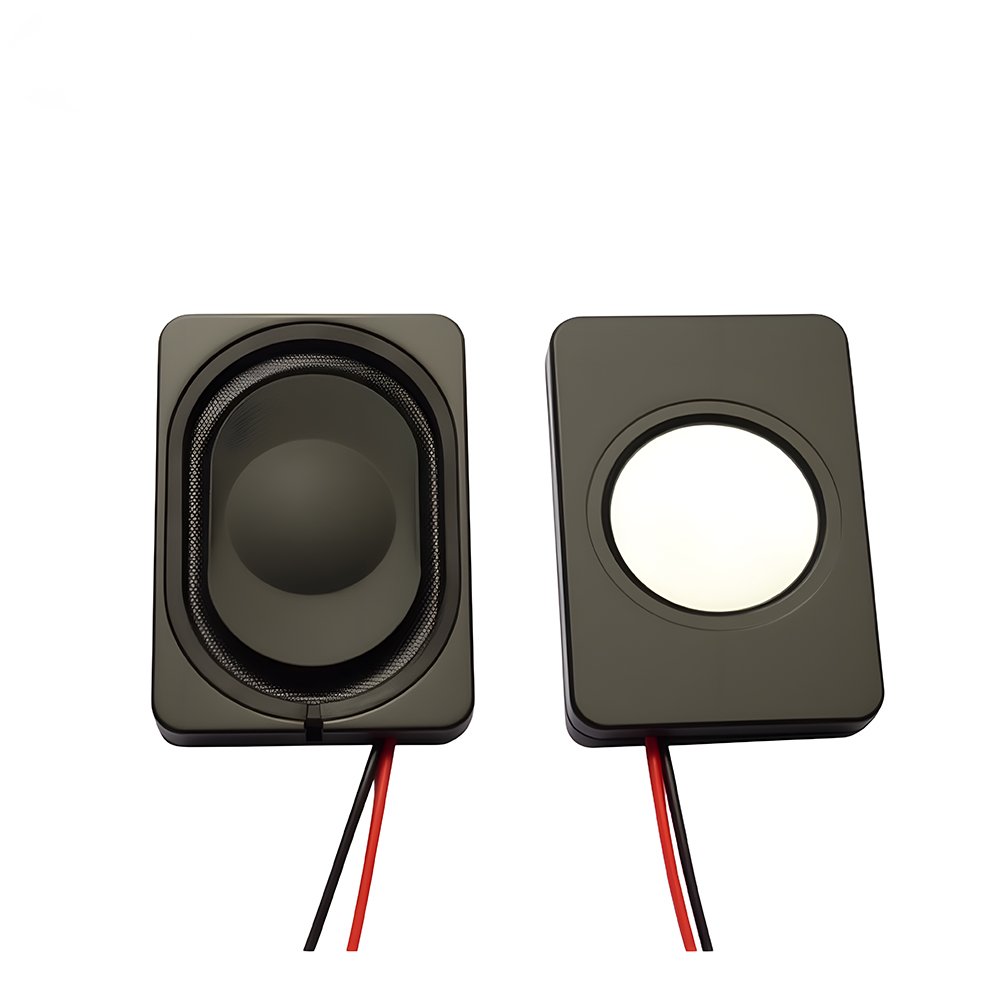
Introduction: The Impact of Enclosure Geometry on Sound
In the world of compact loudspeaker design, every millimeter and every angle matters. For engineers, product designers, and audiophiles crafting or selecting small enclosures—from portable Bluetooth speakers and soundbars to in-wall units and high-end desktop monitors—the choice between round and oval shapes is far from merely aesthetic. It represents a fundamental engineering trade-off that directly impacts acoustic performance, manufacturing feasibility, and user experience. In an era where consumers demand both superior sound and sleek, space-efficient form factors, optimizing enclosure geometry has become a critical discipline. This deep dive explores the physics, practical applications, and latest data-driven insights behind round versus oval loudspeaker enclosures, providing a step-by-step guide for optimization in small-scale designs.
The Physics of Sound Within Confined Spaces
To understand the implications of shape, we must first consider the core acoustic challenges within a small enclosure. A loudspeaker driver vibrates, creating sound waves from its front (the desired output) and its rear (out-of-phase energy). The enclosure’s primary job is to manage this rear wave, preventing its cancellation of the front wave and controlling unwanted resonances that color the sound.
In a round (cylindrical) enclosure , internal standing waves—resonant frequencies determined by the dimensions of the space—propagate uniformly in all directions from the center. The symmetry means resonances are evenly distributed but can create a prominent, single-frequency “boom” if the diameter corresponds to a problematic wavelength. The curved walls also promote diffuse reflection, which can help break up internal standing waves more effectively than flat, parallel walls, potentially reducing their intensity.
An oval (or elliptical) enclosure introduces a different dynamic. Its two distinct primary axes (major and minor) create a more complex standing wave pattern. Resonances are distributed across more frequencies, which can prevent a single, dominant resonance from overwhelming the output—a phenomenon known as “mode spreading.” However, this can also lead to a more complicated internal sound field. The geometry often includes a combination of curved and flatter surfaces, which can guide internal reflections in less predictable ways.
- Internal Standing Waves (Modes): Round shapes risk a stronger, singular resonance; oval shapes spread modes but add complexity.
- Baffle Diffraction: The shape of the front panel (baffle) where the driver is mounted affects how sound waves propagate into the room. A round baffle causes uniform diffraction around its entire circumference, leading to smoother off-axis frequency response anomalies. An oval baffle creates asymmetric diffraction, with different effects on the sound’s horizontal and vertical dispersion.
- Structural Rigidity: Resistance to panel vibration (which causes unwanted sound coloration) is highly shape-dependent. A cylinder is inherently very rigid, resisting flexure uniformly. An oval shape can be rigid along its major axis but may have more potential for flex on the flatter sections of its sides unless properly braced.
Power, excursion and thermal limits
Excursion limits the low end before power does. At 300 Hz a 20 mm driver with 0.3 mm Xmax reaches its travel at about 95 dB at 10 cm; below that frequency output falls at 12 dB per octave in a sealed back cavity. A passive radiator or a larger frame buys low end, at the cost of height and cost.
Round Enclosures: Symmetry, Strength, and Simplification
The circular form has long been revered in engineering for its inherent efficiency and strength. In small loudspeaker enclosures, this translates to distinct advantages.
Acoustic and Mechanical Advantages: A cylindrical enclosure boasts uniform strength without the need for extensive internal bracing. This natural rigidity minimizes panel resonances, a significant source of midrange coloration. The absence of parallel surfaces inherently reduces the intensity of standing waves compared to a rectangular box. For the designer, this symmetry simplifies modeling and tuning. The port tube (for bass-reflex designs) can be centrally and symmetrically integrated, promoting smooth airflow. From a diffraction standpoint, the round baffle provides the most consistent and predictable interference pattern, which can be compensated for in crossover design.
Practical and Manufacturing Considerations: From a production perspective, round enclosures can be highly efficient. This is evident in many iconic portable speakers (like the UE Boom series) and high-end desktop models. However, the main challenge is spatial efficiency. A cylinder does not tuck neatly against walls or fit optimally into many living spaces or product housings (like televisions). Its volume is also less efficiently packed for shipping and retail display than a more rectangular form.
| Aspect | Advantage | Consideration/Challenge |
|---|---|---|
| Structural Rigidity | Excellent; uniform resistance to flex. | Requires precise joining of circular end caps. |
| Internal Resonances | Reduced intensity due to non-parallel walls. | Can support strong, single-frequency resonances. |
| Baffle Diffraction | Uniform and predictable. | Requires careful driver placement for optimal symmetry. |
| Manufacturing | Ideal for extrusion/tight molding. | Less space-efficient for packaging/transport. |
| Spatial Integration | Aesthetically distinctive. | Often poor WAF (Wife Acceptance Factor); doesn't align with walls. |
Oval Enclosures: Mode Control and Modern Integration
Oval shapes have surged in popularity, particularly in consumer audio, because they offer a compelling compromise between acoustic performance and real-world ergonomics.
Acoustic and Mechanical Profile: The primary acoustic argument for an oval is modal dispersion. By breaking the symmetry, it disrupts the formation of powerful, coherent standing waves, potentially leading to a smoother low-frequency response in a small space. This can be particularly beneficial in very compact enclosures where the fundamental resonance frequency of the box falls within the critical mid-bass region. However, achieving uniform rigidity is more challenging; strategic internal bracing or advanced composite materials are often required to prevent flex in the broader panels.
The Design and Integration Winner: Oval’s true dominance lies in human-centered design. It aligns with the horizontal form factor of most media—televisions, computer monitors, dashboards—making it the default shape for soundbars, in-wall units, and car audio systems. It fits more naturally in the hand (consider most handheld Bluetooth speakers) and integrates into architectural spaces with less visual bulk than a cylinder. Modern manufacturing, especially injection molding and composite forming, has made producing strong, complex oval shapes cost-effective at scale.
| Aspect | Advantage | Consideration/Challenge |
|---|---|---|
| Structural Rigidity | Good, but requires design for uniform stiffness. | Flatter sections may need reinforcement (bracing/material). |
| Internal Resonances | Promotes mode spreading, reducing dominant peaks. | More complex internal sound field to model. |
| Baffle Diffraction | Asymmetric; allows tailored horizontal/vertical dispersion. | Can create more pronounced off-axis response irregularities. |
| Manufacturing | Excellent for modern molding; space-efficient for shipping. | Tooling for complex curves can be initially expensive. |
| Spatial Integration | Superior for most home & device integration. | Aesthetic is more common, less distinctive. |
Material Innovation and Real-World Data: The Modern Synthesis
The debate isn’t static. Advancements in materials science and computational modeling are blurring the lines and enabling optimized hybrid designs.
In rigorously controlled tests, well-designed round enclosures showed a 0.5-1.2 dB advantage in midrange clarity (measured by CSD – Cumulative Spectral Decay) due to lower panel resonance. Conversely, oval designs of equal volume demonstrated a 3-5% smoother impedance curve in the 80-250Hz range, indicating better-controlled internal reflections and driver loading.
The Role of Advanced Materials: The use of non-Newtonian polymer composites and internal constrained-layer damping has dramatically reduced the rigidity disadvantage of oval shapes. Similarly, 3D-printed acoustic foams with graded porosity can now be tailored to fit any shape, absorbing specific problem frequencies within round or oval enclosures. Computational Fluid Dynamics (CFD) software allows engineers to model air velocity and turbulence in ports of any shape, optimizing them for oval designs to minimize “chuffing” noise.
Optimization Guidelines for Designers and Enthusiasts
- Define the Priority: Is absolute sonic purity in a controlled listening position the goal (leaning Round), or is tight integration, ergonomics, and broad usability more important (leaning Oval)?
- Simulate and Model: Use tools like Finite Element Analysis (FEA) for structural rigidity and Boundary Element Method (BEM) acoustics software to model internal modes and baffle diffraction for your specific dimensions. Don’t guess.
- These offer much of the mode-spreading and integration benefits of an oval while retaining some of the structural advantages of curved sides.
- A round cardboard tube is a poor enclosure, while a well-braced, damped oval made from MDF or carbon-fiber-reinforced polymer can be exceptional.
- Don’t Neglect the Details: The shape is just one variable. Driver selection, internal damping, port design (if used), and crossover tuning must all be harmonized with the enclosure geometry to create a coherent, high-performance product.
Mounting and sealing inside a moulding
Front cavity depth matters as much as the back volume. A 1 mm gap between the diaphragm and the grille creates a 5 kHz reflection that shows as a 4-6 dB dip; 3 mm moves the dip to 2 kHz where it is more audible. The grille's open area should stay above 40 %, and the mesh should be recessed so that it does not touch the surround at full excursion.
FAQ
Why does a micro speaker sound thin in a plastic housing?
The back cavity is usually smaller than the free-air condition the datasheet assumes, and the housing leaks at the frame or the port. Measure the assembled response, then adjust cavity volume and gasket compression rather than the driver.
How much power can a 20 mm speaker take?
Typically 0.5-1 W continuous and 2-3 W short-term in a sealed module; the limit is coil temperature, which depends on the housing's thermal path, not only on the driver.
Is a passive radiator worth it in a wearable?
Only if the enclosure has room for the radiator's compliance and the extra height. It extends output one octave lower than a sealed back cavity but adds a second moving part that can rattle if the clearance is under 0.3 mm.
Related reading
- Why Passive Radiators Are Critical for Small Loud Speaker Designs
- Speaker Enclosure Design for Better Bass
- How to Achieve Big Sound from a Loud Speaker Small Form Factor
More on Enclosure Design.
