
The arithmetic behind the label is simple. At 2.83 V RMS an 8 ohm load draws 0.35 A and dissipates 1 W, while a 4 ohm load draws 0.71 A and dissipates 2 W. That doubling of current, not the number printed on the terminal, is why a 4 ohm design needs a different supply, a different protection threshold and often a different output device.
This guide treats recommended 8 ohm speakers as a specification problem: what to measure, what to write on the drawing, and what to verify before the first carton ships.
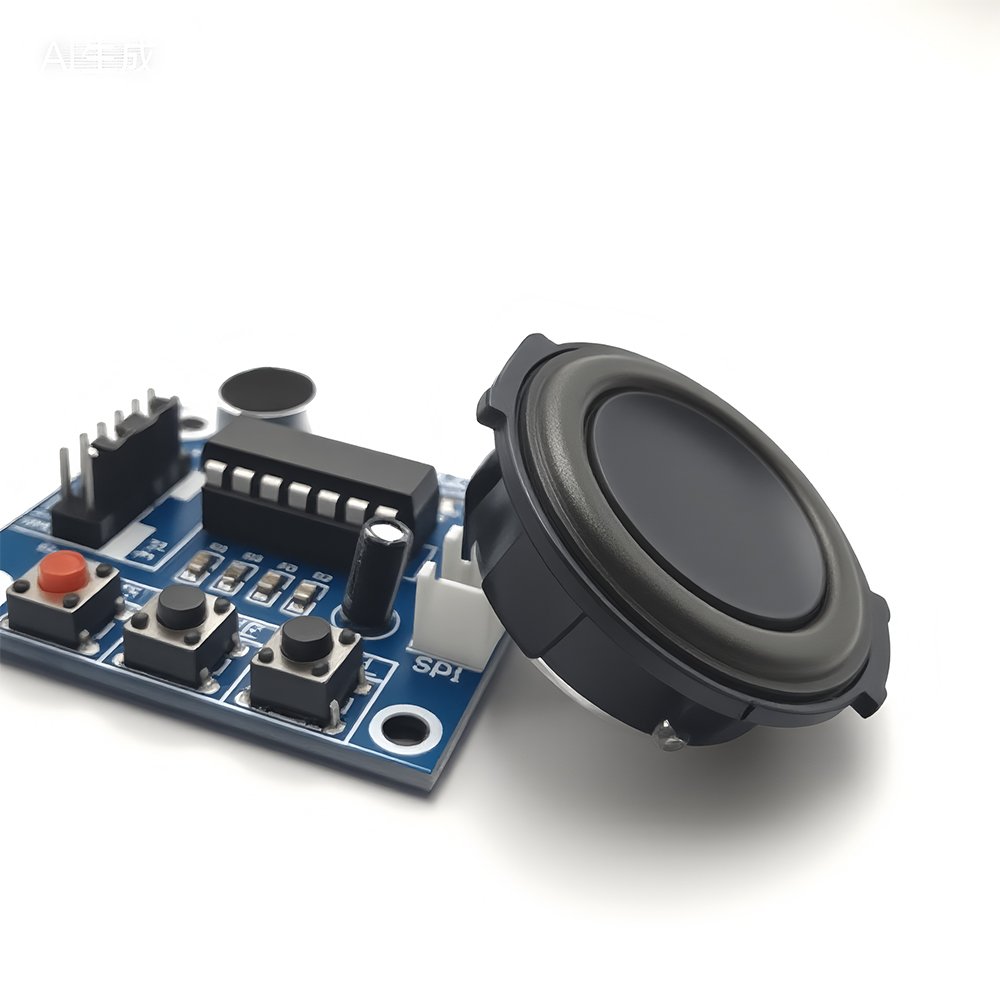
The Engineering Merits of 8-Ohm Drive Units in High-Fidelity Design
The choice of 8 ohms as a nominal impedance is not arbitrary. It represents a sweet spot in loudspeaker design that aligns with the electrical characteristics of most solid-state and tube amplifiers. A speaker’s impedance is a complex, frequency-dependent resistance to alternating current. An 8-ohm nominal rating indicates that, while the impedance will vary across the frequency spectrum, its average value sits around 8 ohms. This load is high enough to prevent excessive current draw, reducing stress on amplifier output stages and minimizing thermal buildup. For manufacturers, this means broader system compatibility and a more forgiving design margin when pairing with consumer electronics.
Modern 8-ohm units use advanced materials to achieve this stable impedance while maximizing performance. From rigid, lightweight diaphragms made of coated paper, polypropylene, and composite ceramics to sophisticated motor systems with copper shorting rings for reducing inductance distortion, the technology focuses on preserving the integrity of the audio signal. The result is a driver that translates electrical energy into acoustic output with remarkable linearity, dynamic range, and low coloration—necessary traits for any Hi-Fi product claiming high fidelity.
Critical Performance Metrics for Selecting Hi-Fi Speakers
Beyond impedance, several key specifications and qualitative factors determine a driver’s suitability for high-end manufacturing. Sensitivity , measured in decibels (dB) at 1 watt/1 meter, indicates how efficiently a speaker converts power to sound. For 8-ohm units, a sensitivity rating between 85-92 dB is typical for woofers and midranges, allowing for good performance with a wide range of amplifier powers. Frequency Response defines the bandwidth the driver can reproduce, but the flatness of its response curve is more telling of its Hi-Fi credentials.
The Total Harmonic Distortion (THD) figures, especially at relevant output levels, reveal the driver’s linearity. Premium manufacturers now often provide distortion spectra showing second and third-order harmonics. Power Handling (RMS) must align with the target system’s output, but thermal and mechanical limits should be designed with real-world program material in mind. Finally, the Thiele/Small parameters (like Qts, Vas, and Fs) are non-negotiable for enclosure design, dictating whether a driver is suited for sealed, ported, or transmission-line cabinets. The best 8-ohm drivers come with step-by-step, verified data sheets enabling precise, predictable integration.
Sizing the amplifier and the supply
Power into a 4 ohm load is roughly double that into 8 ohm for the same rail voltage, but only if the supply can deliver the current. A 12 V rail driving a bridge-tied load gives about 18 W into 4 ohm and 9 W into 8 ohm before losses; the 4 ohm case pulls twice the current and doubles the resistive loss in the inductor and the connector. Size the inductor for the current, not for the average power.
Top Recommended 8-Ohm Woofer and Midrange Drivers
The following 8-ohm drivers are exemplary in their categories, favored by DIY audiophiles and OEM manufacturers alike for their proven performance.
1. Scan-Speak Discovery 18W/4531G00 (6.5″ Mid-Woofer) A benchmark in its price class, this Danish-engineered driver features a glass-fiber reinforced cone for optimal stiffness and damping. Its 8-ohm voice coil, integrated with a large ferrite magnet and low-distortion spider, delivers a smooth frequency response up to 5 kHz, making it an excellent candidate for 2-way designs or as a dedicated mid-woofer. Its linear travel and well-behaved roll-off facilitate easier crossover design.
2. SEAS Prestige ER18RNX (H1600-08) (7″ Wool Cone Mid-Woofer) Norwegian manufacturer SEAS delivers a classic with this unit. Its treated paper (wool) cone provides natural, low-resonance acoustic properties. Its low distortion and excellent off-axis response make it a favorite for high-fidelity bookshelf and floor-standing models.
3. SB Acoustics Satori MW16P-8 (6″ Paper Cone Woofer) Representing the high-end of consumer-grade manufacturing, the Satori line features a patented paper cone with unique ribbing for controlled breakup. The 8-ohm version boasts an underhung motor system with a copper pole cap, achieving ultra-low distortion and superb transient response.
| Model | Size | Cone Material | Sensitivity (dB) | Frequency Range | Power (RMS) | Best For |
|---|---|---|---|---|---|---|
| Scan-Speak 18W/4531G00 | 6.5" | Glass-Fiber | 87 | 38-5,000 Hz | 60W | 2-Way Monitors, Mid-Woofer |
| SEAS ER18RNX | 7" | Treated Paper (Wool) | 88 | 38-4,000 Hz | 80W | Natural Midrange, 3-Way Systems |
| SB Acoustics MW16P-8 | 6" | Papyrus Paper | 87.5 | 35-6,000 Hz | 75W | High-End Monitors, Low-Distortion Designs |
Leading 8-Ohm Tweeters for Detailed High-Frequency Reproduction
The tweeter is responsible for the sparkle, air, and spatial details that define a Hi-Fi experience. Modern 8-ohm tweeters utilize advanced diaphragm materials and waveguide technologies to achieve extended, smooth response with wide dispersion.
1. Scan-Speak Discovery D2608/913000 (1″ Textile Dome Tweeter) This value-packed tweeter from Scan-Speak features a soft textile dome suspended in a damped rear chamber. The 8-ohm impedance and ferrofluid cooling allow for a low resonance frequency and high power handling.
2. The waveguide controls directivity, improving baffle integration and providing a wider “sweet spot.” The 8-ohm version is exceptionally easy to work with in crossover design, offering superb off-axis response for a more immersive soundstage.
3. Morel CAT 378 (1.1″ Soft Dome Tweeter) A favorite in high-end automotive and home audio, Morel’s coated soft dome technology offers exceptional smoothness and detail retrieval. This 8-ohm tweeter features a massive magnet system and rear chamber for very low distortion and extended response down to 1 kHz, allowing for a lower, simpler crossover point.
Advanced Full-Range and Coaxial 8-Ohm Solutions
For minimalist designs or specific form factors, full-range and coaxial drivers provide an integrated solution. Modern examples defy traditional limitations, offering surprising fidelity.
1. Markaudio Alpair 10P (4″ Full-Range Paper Cone) This Japanese-designed driver is a marvel of engineering. Its 8-ohm, paper-cone full-range unit offers a remarkably coherent and detailed sound from a single point source. With a bandwidth of 45-25,000 Hz, it is ideal for high-efficiency, single-driver loudspeakers or as a premium mid-tweeter in a FAST (Full-range And Subwoofer Technology) system.
2. Tymphany Peerless TC9FD18-08 (3.5″ Full-Range Paper Cone) An outstanding budget-to-performance champion, this small 8-ohm full-range driver delivers exceptional linearity and clarity in the midrange and highs. It is widely used in desktop monitors, satellite speakers, and as a dedicated midrange unit.
3. SEAS Prestige H1499 (F8) Coaxial Unit This 8-inch coaxial driver from SEAS integrates an 8-ohm woofer with a centrally mounted 1″ textile dome tweeter. It provides the time-alignment and point-source benefits of a coaxial design with the performance quality of separate SEAS Prestige components, simplifying the path to a high-performance, coherent-sounding system.
Integration, Crossover Design, and System Optimization
Selecting elite drivers is only the first step. Their successful integration defines the final product’s character. Crossover design is the most critical phase. For 8-ohm drivers, component values will differ from their 4-ohm counterparts—inductors can be of higher value and lower DCR, and capacitors can be of lower value for the same crossover point, potentially reducing cost or allowing for higher-quality parts within a budget.
Cabinet design must be driven by the Thiele/Small parameters. An 8-ohm woofer with a low Qts might be ideal for a vented alignment, while a higher Qts may suit a sealed enclosure. Baffle design, damping, and internal reflections must be meticulously managed to let the drivers perform as intended. Finally, measurement and listening tests are irreplaceable. Tools like Klippel analyzers and high-resolution impedance sweeps, combined with extensive critical listening, ensure the manufactured product meets the high-fidelity standard promised by its components.
Wiring, damping and protection
Protection has to act before the output stage latches. DC offset detection, over-current limiting and a thermal fold-back that reduces gain rather than cutting the output are the three functions that matter in a powered speaker. A limiter threshold set 3 dB above the rated power protects the driver without audible pumping on music, which has a crest factor of 10-14 dB above its average level.
FAQ
Is a 4 ohm speaker louder than an 8 ohm speaker?
At the same drive voltage it produces about 3 dB more acoustic output, because it draws twice the power. At the same input power the two are equal; sensitivity, not impedance, sets the level.
Can I connect a 4 ohm speaker to an 8 ohm rated amplifier?
Only if the amplifier's datasheet also states a 4 ohm rating. An 8 ohm-only design may overheat or trip its protection at high level; check the minimum-load specification and the thermal test condition, not the marketing wattage.
Does a higher impedance mean better sound quality?
No. Impedance changes the current the amplifier must deliver; sound quality depends on the motor, diaphragm, crossover and the enclosure. A well-designed 4 ohm system and a well-designed 8 ohm system can measure identically.
Related reading
- Manufacturing Guide: The Assembly Process of High-Performance NdFeB Speakers
- MOQ Guide for Custom Speakers
- OEM vs ODM Speaker Manufacturing Explained
More on OEM Manufacturing.
