
Wireless charging adds a coil, a controller and a thermal problem to a speaker. A Qi 15 W link runs at 70-80 % end-to-end efficiency, so 3-4 W becomes heat inside a sealed housing that is already warmed by the amplifier; the design limit is usually the cell temperature, not the coil current.
The notes below apply to wireless charging speaker OEM development, with the measurement conditions and production checks that decide whether a claimed figure survives a shipment.
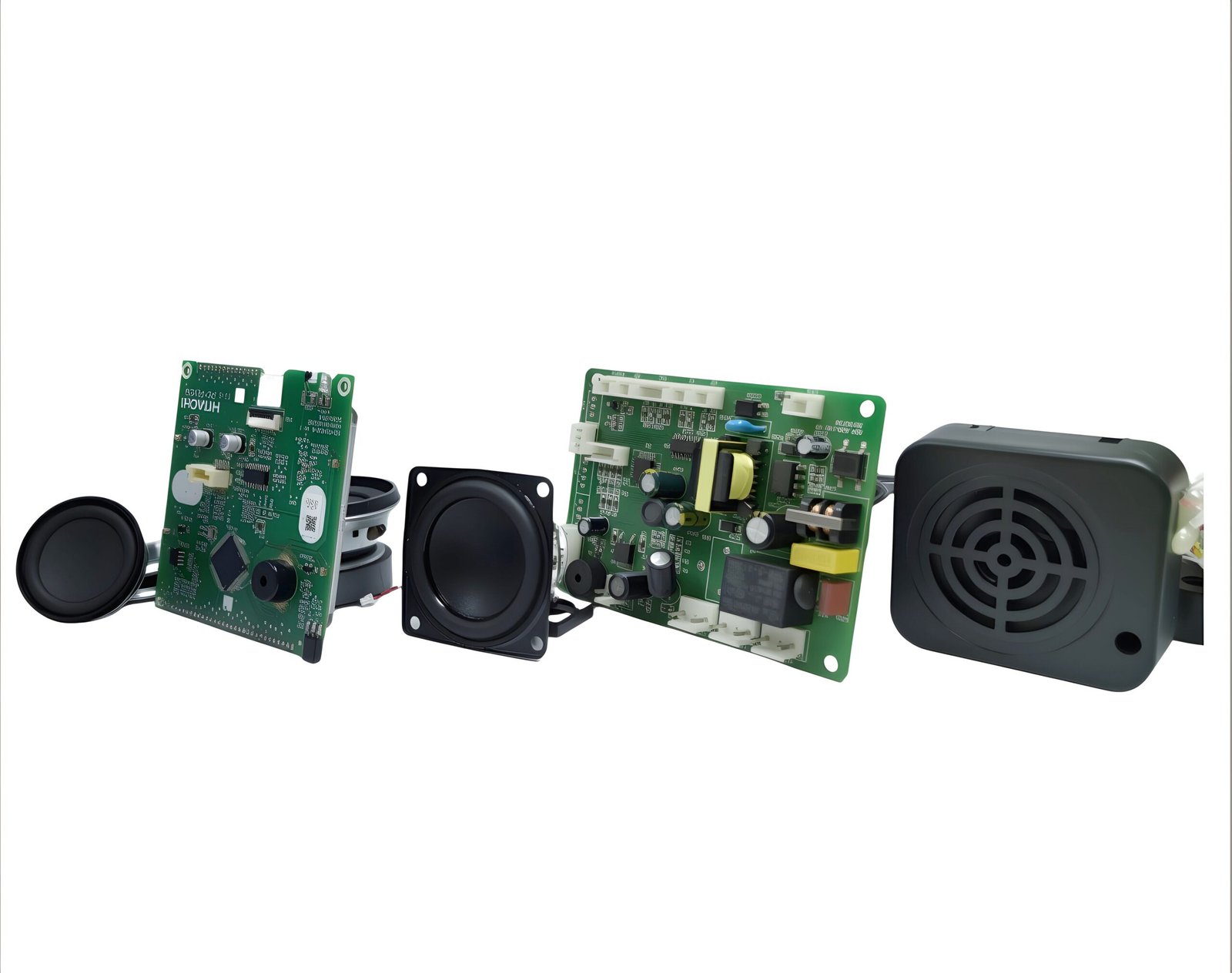
Market Outlook and the Strategic Value of OEM Development
A wireless charging speaker OEM strategy positions your brand squarely at this lucrative intersection.
For brands, retailers, and innovators, OEM development is the critical pathway from concept to market-ready product. It changes a vision of cord-free convenience into a tangible, high-quality device without the prohibitive cost of establishing in-house manufacturing. In an era where consumers seek decluttered spaces and “just works” experiences, a well-executed wireless charging speaker is more than a product; it’s a statement of modern, user-centric design.
Core Technologies: The Pillars of a Superior Product
A successful wireless charging speaker OEM project rests on three interdependent technological pillars: audio engineering, wireless charging implementation, and intelligent connectivity. Mastering this triad is non-negotiable for product excellence.
1. Audio Fidelity & Acoustic Design: The speaker’s primary function must not be compromised. This involves selecting the right driver configuration (e.g., full-range, woofer+tweeter), tuning the passive radiators for enhanced bass, and designing a precise acoustic chamber. Advanced OEM partners utilize computational audio and psychoacoustic modeling to optimize sound profiles for the enclosure’s size. Support for modern audio codecs like Qualcomm® aptX™ Adaptive and LDAC for high-resolution Bluetooth streaming is now a key differentiator for discerning listeners.
2. Wireless Charging Implementation: The choice between the ubiquitous Qi standard (for mobile devices) and proprietary solutions (e.g., for proprietary headphones) is fundamental. For Qi charging, focus is on coil design, alignment solutions (e.g., multi-coil arrays, magnetic guidance like MagSafe), and thermal management. Key specifications include charging power (5W Basic Power, 15W Extended Power Profile) and efficiency. Foreign Object Detection (FOD) is a critical safety feature that must be flawlessly executed.
3. Connectivity & Smart Features: Bluetooth 5.3 or later is now standard, offering improved range, stability, and power efficiency. True Wireless Stereo (TWS) pairing for creating a wider soundstage with two units is a highly desirable feature. Integration with voice assistants (Google Assistant, Alexa, Siri via BLE) and multi-point connection (switching between phone and laptop) adds significant user convenience. App-enabled controls for EQ customization and firmware updates future-proof the product.
Coexistence with the audio path
The charger switches at 100-300 kHz and the Class D amplifier at 300-500 kHz, so the two can beat. Keep the coils and the amplifier inductor on opposite sides of the board, route the speaker leads away from the coil, and add a ferrite bead at the amplifier's supply. The audible result of a bad layout is a whistle at the difference frequency, which is easy to miss on a bench and obvious in a quiet bedroom.
| Item | Typical value | Design note |
|---|---|---|
| Qi baseline | 5 W BPP | Coil alignment tolerance ±4 mm |
| Qi EPP | 15 W | Foreign-object detection required |
| Qi2 | 15 W, magnetic alignment | Magnet ring adds 2–3 mm height |
| Coil-to-coil gap | 3–5 mm | Each millimetre costs efficiency |
| Standby draw | < 0.1 W | Needed for EU standby rules |
Design, Customization, and Manufacturing Excellence
This phase changes technical specifications into a desirable physical product that reflects your brand identity. A sophisticated OEM partner offers deep customization across all touchpoints.
Industrial Design (ID) & User Experience (UX): The design must balance aesthetics, ergonomics, and acoustic performance. Choices in materials—fabric meshes, silicone, recycled plastics, or aluminum—define the product’s feel and durability. The placement of controls, status LEDs, and the charging zone must be intuitive. A successful design tells a cohesive story, whether it’s minimalist, rugged, or luxurious.
Hardware & Firmware Customization: Beyond the shell, customization is king. This includes:
- Branding: Custom logos, indicator light colors, and startup sound signatures.
- Feature Set: Selecting which smart features to include or exclude to hit target price points.
- Firmware: Developing a unique user interface for button presses and developing a companion app under your brand name.
This includes acoustic testing in anechoic chambers, wireless charging efficiency and safety validation, drop tests, and ingress protection (IPX ratings for water/dust resistance) certification. A reliable OEM partner ensures consistent quality across production runs and manages the entire supply chain, from component sourcing (like speaker drivers and Bluetooth SoCs from Qualcomm or Actions) to final assembly and logistics.
The OEM Development Process and Future Trends
- Design & Engineering: Creation of ID/UX, electronic schematic design, prototyping, and acoustic tuning.
- Prototyping & EVT/DVT: Building Engineering Validation Test (EVT) and Design Validation Test (DVT) units for functional and reliability testing.
- Tooling & Pilot Run (PVT): Manufacturing mold tooling and executing a Pilot Verification Test run to finalize the production process.
- Mass Production & Delivery: Ramping up to full-scale manufacturing with ongoing quality checks before shipment.
Looking ahead, several trends will define the next generation of wireless charging speakers:
- Sustainable Manufacturing: Demand for recycled materials, biodegradable packaging, and energy-efficient production will grow.
- Higher-Fidelity Wireless Audio: Expect wider adoption of LE Audio with LC3 codec for better sound quality at lower bitrates.
- Fast Charging Evolution: Integration of faster wireless charging standards (beyond 15W) as they become more widespread in smartphones.
- Context-Aware Intelligence: Speakers with built-in sensors that adapt audio or charging based on environment (e.g., room acoustics, user presence).
Coil geometry, alignment and foreign-object detection
The coil diameter and the number of turns set the inductance and the coupling. A 43 mm coil is the common choice for a 15 W pad; the shield ferrite behind it is 0.5-1 mm thick and must cover the coil, or the field couples into the battery and the metal chassis instead of the receiver. The gap between the coils should be 3-5 mm, and every millimetre costs efficiency.
FAQ
Why does my wireless charger only deliver 5 W?
Coil misalignment, a thick phone case, or thermal derating. Check the coil gap first, then the pad temperature after 20 minutes; a controller that folds back to 5 W is protecting the surface, not failing.
Is Qi2 different from Qi?
Qi2 adds a magnetic alignment ring and raises the practical power to 15 W with better positional tolerance. A Qi2 receiver also works on a Qi pad, but without the magnetic hold the alignment is not guaranteed.
How do I stop the charging coil from adding audio noise?
Separate the coil and the amplifier inductor, keep the speaker leads short and away from the coil, and add a ferrite bead on the amplifier supply. Test with a quiet track at low volume, where the beat tone is most audible.
Related reading
- Multifunctional Station vs. Standalone Wireless Charging Speaker
- Top 5 Wireless Charging Speaker Models for Office Suppliers
- Buyers Guide: Identifying Qi-Certified Wireless Charging Speaker Factories
More on Bluetooth Audio.
