
The audible difference between two speakers usually sits in three places: the 2-5 kHz region where the ear is most sensitive, the crossover overlap where two drivers share the band, and the directivity index, which decides how much reflected energy reaches the listener. Each can be measured before a sample is approved.
The notes below apply to embedded speakers, with the measurement conditions and production checks that decide whether a claimed figure survives a shipment.
Introduction: The Critical Role of Audio in Modern Healthcare
In the high-stakes environment of modern healthcare, where split-second decisions and precise monitoring can mean the difference between life and death, every component of medical equipment must perform with unwavering reliability. While much attention is rightly paid to imaging resolution, sensor accuracy, and data analytics, the role of audio output —specifically embedded speakers—is often an underappreciated cornerstone of device functionality.
Gone are the days of simple buzzers; today’s embedded speakers for medical devices are sophisticated systems engineered to deliver crystal-clear audio across a range of critical applications. They must cut through the cacophony of a busy ICU, provide intelligible instructions in surgical suites, and offer reassuring clarity in patient-facing devices, all while adhering to the most rigorous standards of safety, durability, and hygiene.
Technical Specifications & Performance Parameters: Engineering for Clarity and Reliability
Selecting an embedded speaker for medical equipment requires a meticulous balance of acoustic performance, physical constraints, and regulatory compliance. The baseline is governed by international standards, particularly the IEC 60601-1-8 for alarm systems in medical electrical equipment, which mandates specific sound pressure levels, frequency patterns, and priorities for different types of alarms. However, performance goes far beyond meeting minimum standards.
- Frequency Response: Medical audio often requires a tailored response. Alarms benefit from a focus on mid-range frequencies (500 Hz – 2 kHz) where human hearing is most sensitive, while voice guidance requires a broader range (200 Hz – 4 kHz) for intelligibility. Advanced speakers for diagnostic applications, like those in audio-enhanced stethoscopes or Doppler devices, may need a specialized response to accurately reproduce physiological sounds.
- Sound Pressure Level (SPL): Measured in decibels (dB), SPL must be sufficient to be heard over ambient noise, which in hospitals can average 60-70 dB and spike higher. Critical alarm speakers often need to produce 75-85 dB at 1 meter. The speaker must do this without distortion, even at maximum output.
- Total Harmonic Distortion (THD): Low THD (<5% at rated power) is decisive for clarity. Distorted alarms can be confusing or missed entirely, especially in high-stress situations.
- Directionality & Dispersion: The speaker’s design determines how sound waves propagate. A wide dispersion angle is often needed for room-filling alerts, while a more directional design might be used for operator-specific feedback.
Physical & Environmental Design: Medical environments are harsh. Embedded speakers must be:
- Sealed & Cleanable: They require an IP54 rating or higher to withstand rigorous cleaning with disinfectants, alcohol wipes, and fluid spills. The diaphragm and internal components must be protected from ingress.
- Magnetically Shielded: To prevent electromagnetic interference (EMI) with sensitive diagnostic electronics, speakers must use shielded magnets. This is non-negotiable for devices like MRI adjacent equipment, patient monitors, and imaging systems.
- Compact & Integratable: With medical devices trending toward miniaturization, speakers like thin-profile piezo-electric buzzers or micro dynamic speakers are often specified. They must fit into increasingly slim housings without compromising output.
| Feature | Dynamic (Moving Coil) Speaker | Piezo-Electric Speaker | Balanced Armature Receiver |
|---|---|---|---|
| Best For | General alarms, voice guidance, broad frequency needs | High-priority, piercing alarms in compact spaces | Ultra-compact devices, hearing-aid integration, precise freq. |
| Frequency Response | Broad, good for mid/low tones | Narrow, focused on high frequencies (1-4 kHz) | Very precise, can be tuned for specific ranges |
| Power Efficiency | Moderate | Very High | High |
| Durability/Cleanability | Excellent (can be fully sealed) | Excellent (solid-state construction) | Good (requires careful sealing) |
| Cost Profile | Low to Moderate | Very Low | Moderate to High |
| Example Applications | Ventilators, patient monitors, ultrasound machines | Infusion pumps, bedside monitors, handheld devices | Digital stethoscopes, wearable patient monitors |
Horns, waveguides and directivity
A horn trades efficiency for directivity. A compression driver with a 1 inch throat on a 60 by 40 degree horn can produce 110 dB at 1 m with a few watts, but its throat distortion rises with level and its coverage narrows with frequency. For a long-throw installation the 60 by 40 pattern is chosen so that the rear seats still receive direct sound at 20 m.
Market Dynamics & Selection Criteria for OEMs
The global market for specialized audio components in medical devices is experiencing steady growth, driven by the proliferation of connected health devices, point-of-care diagnostics, and advanced patient monitoring systems.
For an Original Equipment Manufacturer (OEM), the selection process extends beyond a datasheet. It involves a multi-faceted evaluation:
- Regulatory Pathway Alignment: The speaker supplier must understand and support the OEM’s regulatory strategy (FDA 510(k), CE Marking under MDR, etc.). This includes providing full material disclosures, test reports for IEC 60601 (for electrical safety and EMC), and potentially supporting biocompatibility testing if the speaker has patient contact.
- OEMs prioritize partners with proven reliability, transparent sourcing, and flexible manufacturing capabilities to avoid production delays for critical medical equipment.
- Acoustic Integration Support: The best speaker poorly integrated will perform badly. Leading suppliers offer Application Engineering support , helping with acoustic cavity design, grille mesh optimization, and digital signal processing (DSP) tuning to ensure the final product meets its acoustic goals without costly prototyping cycles.
- Customization Capability: Off-the-shelf solutions don’t always fit. The ability to customize mounting brackets, connector types, grille designs, and even acoustic performance curves is a significant value driver for high-volume or specialized medical device projects.
Design Considerations for Specific Medical Applications
The “one-size-fits-all” approach fails utterly in medical technology. The design imperatives for an embedded speaker vary dramatically by the device’s use case and environment.
- Speakers are often part of a multi-tone, prioritized audio system . Design focuses on maximum intelligibility and the ability to project alarm sounds that are distinct and urgent, following the ISO 7731 standard for danger signals. Redundancy, such as a primary dynamic speaker backed by a secondary piezo alarm, is common.
- Surgical & Interventional Suites: Equipment like electrosurgical units, insufflators, and navigation systems provides auditory feedback (e.g., tone changes with cutting/coagulation modes). The speaker must produce clear, distinct tones at a volume adjustable by the surgeon, often designed to blend without being intrusive. Strict EMI shielding is critical to avoid interfering with other sensitive equipment in the OR.
- Point-of-Care & Handheld Diagnostics (Ultrasound, Glucose Meters): Space is the primary constraint. Designers seek ultra-miniaturized speakers or micro-speakers that still deliver clear voice prompts, status beeps, or Doppler audio. Sealing against dust and fluids (at least IP67) is standard for devices used in varied clinical settings.
- Patient-Facing and Wearable Devices (Infusion Pumps, Wearable Monitors): Audio serves both alerting and comforting functions. Alarm sounds must be attention-grabbing for the patient, while status confirmations can be more gentle. Psychoacoustics —how sound is perceived—plays a role. Speakers must be durable for daily patient use and often require custom grilles to align with consumer-style product design.
The Future of Audio in Medical Devices: Trends Shaping the Next Generation
The integration of audio in medical devices is becoming more sophisticated, moving beyond simple output to become an intelligent, connected component of the healthcare ecosystem.
- AI-Enhanced Audio Processing: Embedded DSP chips, coupled with AI algorithms, are enabling smart audio filtering . Future ventilators or monitors could use onboard AI to distinguish between a critical alarm condition and background noise (like a dropped bedrail), potentially reducing alarm fatigue—a top patient safety concern.
- Voice Synthesis & Biometric Feedback: More devices will incorporate high-quality voice synthesis for complex instructions and patient communication.
- Haptic-Audio Synergy: To combat alarm desensitization in noisy environments, designers are combining precise audio alerts with synchronized haptic feedback (vibration). This multi-sensory approach, already prevalent in consumer electronics, is migrating to clinical devices for nurses’ pocket pagers and handheld tools, ensuring critical notifications are never missed.
- Sustainability & Materials: The drive for greener medical devices is influencing component choice. Expect a greater focus on speakers using recyclable materials , halogen-free components, and designs that facilitate easier disassembly at end-of-life, all without compromising the stringent performance and safety benchmarks.
Reading a response curve properly
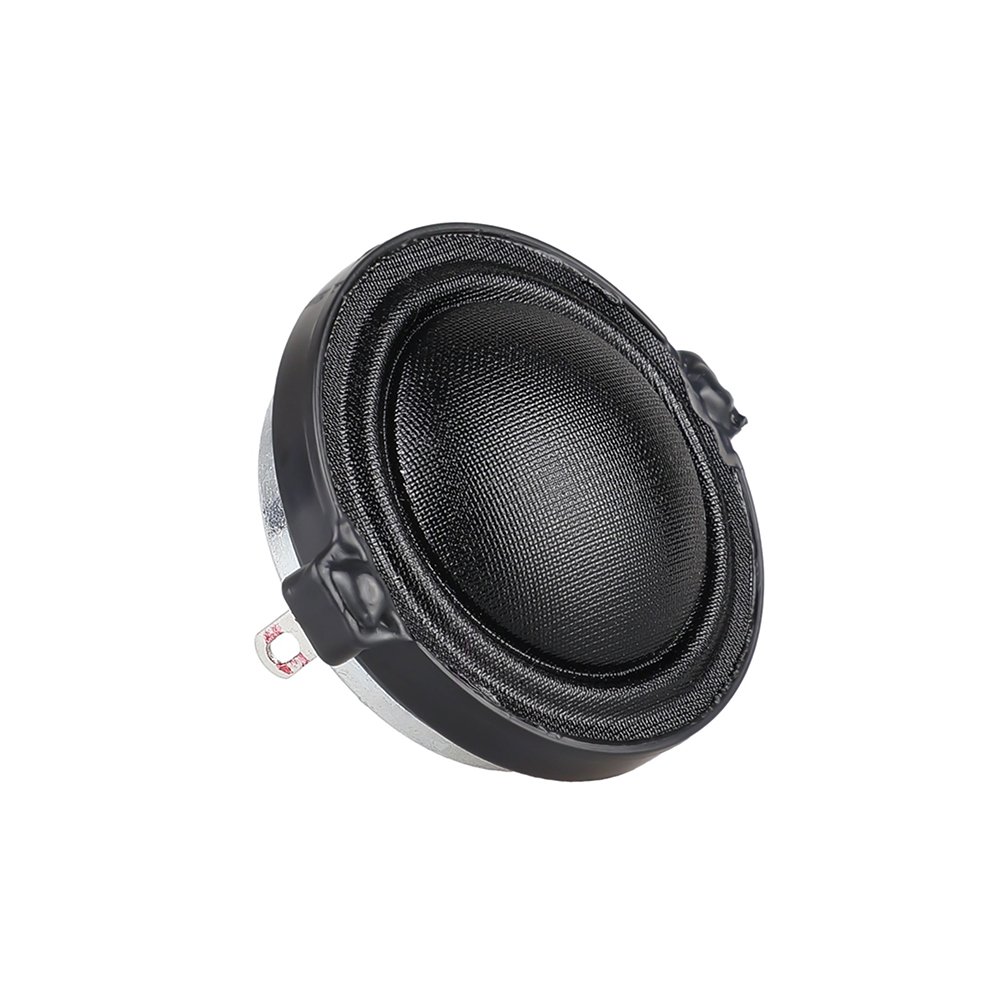
Off-axis measurements decide whether the speaker works in a room. A 25 mm dome typically widens its directivity above 8 kHz, while a 25 mm compression driver on a 90 by 60 degree horn holds it down to 2 kHz. The mismatch at the crossover, not the on-axis response, is what makes a speaker sound different when the listener moves.
FAQ
What smoothing should a published response curve use?
State it explicitly: 1/24 octave is close to what the ear resolves in a room, while 1/3 octave hides narrow peaks. A curve without distance, level and smoothing is not comparable with any other curve.
Why cross a tweeter no lower than one octave above resonance?
Below that point the diaphragm travel and distortion rise quickly, and a 2 kHz crossover on a 900 Hz tweeter leaves margin for high-level transients without exceeding Xmax.
Does a flat on-axis curve guarantee good sound?
No. Directivity, the crossover's phase behaviour and low-frequency room interaction matter as much; a flat curve measured at 1 m can still sound uneven at the listening position.
Related reading
- 4 Ohm vs 8 Ohm Speakers Full Engineering Guide
- Box Speakers for Commercial Audio Systems
- Mini Speakers for Wearable Devices
More on Speaker Design.
