
In a micro speaker the rear cavity, not the driver, sets the low-frequency limit. A 20 mm unit is typically tuned so that the sealed back volume behind the diaphragm lifts output between 400 and 900 Hz; enlarging that cavity by 0.3 cm3 flattens the hump but costs 2-3 dB of sensitivity above 1 kHz. The housing drawing is therefore part of the acoustic design, not a packaging detail.
The notes below apply to mini speakers, with the measurement conditions and production checks that decide whether a claimed figure survives a shipment.
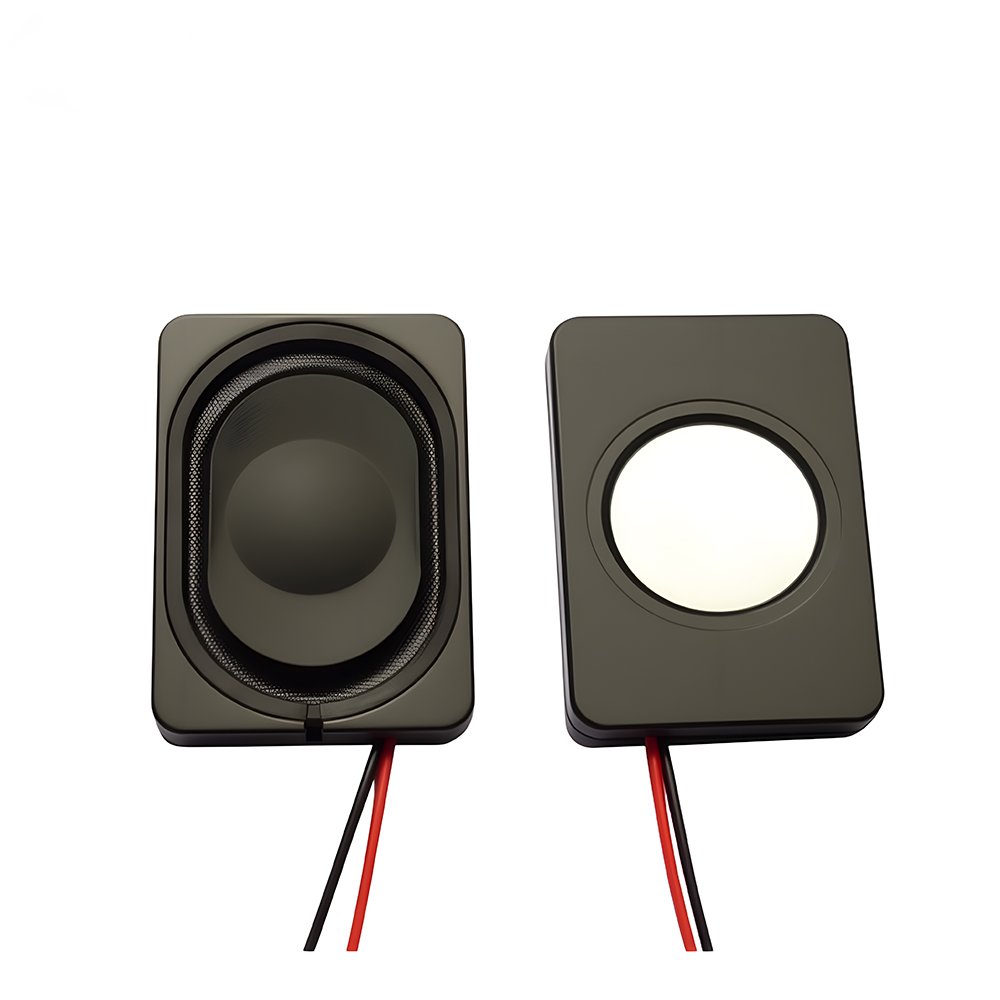
Wearable Audio Redefined: Merging Portability with Performance
Miniature speakers are changing wearable technology by delivering high-quality audio from devices so small they can be worn on the wrist, in eyewear, or integrated into clothing. Unlike traditional portable speakers, these micro-acoustic components face unique challenges: they must produce clear sound while consuming minimal power, surviving environmental exposure, and fitting into spaces often smaller than a fingernail. The latest advancements in micro-electro-mechanical systems (MEMS) speakers, piezoelectric materials, and bone conduction technology are enabling manufacturers to embed rich audio experiences into smartwatches, fitness trackers, augmented reality glasses, and even smart jewelry. This shift represents more than miniaturization—it’s a fundamental rethinking of how humans interact with audio in motion, creating tight, always-accessible sound that integrates into daily life without bulky headphones or external devices.
Engineering Sound in Microscopic Spaces: Technical Evolution & Design Challenges
Designing speakers for wearables involves overcoming severe physical constraints. Traditional dynamic speaker drivers rely on moving coils and large diaphragms that require space for air displacement—a luxury wearable devices don’t have. MEMS speakers, for instance, use semiconductor fabrication techniques to create speakers as small as 4x4mm, with thicknesses under 1mm. These speakers operate by vibrating a microscopic silicon diaphragm, producing sound with remarkably low distortion. Piezoelectric speakers, another key technology, use materials that change shape when voltage is applied, converting electrical signals directly into sound waves without bulky magnets. For devices like smart rings or hearing aids, balanced armature drivers—long used in high-end in-ear monitors—are being miniaturized further to deliver focused frequency ranges in sealed enclosures.
The primary trade-offs in miniaturization involve frequency response, power efficiency, and durability. Smaller speakers naturally struggle with bass reproduction due to limited air movement. Advanced digital signal processing (DSP) algorithms now compensate by enhancing low frequencies psychoacoustically, making the ear perceive deeper bass than physically produced. Power consumption is critical; a smartwatch speaker drawing too much power would decimate battery life. New designs operate at under 10mW during playback, often using ultra-efficient class-D amplifiers. Durability challenges include waterproofing (many wearables now carry IP67/68 ratings), resistance to sweat and dust, and resilience against physical shocks from daily wear. Materials like graphene diaphragms and corrosion-resistant nanocoatings are addressing these issues, enabling speakers that survive workouts, rain, and accidental drops.
| Technology | Typical Size | Power Efficiency | Key Strengths | Common Applications |
|---|---|---|---|---|
| MEMS Speakers | 4x4x1mm | Excellent (≤5mW avg) | Ultra-thin, high consistency, good mid-range | Smartwatches, hearing aids, AR glasses |
| Piezoelectric | 10x10x0.5mm | Very Good (≈8mW avg) | No magnets, thin profile, wide frequency | Fitness trackers, smart clothing, IoT badges |
| Balanced Armature | 6x4x3mm | Good (≈12mW avg) | Precise highs/mids, works in sealed spaces | Premium smart earbuds, advanced hearing devices |
| Bone Conduction | 15x10mm (transducer) | Moderate (≈15mW avg) | Leaves ear open, situational awareness | Sport glasses, safety helmets, specialized comms |
Power, excursion and thermal limits
Excursion limits the low end before power does. At 300 Hz a 20 mm driver with 0.3 mm Xmax reaches its travel at about 95 dB at 10 cm; below that frequency output falls at 12 dB per octave in a sealed back cavity. A passive radiator or a larger frame buys low end, at the cost of height and cost.
The User Experience: Sound Quality, Personalization & Real-World Applications
For consumers, the ultimate test is how these tiny speakers perform in daily scenarios. A smartwatch speaker handling phone calls in a noisy street, AR glasses providing spatial audio navigation prompts, or a fitness tracker giving voice feedback during a run—each demands clarity despite background noise. Beamforming microphone arrays paired with mini speakers enable clear voice capture and playback even in windy or crowded environments. Adaptive audio algorithms, like those in the latest Apple Watch and Wear OS devices, automatically adjust volume and equalization based on ambient noise levels detected by onboard sensors.
Personalization is becoming standard. Through companion apps, users can tailor sound profiles for music, calls, or alerts. Some wearables now learn listening preferences over time, automatically optimizing for speech intelligibility or music fidelity. Haptic-acoustic integration adds another layer: smartwatches combine subtle vibrations with audio alerts for discreet notifications. In social contexts, directional sound projection technologies (like ultrasonic beamforming in experimental stages) aim to create personal audio bubbles, allowing only the wearer to hear the device’s output—a potential step change for public usability.
Real-world applications extend far beyond consumer electronics. In healthcare, wearable patches with mini speakers deliver medication reminders or guided breathing exercises for chronic patients. Industrial safety helmets integrate speakers for hands-free communication in loud environments. Even fashion has embraced the trend, with companies like House of Holland experimenting with speaker-equipped clothing that reacts to movement or environment. The common thread is contextual audio—sound that enhances an activity without isolating the user from their surroundings.
Market Growth, Key Players & Future Innovations
The wearable audio market is expanding rapidly. The hearables market (including true wireless earbuds) continues to merge with wearables, driving R&D in micro-acoustics. Key players like Knowles, AAC Technologies, and Infineon dominate MEMS speaker supply, while Sonion and Sonos lead in advanced micro-driver designs. Consumer tech giants—Apple, Samsung, Google—are investing heavily in proprietary audio technologies, such as Apple’s custom drivers in the Apple Watch Ultra, designed for clearer outdoor audio.
Flexible printed speakers, using conductive inks on thin polymer films, can be integrated into fabric sleeves or curved surfaces, enabling entirely new form factors. Energy-harvesting speakers that convert ambient vibrations into power could lead to battery-free audio wearables. Perhaps most promising is the development of multifunctional acoustic surfaces: a single component acting as speaker, microphone, and ultrasonic sensor for gesture control.
As 5G and edge computing mature, wearable speakers will become gateways to real-time translated conversations, immersive audio environments in AR/VR, and proactive health feedback—like a smartwatch analyzing cough frequency or voice stress to detect illness. The convergence of biometric sensing and audio output will make wearables not just playback devices, but interactive health and communication partners.
Mounting and sealing inside a moulding
Mounting bosses transfer vibration into the housing. A soft gasket under the frame decouples the driver above 200 Hz, and a rigid boss pattern keeps the frame flat within 0.1 mm. Both are checked on the first article with a feeler gauge and a sweep in the final housing, not on a bare driver in free air.
FAQ
Why does a micro speaker sound thin in a plastic housing?
The back cavity is usually smaller than the free-air condition the datasheet assumes, and the housing leaks at the frame or the port. Measure the assembled response, then adjust cavity volume and gasket compression rather than the driver.
How much power can a 20 mm speaker take?
Typically 0.5-1 W continuous and 2-3 W short-term in a sealed module; the limit is coil temperature, which depends on the housing's thermal path, not only on the driver.
Is a passive radiator worth it in a wearable?
Only if the enclosure has room for the radiator's compliance and the extra height. It extends output one octave lower than a sealed back cavity but adds a second moving part that can rattle if the clearance is under 0.3 mm.
Related reading
- Top 5 Small Loud Speakers for Wearable Audio Devices
- 4 Ohm vs 8 Ohm Speakers Full Engineering Guide
- Box Speakers for Commercial Audio Systems
More on Speaker Design.
