
In a micro speaker the rear cavity, not the driver, sets the low-frequency limit. A 20 mm unit is typically tuned so that the sealed back volume behind the diaphragm lifts output between 400 and 900 Hz; enlarging that cavity by 0.3 cm3 flattens the hump but costs 2-3 dB of sensitivity above 1 kHz. The housing drawing is therefore part of the acoustic design, not a packaging detail.
This guide treats small speaker frequency limits as a specification problem: what to measure, what to write on the drawing, and what to verify before the first carton ships.
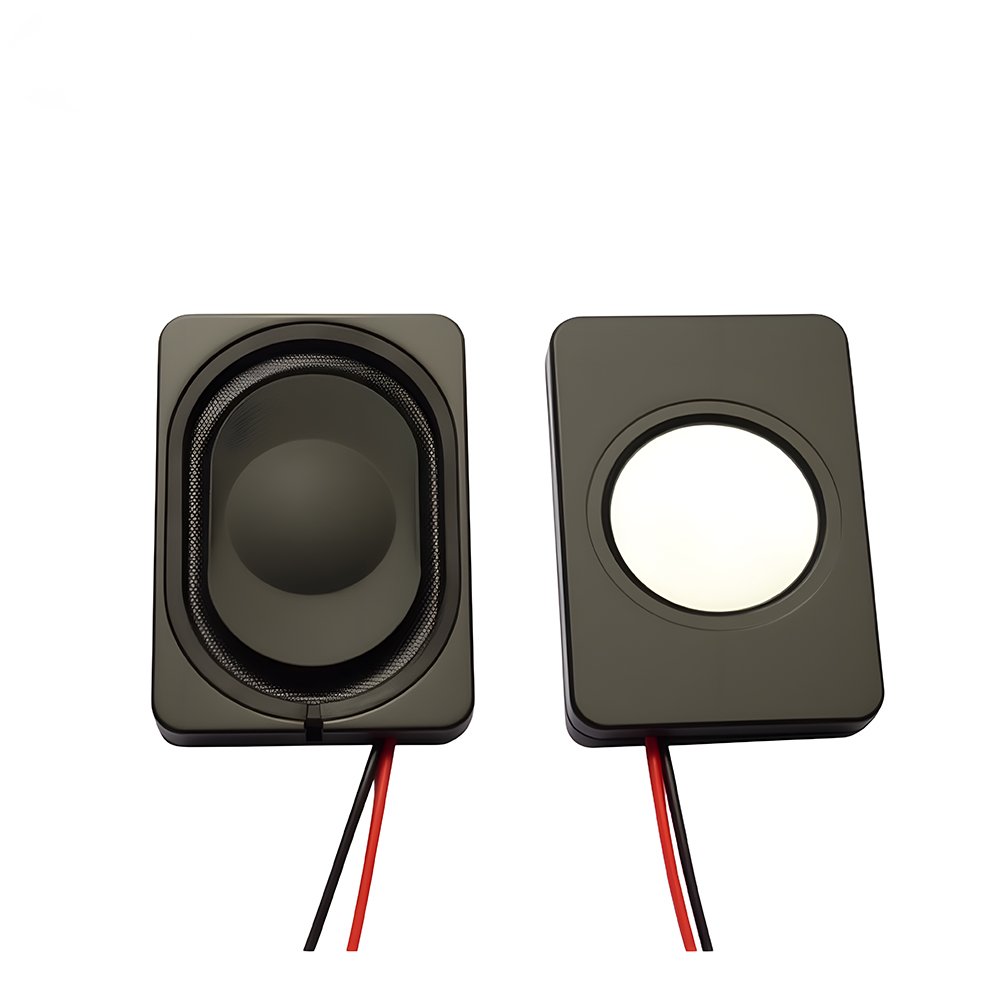
The Fundamentals of Speaker Frequency Response
Frequency response refers to the range of audio frequencies a speaker can reproduce, measured in Hertz (Hz). The human hearing range typically spans from 20 Hz (deep bass) to 20,000 Hz (high treble). For a standard small speaker—such as a portable Bluetooth speaker, compact bookshelf unit, or smart speaker—the physical size of the driver(s) and enclosure directly impacts its ability to reproduce extreme lows and highs.
Most small speakers utilize drivers between 0.5 to 3 inches in diameter. These smaller drivers can respond quickly to high-frequency signals, often producing clear treble up to 18–20 kHz. However, reproducing lower frequencies requires moving more air, which demands larger surface areas and greater displacement—something physically limited in small enclosures. Consequently, while many small speakers claim a frequency range starting at, say, 80 Hz or 100 Hz, their actual usable bass output often rolls off significantly below 150–200 Hz.
Below 70 Hz, output drops sharply, meaning you might “see” 60 Hz on a spec sheet but not hear it meaningfully.
| Model | Driver Size | Claimed Frequency Range | Measured -3 dB Points |
|---|---|---|---|
| JBL Flip 6 | 1.7" + passive radiators | 63 Hz – 20 kHz | 75 Hz – 18 kHz |
| Sonos Roam | 1" tweeter + mid-woofer | 70 Hz – 20 kHz | 85 Hz – 19 kHz |
| Bose SoundLink Flex | 1.75" full-range | 60 Hz – 20 kHz | 80 Hz – 18 kHz |
| UE Boom 3 | 2" drivers | 90 Hz – 20 kHz | 100 Hz – 17 kHz |
Physical Constraints: Why Small Speakers Struggle with Bass
The laws of physics present the biggest challenge. Bass frequencies have long wavelengths (e.g., 40 Hz has a wavelength of about 8.5 meters). To reproduce them effectively, a speaker must move substantial air volumes. This is often described by Hoffman’s Iron Law , which outlines the trade-off between enclosure size, bass extension, and efficiency. Small speakers sacrifice deep bass to remain compact and energy-efficient.
These designs amplify certain bass frequencies by resonating but don’t extend the absolute lowest limit significantly. DSP (Digital Signal Processing) and psychoacoustic bass enhancement (like Apple’s “Dynamic Bass”) are also used to create the illusion of deeper bass, but they can’t generate truly flat response below the driver’s physical capabilities.
Recent advancements in materials—such as graphene-coated diaphragms and neodymium magnets —allow drivers to be lighter and more responsive, improving mid-bass punch. However, breakthroughs in acoustic metamaterials and compact transducer designs (e.g., xMEMS micro-speakers ) are pushing boundaries, enabling slightly wider ranges in tiny footprints as of 2024.
Cavity, gasket and the low end
Measure the back cavity by filling the assembled part with glass beads or by casting the volume, not by multiplying wall dimensions. Ribs, bosses and the magnet cut-out remove 15-30 % of the nominal space, and that difference moves the tuning by more than the tolerance on the driver itself. Send the housing model with the driver drawing and the tuning is confirmed before tooling.
Measuring Real-World Performance: Specifications vs. Listening Experience
Manufacturers often list optimistic frequency ranges in marketing materials. The -3 dB point is a more meaningful metric—it indicates the frequency at which output drops by 3 decibels relative to the average, marking the “usable” limit. For instance, a small speaker rated down to 60 Hz might have its -3 dB point at 90 Hz, meaning bass will be noticeably weaker below that threshold.
Room acoustics and placement also dramatically affect perceived frequency limits. Placing a small speaker near a wall or corner can reinforce bass due to boundary reinforcement, potentially adding 5–10 Hz of apparent extension. Conversely, placing it in open space or on a soft surface can reduce bass output.
In controlled tests, small speakers typically show a gradual roll-off below 150 Hz and a sharp drop below 80 Hz . For music genres like classical or jazz, this may be sufficient, but for electronic or hip-hop, listeners will notice the lack of sub-bass (20–60 Hz). The integration of Wi-Fi subwoofers (like those paired with Sonos or HomePod) is a growing trend to address this limitation without enlarging the main unit.
Enhancing Frequency Response: Tips and Technologies
While you can’t change physics, several strategies can optimize a small speaker’s performance:
- Positioning: Place the speaker on a solid surface close to a wall to reinforce bass.
- EQ Adjustments: Use a parametric equalizer in your source app to slightly boost the 80–150 Hz region, but avoid overdriving.
- Paired Subwoofers: Many modern small speakers support wireless subwoofers for full-range sound.
- Stereo Pairing: Two small speakers set in stereo can create a wider soundstage and better bass perception.
Technologically, beamforming tweeter arrays (as seen in the HomePod mini ) and room correction software help tailor output to the environment. Upcoming innovations like bass reflex tubes with adaptive ports and piezoelectric drivers may further extend limits in the next 2–3 years.
Future Trends: Pushing the Boundaries of Small Speakers
The market for compact speakers is evolving beyond mere portability. Demand for rich sound in small smart home devices is driving R&D. Companies like Devialet and KEF are applying patented acoustic technologies (e.g., spherical wave propagation, Uni-Q drivers) to improve dispersion and bass response in compact form factors.
Also, AI-driven real-time tuning —where a speaker analyzes room acoustics and adjusts its output—is becoming standard in mid-to-high-end models. This doesn’t break physical limits but ensures optimal performance within them. As of 2024, brands like Sonos and Bang & Olufsen are using machine learning to dynamically manage frequency compression and distortion at high volumes.
Looking ahead, material science and acoustic engineering may gradually shift the standard frequency limits. However, for the foreseeable future, small speakers will continue to prioritize balance, clarity, and portability over deep bass extension.
Power, excursion and thermal limits
Excursion limits the low end before power does. At 300 Hz a 20 mm driver with 0.3 mm Xmax reaches its travel at about 95 dB at 10 cm; below that frequency output falls at 12 dB per octave in a sealed back cavity. A passive radiator or a larger frame buys low end, at the cost of height and cost.
FAQ
Why does a micro speaker sound thin in a plastic housing?
The back cavity is usually smaller than the free-air condition the datasheet assumes, and the housing leaks at the frame or the port. Measure the assembled response, then adjust cavity volume and gasket compression rather than the driver.
How much power can a 20 mm speaker take?
Typically 0.5-1 W continuous and 2-3 W short-term in a sealed module; the limit is coil temperature, which depends on the housing's thermal path, not only on the driver.
Is a passive radiator worth it in a wearable?
Only if the enclosure has room for the radiator's compliance and the extra height. It extends output one octave lower than a sealed back cavity but adds a second moving part that can rattle if the clearance is under 0.3 mm.
Related reading
- Speaker Frequency Response Optimization
- What Technologies Enable High Volume in Loud Speaker Small Units?
- What Happens If You Connect a 4 Ohm Speaker to an 8 Ohm Amp?
More on Speaker Design.