
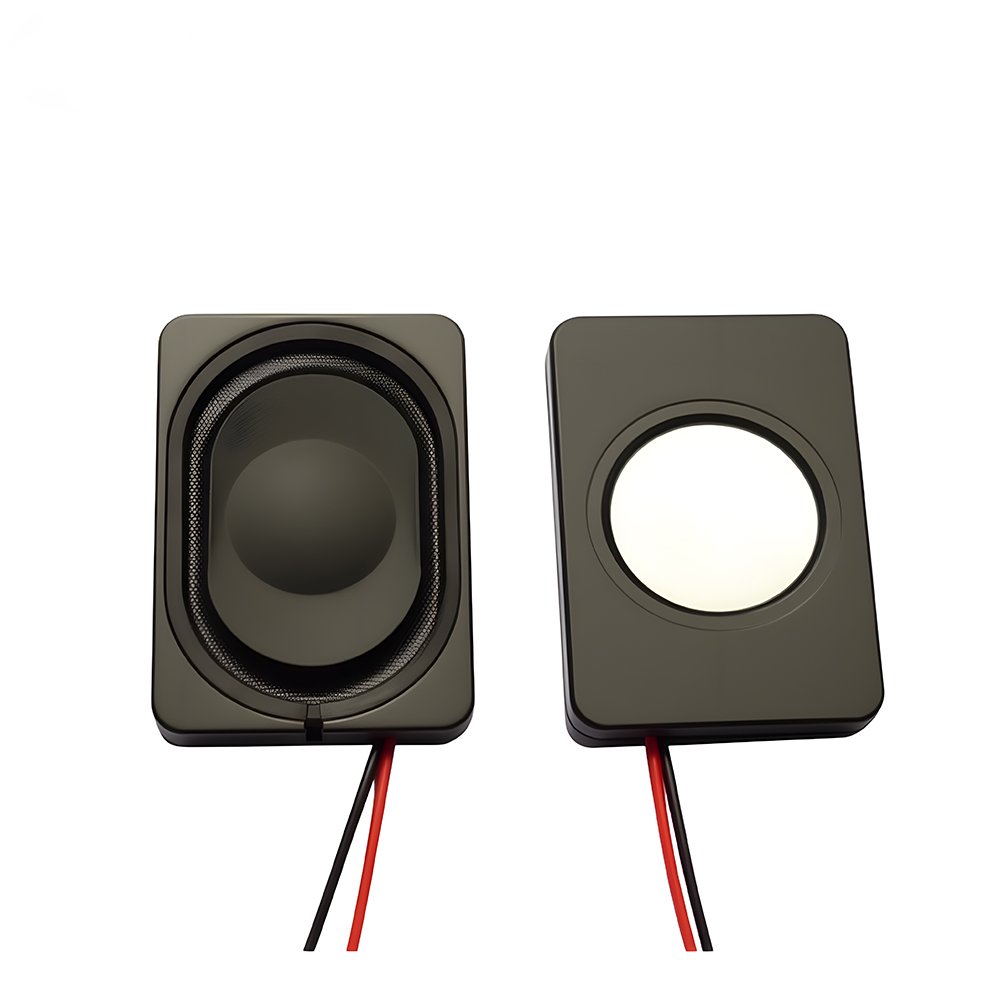
In a micro speaker the rear cavity, not the driver, sets the low-frequency limit. A 20 mm unit is typically tuned so that the sealed back volume behind the diaphragm lifts output between 400 and 900 Hz; enlarging that cavity by 0.3 cm3 flattens the hump but costs 2-3 dB of sensitivity above 1 kHz. The housing drawing is therefore part of the acoustic design, not a packaging detail.
The notes below apply to small speaker acoustic design principles, with the measurement conditions and production checks that decide whether a claimed figure survives a shipment.
1. The Core Challenge: Physics of Miniaturization
At the heart of small speaker design lies a fundamental battle against physics. The core performance parameters of a loudspeaker—its low-frequency extension, efficiency, and maximum output level—are intrinsically linked to the size of its radiating surface (the driver) and the volume of its enclosure. Thiele-Small parameters , the set of specifications defining a driver’s electrical and mechanical characteristics, become the critical scripture for designers.
A key limitation is mass law , which states that the low-frequency output of a speaker is proportional to the volume of air it can displace. Displacement is the product of the driver’s effective piston area (Sd) and its linear excursion (Xmax). A small driver has a small area, so to move the same volume of air as a large woofer, it must move much farther in and out. This demands a motor structure (magnet and voice coil) capable of generating significant force while maintaining control over a long-excursion diaphragm, all within a tiny footprint.
This raises the system’s resonant frequency (Fs), inherently limiting bass response. The challenge, therefore, is threefold: design a motor for high displacement, manage the mechanical and thermal limits of miniaturization, and employ sophisticated signal processing to overcome inherent physical shortcomings. The rise of Class-D amplification and advanced DSP (Digital Signal Processing) has been central, providing efficient, cool-running power and the ability to tailor response curves in ways impossible with analog alone.
2. Driver & Motor Structure Innovation
The driver is the heart of the system. In small speakers, every component is optimized for maximum performance per cubic millimeter.
- Traditional paper pulp has given way to composites, coated fabrics, and sophisticated plastics like polypropylene and PET . High-end micro-drivers often use boron-reinforced titanium or amorphous diamond-coated diaphragms for an ideal blend of lightness (for high efficiency and fast transient response) and rigidity (to prevent breakup distortions at high frequencies).
- Motor Systems: The goal is maximum magnetic flux in a minimal space. Ferrite magnets are common, but neodymium magnets are the gold standard for small speakers due to their exceptional strength-to-size ratio. Innovations like underhung and overhung voice coil designs, combined with finite element analysis (FEA) modeling, optimize magnetic field linearity, reducing distortion especially at high excursions.
- Suspension & Stability: The surround (outer suspension) and spider (inner suspension) must allow for long, linear travel while maintaining perfect centering of the voice coil. New manufacturing techniques for multi-roll surrounds and laser-cut, non-woven spider materials provide precise control over the restoring force.
| Material | Key Properties | Typical Use Case |
|---|---|---|
| Polypropylene | Good damping, low cost, lightweight | Mid-range drivers in portable speakers |
| Aluminum/Magnesium | Light, stiff, bright tonal character | Tweeters, full-range drivers in premium earbuds |
| Titanium Composite | Extremely stiff, low mass, excellent detail | High-performance micro-drivers |
| Bio-Cellulose | Exceptional internal damping, natural sound | High-fidelity miniature drivers |
| LCP (Liquid Crystal Polymer) | High stiffness-to-weight, controlled breakup | Advanced headphones and ultra-compact drivers |
Mounting and sealing inside a moulding
Mounting bosses transfer vibration into the housing. A soft gasket under the frame decouples the driver above 200 Hz, and a rigid boss pattern keeps the frame flat within 0.1 mm. Both are checked on the first article with a feeler gauge and a sweep in the final housing, not on a bare driver in free air.
3. Enclosure Design & Acoustic Loading
The enclosure is far more than a cosmetic shell; it is an active acoustic component. For small speakers, the choice of enclosure type is a critical trade-off between size, bass response, and efficiency.
- Sealed (Acoustic Suspension) Enclosures: The simplest design. Air inside acts as a spring, providing a smooth, second-order roll-off below the system resonance. While not the most efficient for bass, sealed designs are valued for their tight, accurate transient response and small size. They are prevalent in true wireless earbuds and many mini Bluetooth speakers.
- Bass-Reflex (Ported) Enclosures: A port or passive radiator is used to extend low-frequency output. The Helmholtz resonance of the port mass and enclosure volume creates a tuned output that can add 3-5 dB of output near the tuning frequency. This allows for deeper perceived bass from a given enclosure volume. Passive radiators (an unpowered diaphragm) are often preferred in small speakers as they eliminate port noise (chuffing) and are less prone to debris blockage.
- Passive Radiator Technology: This has become a hallmark of premium compact speakers. By using one or more passive radiators, designers can effectively increase the apparent displacement area of the system without increasing driver size. Modern implementations use dual opposing passive radiators to cancel cabinet vibration, allowing for more output with less cabinet coloration.
- Acoustic Labyrinths and Transmission Lines: Rare in truly small speakers due to size constraints, but advanced internal ducting and acoustic damping are used to manage rear waves and suppress internal standing waves that can color the sound.
4. The Digital Shift: DSP, Equalization, and Psychoacoustics
This is where modern small speakers perform their greatest feats of “acoustic alchemy.” Digital Signal Processing (DSP) is the indispensable tool that compensates for physical limitations.
- Bass Enhancement: Sophisticated algorithms like dynamic bass EQ analyze content in real-time and apply harmonic generation or subtle dynamic EQ to create the perception of deeper bass without forcing the driver into destructive over-excursion. Apple’s computational audio in the HomePod mini is a prime example.
- Driver Protection & Limiters: Thermal and excursion models run in real-time on the DSP. If the processor predicts the voice coil will overheat or the diaphragm will exceed Xmax, it intelligently limits certain frequencies to protect the hardware, often in a way that is minimally audible to the listener.
- Room/Environment Adaptation: Using built-in microphones, speakers like the Sonos Era series or Bose Smart Soundbar 900 perform automatic room correction . They measure the acoustic response of the room and apply a corrective EQ curve to counteract bass nulls, peaks, and other room-mode distortions.
- Psychoacoustic Tuning: DSP is used to shape the sound signature to meet market preferences, often emphasizing clarity in the vocal range or adding a “smile curve” (boosted bass and treble). It also enables features like virtual surround sound from a single compact bar.
5. System Integration and Cross-Disciplinary Design
A small speaker is not just an acoustic device; it is a tightly integrated system of conflicting priorities.
- Thermal Management: High power in a small space generates heat. Efficient Class-D amps, strategic heat sinking into the chassis, and venting are critical to prevent performance throttling and long-term reliability issues.
- Battery vs. Mains Power: Portable designs are dominated by battery capacity and efficiency. Every decision, from amplifier chip selection to DSP algorithm complexity, is weighed against its impact on playtime. Bluetooth codec efficiency (e.g., LDAC vs. AAC vs. SBC) also plays a role in power drain.
- Industrial Design & Acoustics: The conflict is direct: designers want tight grilles, waterproofing (IP67), and striking aesthetics. Acousticians need open, unobstructed paths for sound waves. The compromise often involves micro-perforated metal or fabric grilles that are acoustically transparent but visually solid, and the use of internal waveguide geometry to direct sound around physical obstacles.
The market in 2024 is being shaped by machine learning applications in DSP for even smarter adaptive audio, new graphene and nano-material composites for diaphragms, and the integration of spatial audio processing for immersive experiences from single-point sources. The miniaturization trend shows no signs of slowing, pushing acoustic engineers to continuously find new solutions at the intersection of physics, material science, and digital intelligence.
Cavity, gasket and the low end
The gasket is part of the acoustic seal. A 0.5 mm silicone or TPU gasket compressed 30-50 % seals a 20 mm frame at 0.2 mm deflection; over-compression buckles it and under-compression leaks, and a leak at the frame behaves as a lossy port that cancels the lowest octave. Compression force is set by the boss height, so the drawing must control it.
FAQ
Why does a micro speaker sound thin in a plastic housing?
The back cavity is usually smaller than the free-air condition the datasheet assumes, and the housing leaks at the frame or the port. Measure the assembled response, then adjust cavity volume and gasket compression rather than the driver.
How much power can a 20 mm speaker take?
Typically 0.5-1 W continuous and 2-3 W short-term in a sealed module; the limit is coil temperature, which depends on the housing's thermal path, not only on the driver.
Is a passive radiator worth it in a wearable?
Only if the enclosure has room for the radiator's compliance and the extra height. It extends output one octave lower than a sealed back cavity but adds a second moving part that can rattle if the clearance is under 0.3 mm.
Related reading
- How to Optimize Acoustic Performance Through Speaker Design
- Portable Speaker Design Trends
- Top 5 Speaker Design Trends for Minimalist Interiors
More on Speaker Design.
