
Impedance is a frequency-dependent number, not a single value. A driver sold as 8 ohm usually falls to 6-7 ohm around its resonance and climbs past 20 ohm at the top of its band, while a 4 ohm part can dip to 3.2 ohm in the same region. The nominal figure is a rounded label agreed for matching; the minimum impedance is what the amplifier has to survive on a real programme signal.
This guide treats 4 ohm vs 8 ohm speakers as a specification problem: what to measure, what to write on the drawing, and what to verify before the first carton ships.
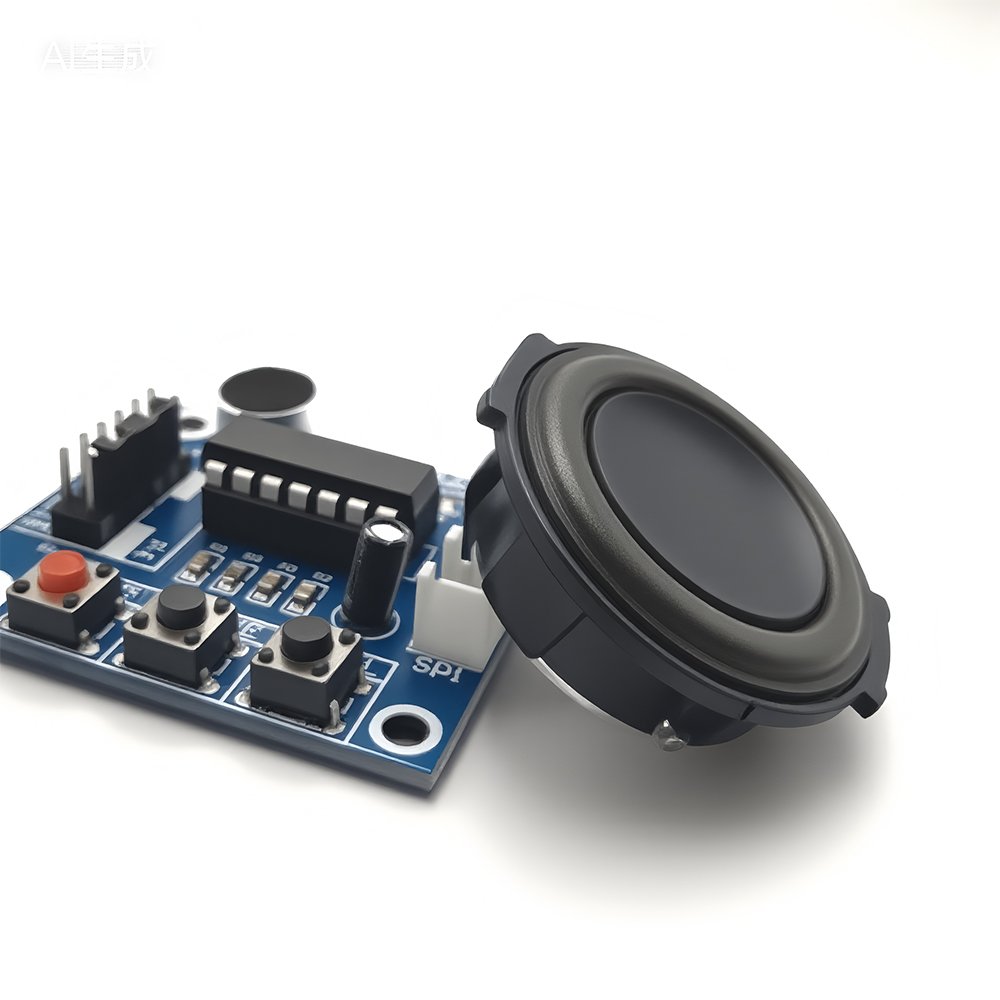
The Fundamentals of Electrical Impedance in Loudspeakers
In simple terms, impedance is the measure of opposition a speaker presents to the alternating current (AC) flow from an amplifier . It’s the AC equivalent of DC resistance but is more complex because it varies with frequency.
A speaker’s nominal impedance (e.g., 4Ω or 8Ω) is a simplified, single-number rating given by manufacturers. In reality, a speaker’s impedance curve is a graph that shows how its impedance changes across the audible frequency spectrum. This curve is rarely flat. A typical dynamic loudspeaker driver’s impedance is at its minimum near its resonance frequency and rises significantly at higher frequencies due to the voice coil’s inductance.
- Voice Coil DC Resistance (Re): The pure electrical resistance of the copper wire.
- Driver Mechanical Properties: Mass, suspension compliance, and motor strength (Bl factor) influence the motional impedance.
- Crossover Networks: In multi-driver speakers, inductors, capacitors, and resistors add complexity, shaping the final impedance curve the amplifier “sees.”
Why does this matter for your amplifier? An amplifier’s power output, stability, and heat generation are directly tied to the connected load. Using Ohm’s Law (Power = Voltage² / Impedance), for a fixed amplifier output voltage, a lower impedance draws more current, resulting in higher power output. This is why an amplifier often delivers more watts into 4 ohms than 8 ohms. However, this increased current demand pushes the amplifier’s power supply and output transistors harder, generating more heat and increasing the risk of clipping or triggering protection circuits if the amp is not durably designed.
Head-to-Head Comparison: 4 Ohm vs 8 Ohm Speaker Design Philosophy
The choice of nominal impedance is a fundamental design decision that shapes the entire loudspeaker.
4-Ohm Speaker Design & Characteristics: Modern 4-ohm designs are prevalent in high-performance home audio, car audio, and many European-market speakers. The primary engineering rationale is efficiency in power transfer. With a lower impedance, a speaker can extract more power from a given amplifier voltage. This allows designers to create speakers with higher sensitivity (dB output per watt) or to use more powerful motor structures and complex crossover networks without sacrificing sensitivity. The potential sonic benefit is greater dynamic headroom and control , especially in the bass frequencies, as the amplifier can deliver more current to quickly move the speaker cone. However, the lower impedance means the electrical damping factor (the amplifier’s ability to control unwanted cone movement) is theoretically lower, placing more emphasis on the amplifier’s own damping capability.
8-Ohm Speaker Design & Characteristics: The 8-ohm standard has historical roots in tube amplifier era and remains common in North American and vintage Hi-Fi markets. A higher impedance presents an easier load for the amplifier, drawing less current for the same power output. This generally means lower distortion, less heat generation, and greater stability , especially for older, budget, or low-powered amplifiers. It also allows for the use of thinner voice coil wire (more winding turns) which can improve motor linearity in some designs. From a system-building perspective, 8-ohm speakers offer greater flexibility, particularly when connecting multiple pairs in parallel to a single amplifier channel without dropping the impedance to dangerously low levels. The trade-off is that for a given sensitivity, an 8-ohm speaker may require more amplifier voltage (and thus a higher-powered amp) to achieve the same volume level as a 4-ohm design.
Technical Performance Comparison Table
| Parameter | 4-Ohm Speakers | 8-Ohm Speakers | Engineering Implication |
|---|---|---|---|
| Current Draw | Higher | Lower | 4Ω demands more from amp's power supply; 8Ω is gentler. |
| Amplifier Power Output | Typically higher (e.g., 150W into 4Ω vs 100W into 8Ω) | Typically lower | Amp may deliver more power to 4Ω, but not all amps are stable. |
| System Damping Factor | Nominally lower (DF = Amp Zout / Spk Zin) | Nominally higher | Amplifier's own output impedance becomes more critical with 4Ω. |
| Typical Sensitivity | Can be designed to be higher | Often slightly lower | 4Ω design can use power transfer for efficiency. |
| Cable Losses | More critical; requires thicker gauge cable | Less critical; thinner cable often sufficient | High current in 4Ω systems means higher I²R losses in wire. |
| Multi-Speaker Wiring | Parallel wiring drops impedance quickly (to 2Ω, 1Ω). Risky. | Parallel wiring is safer (drops to 4Ω, 2Ω). More flexible. | 8Ω is preferable for complex multi-room or multi-speaker setups. |
| Market Prevalence | Dominant in car audio, high-end EU home audio | Dominant in vintage, NA market, budget/home theater | Check amp specs for compatibility with your region's standard. |
Sizing the amplifier and the supply
Thermal behaviour sets the real limit. Copper resistance rises about 0.39 % per degree C, so a voice coil that reaches 150 degrees C has 50 % more resistance than cold and draws less current for the same voltage, which shows up as 1-3 dB of power compression. A 100-hour IEC 60268-5 noise test at rated power exposes that shift; a five-minute sine sweep does not.
The Critical Role of Amplifier Compatibility & Matching
The speaker-amp pairing is a symbiotic relationship. Mismatching can lead to poor sound, damaged equipment, or both.
Amplifier Specifications to Decode: Always consult your amplifier’s manual or spec sheet. Key data points are:
- Power Output Ratings: Look for ratings like “100W/ch @ 8Ω, 150W/ch @ 4Ω.” A well-designed amp should deliver roughly 1.5x to 2x the power into 4 ohms. If it only lists an 8-ohm power rating, it may not be 4-ohm stable.
- Impedance Range/Stability: The best spec will state “Stable into 4 ohms” or “2 ohms capable.” Some AV receivers have a specific setting or mode for 4-ohm loads, which typically limits current to prevent overheating.
- Dynamic Power/Current Delivery: Specs like “High Current Design” or “IFA Dynamic Power” (e.g., 180W @ 4Ω, 300W @ 2Ω) indicate a durable power supply capable of delivering high current peaks, which is ideal for driving low-impedance loads.
- Using 4-Ω Speakers with an Underpowered or Non-Compatible Amp: The amp will struggle to supply the required current. This leads to clipping (audible distortion) and, more dangerously, generates excessive heat. Thermal overload can trigger protection shutdowns or, in worst cases, permanently damage the amplifier’s output stage.
- Using 8-Ω Speakers with a High-Current Amp: This is generally safe and often ideal. The amp operates with less stress, runs cooler, and distortion is typically lower. You are simply not utilizing the amplifier’s full power potential, which is not a problem.
General Rule of Thumb: A high-quality, modern amplifier designed for 4-ohm loads will almost always drive 8-ohm speakers flawlessly. The converse is not true. When in doubt, an 8-ohm speaker is the safer, more compatible choice.
Application-Based Recommendations & Real-World Data
- Home Theater & Multi-Channel AV Receivers: Recommendation: Lean towards 8-ohm speakers. Most mainstream AV receivers from brands like Denon, Yamaha, and Marantz are optimized for 6-8 ohm loads. They often have multiple channels driven simultaneously, which strains the power supply. Using 4-ohm speakers can cause these receivers to run hot and dynamically compress during complex movie scenes.
- Stereo Hi-Fi & High-Fidelity Music Systems: Recommendation: Either, with careful matching. Data Point: Measurements of high-end stereo amps (e.g., the Buckeye Purifi 1ET400A-based model ) show they can double power cleanly from 8Ω to 4Ω (e.g., 225W to 450W), making them ideal partners for demanding 4-ohm loads like those from brands such as Focal or KEF .
- Car Audio Systems: Recommendation: 4-ohm is standard, but SVC/DVC subwoofers vary. The 12-volt electrical system in cars requires high current draw to achieve significant power. Therefore, 4-ohm speakers are the norm. However, subwoofers often come in Single Voice Coil (SVC) 4Ω or Dual Voice Coil (DVC) 2Ω/8Ω configurations to allow flexible wiring to match monoblock amplifier outputs for maximum power.
- Pro Audio & Live Sound: Recommendation: Primarily 8-ohm. This allows for multiple cabinets to be daisy-chained (connected in parallel) without dropping the total load below a safe threshold (usually 2Ω) for the high-power professional amplifiers used.
Wiring, damping and protection
Two 8 ohm drivers in parallel present 4 ohm, and four in a series-parallel array return to 8 ohm; both are legitimate, but the array's impedance minimum is set by the worst driver, not by the average. Keep runs under 5 m and use 0.75-1.5 mm2 cable for 4 ohm loads, because a long thin run adds resistance that the amplifier's feedback cannot correct and the damping factor falls accordingly.
FAQ
Is a 4 ohm speaker louder than an 8 ohm speaker?
At the same drive voltage it produces about 3 dB more acoustic output, because it draws twice the power. At the same input power the two are equal; sensitivity, not impedance, sets the level.
Can I connect a 4 ohm speaker to an 8 ohm rated amplifier?
Only if the amplifier's datasheet also states a 4 ohm rating. An 8 ohm-only design may overheat or trip its protection at high level; check the minimum-load specification and the thermal test condition, not the marketing wattage.
Does a higher impedance mean better sound quality?
No. Impedance changes the current the amplifier must deliver; sound quality depends on the motor, diaphragm, crossover and the enclosure. A well-designed 4 ohm system and a well-designed 8 ohm system can measure identically.
Related reading
- MOQ Guide for Custom Speakers
- Mounting Guide: Securing Box Speakers in Retail Environments
- Installation Guide: Ceiling and Wall Mounting 8 Ohm Speakers
More on Speaker Design.
