
The second defining block is the application processor. Wake-word detection usually runs on a low-power DSP that consumes a few milliwatts and wakes the main SoC only when the phrase is detected; running detection on the main processor costs 10-50 times the standby power and shortens battery life in a portable product.
The notes below apply to AI Bluetooth speaker solutions, with the measurement conditions and production checks that decide whether a claimed figure survives a shipment.
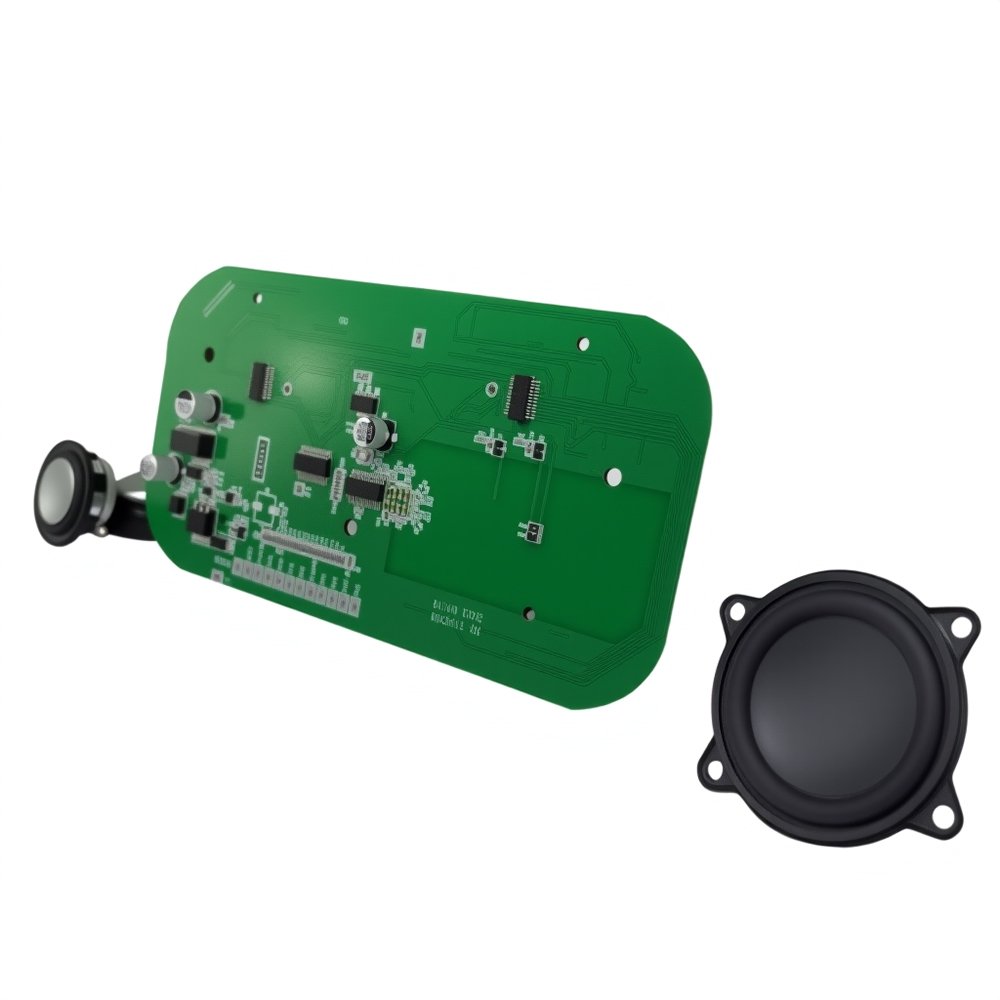
The Convergence of AI and Bluetooth Audio in the Modern IoT Ecosystem
At the heart of this evolution for consumer and enterprise applications is the AI Bluetooth speaker. Once considered merely a conduit for streaming music, the modern AI Bluetooth speaker is a sophisticated edge computing node, a voice-enabled interface, and a data collection hub. For IoT companies, integrating these solutions is no longer a luxury but a strategic imperative. This growth is fueled by advancements in low-power AI chipsets, the proliferation of Bluetooth 5.2/5.3 standards offering enhanced range and audio quality, and the insatiable demand for tight, voice-first user experiences.
The fundamental shift lies in moving intelligence from the cloud to the edge. Early voice assistants relied heavily on cloud servers for processing, causing latency and privacy concerns. Today, on-device AI allows Bluetooth speakers to perform critical tasks like wake-word detection, basic command recognition, and even sound event classification locally. For IoT companies, this means devices that are more responsive, private, and efficient, enabling use cases in remote monitoring, industrial settings, and privacy-sensitive environments like healthcare.
Core AI Capabilities Changing Bluetooth Speaker Functionality
The value proposition of an AI Bluetooth speaker for an IoT company hinges on its embedded intelligence. These are not just speakers with a microphone; they are equipped with a suite of AI-driven capabilities that redefine interaction and functionality.
Advanced Voice Interaction: Beyond simple command-and-control, modern Natural Language Processing (NLP) models on the edge enable more natural, conversational dialogues. Features like voice biometrics allow for multi-user recognition, personalizing responses and access for each family member or employee in a corporate setting. Sentiment analysis can gauge user emotion from vocal tones, enabling customer service bots or caregiving companions to respond with appropriate empathy.
Real-time Adaptive Noise Cancellation (ANC) and beamforming microphones isolate user voice commands even in noisy environments like factories or busy households. More impressively, sound event detection enables the speaker to identify specific audio signatures—a baby crying, glass breaking, machinery emitting an unusual sound, or a smoke alarm beeping.
Predictive Personalization and Automation: By learning user routines and preferences, the AI can anticipate needs. In a smart home ecosystem, a speaker might learn that a user typically turns off lights and adjusts the thermostat after a nightly news podcast, and subsequently automate this sequence. In retail, a speaker in a store can provide personalized promotions based on recognized user profiles and past interactions.
| Feature | Bluetooth 5.0/5.1 | Bluetooth 5.2 | Bluetooth 5.3 |
|---|---|---|---|
| Max Range | Up to 240m (outdoor) | Up to 240m (outdoor) | Up to 240m (outdoor) |
| Audio Focus | Basic Audio Quality | LE Audio, LC3 Codec (Hi-Fi quality at half bitrate) | Enhanced LC3, better audio sync |
| Key IoT Advantage | Improved speed & range for data | LE Audio & Auracast™ (broadcast to unlimited speakers), lower power | Conn. Subrating for better power efficiency in intermittent data |
| Ideal For | General-purpose IoT audio | High-quality multi-speaker sync, public broadcast scenarios | Battery-sensitive, always-listening devices |
Microphone array and far-field performance
Array geometry sets the beam. Two microphones 40-60 mm apart give a usable cardioid above 500 Hz; four in a square or a line give a steerable beam and better rejection of the loudspeaker's output. The spacing must be matched to within 0.2 mm, because a phase error between capsules shifts the beam and reduces the rejection at the design angle.
Strategic Applications and Use Cases Across Industries
For IoT companies, the application of AI Bluetooth speakers extends far beyond the living room. Their combination of audio I/O, local processing, and wireless connectivity makes them versatile platforms.
Smart Home & Residential IoT: This is the most mature market. Here, the speaker acts as the central voice-controlled hub, orchestrating lights, locks, thermostats, and security cameras. AI enhances this by enabling routines based on acoustic events (e.g., “if glass break is detected, turn on all lights, record video, and send an alert”) and providing proactive updates (e.g., “your washing machine has finished its cycle”).
Enterprise & Smart Office: In offices, AI Bluetooth speakers facilitate voice-controlled conferencing, room booking, and information retrieval. They can also monitor ambient conditions like noise levels to optimize workspace utilization and employee well-being. In retail, they function as interactive point-of-sale assistants, in-store navigators, and personalized shopping advisors.
Healthcare & Assisted Living: This is a critical growth area. AI speakers can serve as non-intrusive companions for the elderly, providing medication reminders, facilitating voice calls to family, and detecting falls through sound analysis. Their ability to recognize distress in a voice or detect specific sounds (like a person falling) can trigger immediate alerts to caregivers.
Industrial IoT (IIoT): In manufacturing and logistics, ruggedized AI Bluetooth speakers can provide voice-guided workflows to hands-busy workers, deliver real-time equipment status updates, and log data through voice. The sound event detection capability can be trained to identify predictive maintenance cues, such as the specific sound of a bearing beginning to fail.
Technical Integration and Development Considerations
Integrating an AI Bluetooth speaker solution into an IoT product line requires careful planning.
Hardware Platform Selection: The choice lies between off-the-shelf smart speaker modules from vendors like Qualcomm (QCC series), Actions Semiconductor, or Realtek, and fully custom designs. Key hardware considerations include:
- AI Acceleration: Presence of a dedicated NPU (Neural Processing Unit) or DSP for efficient on-device AI inference.
- Microphone Array Quality: Number and configuration of mics for effective beamforming and noise suppression.
Software & AI Model Development: The core intelligence resides in the software stack. Developers must choose or train machine learning models for wake-word detection, speech recognition, and sound classification. Using vendor SDKs (e.g., TensorFlow Lite for Microcontrollers) and pre-trained models can significantly accelerate time-to-market. The firmware must also handle secure OTA (Over-the-Air) updates to improve AI models and patch vulnerabilities post-deployment.
Interoperability & Ecosystem Strategy: A speaker’s utility is multiplied by its connections. Support for major voice assistants (Amazon Alexa Voice Service, Google Assistant SDK) may be necessary for consumer appeal. For proprietary ecosystems, a well-documented API for third-party device integration is critical.
Addressing Data Security and Privacy by Design
As with any connected device that constantly listens, AI Bluetooth speakers are under intense scrutiny regarding privacy and data security. IoT companies must build “Privacy by Design” into their solutions from the ground up. This involves implementing strong hardware security features like secure boot and trusted execution environments. Data minimization principles should be enforced—processing audio locally whenever possible and only sending encrypted data to the cloud when necessary for complex queries. Clear user consent mechanisms and transparent data policies are non-negotiable for building trust. Features like a physical mute switch and visible LED indicators for when the microphone is active are now expected by informed consumers and are often required by regulatory frameworks.
The Future Trajectory and Strategic Recommendations
The future of AI Bluetooth speakers in IoT is pointed towards greater autonomy, collaboration, and ambient intelligence. We will see the rise of swarm intelligence , where multiple speakers in an environment collaborate to better understand context and locate users. Integration with other sensors (temperature, humidity, motion) on a single board will create more holistic environmental awareness.
For IoT companies looking to integrate this technology, the path forward is clear:
- Start with the Use Case: Define the specific problem the AI speaker will solve. Is it hands-free control, environmental monitoring, or user companionship?
- Prioritize Privacy & Security: Make these your unique selling proposition, not an afterthought.
- Choose the Right Level of Integration: Decide between a modular approach using certified hardware/software stacks or a custom build for maximum differentiation.
- Plan for Interoperability: Design for the open ecosystem (Matter, etc.) while creating value within your own branded ecosystem.
By strategically implementing AI Bluetooth speaker solutions, IoT companies can create more intuitive, helpful, and contextually aware products, securing a competitive edge in an increasingly intelligent and connected world.
Echo cancellation, noise suppression and privacy
Echo cancellation needs a reference of what the speaker is playing. Take the reference from the amplifier input, not from the microphone, and align it in time to within one sample; a 1 ms misalignment reduces the cancellation by 10-15 dB. The result should be measured as echo return loss enhancement at several volumes, not asserted.
FAQ
How many microphones does an AI speaker need?
Two are enough for a near-field product; four to six are typical for a 5 m far-field device that must reject its own output. The geometry and the port design matter more than the count.
What SNR should the microphones have?
65-70 dB for a far-field array, with an acoustic overload point above 120 dB SPL so that the capsule does not clip when the speaker is playing.
Can wake-word detection run on the main processor?
It can, but the standby power is 10-50 times higher. A dedicated low-power DSP that wakes the SoC keeps standby in the milliwatt range, which matters for battery products.
Related reading
- Premium Bluetooth Speaker Manufacturing Standards
- How to Start Your Own Bluetooth Speaker Brand
- Bluetooth Speaker Market Trends 2026
More on Bluetooth Audio.
