
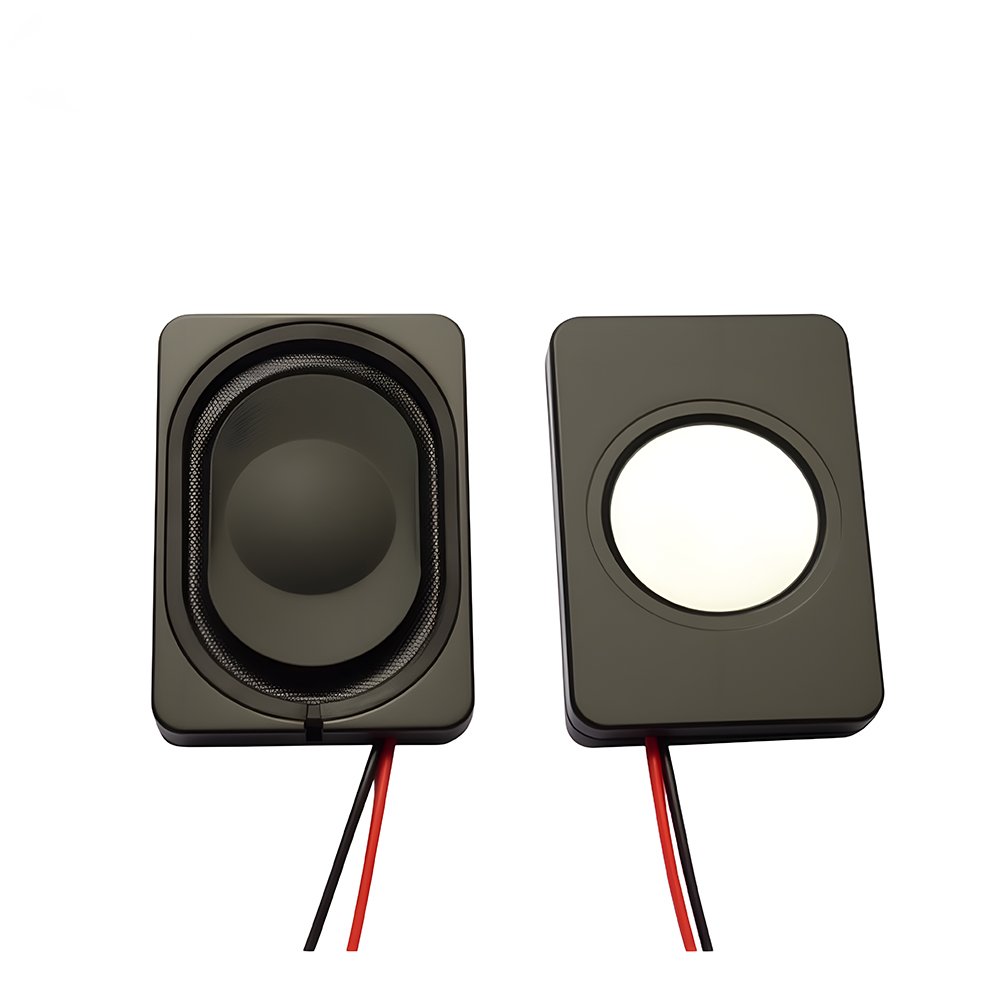
In a micro speaker the rear cavity, not the driver, sets the low-frequency limit. A 20 mm unit is typically tuned so that the sealed back volume behind the diaphragm lifts output between 400 and 900 Hz; enlarging that cavity by 0.3 cm3 flattens the hump but costs 2-3 dB of sensitivity above 1 kHz. The housing drawing is therefore part of the acoustic design, not a packaging detail.
The notes below apply to portable speaker design trends, with the measurement conditions and production checks that decide whether a claimed figure survives a shipment.
The Ascendancy of Sustainable & Durable Materials
The modern consumer is increasingly environmentally conscious, driving a significant shift toward sustainable design. Manufacturers are responding by innovating with new materials that reduce environmental impact without compromising durability or sound quality.
A primary focus is on replacing virgin plastics. We now see widespread use of post-consumer recycled (PCR) plastics in speaker casings and components. Brands like House of Marley and Sonos prominently feature this, often combining PCR plastics with natural fabrics like hemp or organic cotton for grilles.
For true premium segments, materials like recycled aluminum and FSC-certified wood are becoming hallmarks of quality. Aluminum offers excellent rigidity for reduced cabinet resonance, while sustainably sourced wood provides a warm, natural aesthetic and can influence acoustic tuning.
This sustainability drive is intrinsically linked to the demand for extreme durability. The IP (Ingress Protection) rating has become a critical specification, with IP67 (dust-tight and immersible up to 1m) now a common benchmark for outdoor speakers.
| Material | Common Application | Key Benefit | Example Brands Using |
|---|---|---|---|
| Post-Consumer Recycled (PCR) Plastic | Main casing, buttons | Reduces landfill waste, lowers carbon footprint | Sonos, House of Marley, Ultimate Ears |
| Ocean-Bound Recycled Plastic | Outer body, durable components | Cleans waterways, creates durable housing | JBL, Sony |
| Recycled Aluminum | Speaker grilles, chassis, accents | Premium feel, excellent heat dissipation, high rigidity | Bang & Olufsen, Bose |
| Organic/Fabric Blends (Hemp, Cotton) | Speaker grille cover | Biodegradable options, unique texture, good acoustic transparency | House of Marley, Braven |
| Bio-Based Polymers | Partial casing components | Derived from renewable sources like castor oil | WSAudiology (research phase) |
Miniaturization & Acoustic Engineering Breakthroughs
The relentless pursuit of “bigger sound from a smaller box” continues to be the holy grail of portable speaker design. This is being achieved through sophisticated acoustic engineering and component innovation.
Neodymium magnets remain standard for their high strength-to-size ratio, allowing for smaller, more powerful drivers. The real advancements, however, lie in passive radiator technology. Modern speakers utilize multiple, strategically tuned passive radiators that work in concert with active drivers. This design excites more air inside a compact enclosure, dramatically enhancing bass response and overall sound pressure level (SPL) without needing larger drivers or more power.
Computational modeling and Finite Element Analysis (FEA) allow engineers to simulate sound waves within a speaker’s internal chamber before a physical prototype is built. This optimizes the internal volume and porting (if any) to minimize distortion and tune the frequency response for a specific, pleasing sound signature.
In practice, the proliferation of multi-driver arrays in portable form factors is notable. We now see compact speakers housing separate tweeters and mid-woofers, or even coaxial drivers, paired with dedicated digital signal processing (DSP) chips. This DSP performs real-time audio tuning, adjusting for volume level, compensating for physical limitations, and even optimizing sound based on the speaker’s orientation (e.g., horizontal vs. vertical).
Mounting and sealing inside a moulding
Mounting bosses transfer vibration into the housing. A soft gasket under the frame decouples the driver above 200 Hz, and a rigid boss pattern keeps the frame flat within 0.1 mm. Both are checked on the first article with a feeler gauge and a sweep in the final housing, not on a bare driver in free air.
Tight Integration of Smart Features & Ecosystem Connectivity
A portable speaker is no longer an isolated device. It is a node in a user’s personal audio ecosystem and smart home. Bluetooth 5.3 is now table stakes, offering more stable connections, lower latency (critical for video sync), and improved power efficiency. However, the trend extends far beyond basic pairing.
The integration of voice assistants (Google Assistant, Amazon Alexa, and to a lesser extent, Siri via AirPlay 2) directly into portable speakers is commonplace. This allows for hands-free control of music, smart home devices, and queries, changing the speaker into a portable command center.
Users expect to group a portable speaker with their fixed home audio system effortlessly or pair two portable units for a stereo or party mode. The ease of this ecosystem lock-in is a major purchasing driver.
Emerging connectivity trends include Bluetooth Auracast , a new broadcast capability that promises to allow a single audio source to stream to an unlimited number of nearby speakers—a potential step change for social gatherings and public spaces. In practice, ultra-wideband (UWB) technology is being explored for “contextual awareness,” where a speaker could automatically adjust its sound profile or playlist as a user carrying a UWB-enabled phone moves from room to room.
Bold Aesthetics & Personalization
Design is now a primary differentiator. The utilitarian gray or black plastic blob is largely passé. Current trends favor bold colors, textured finishes, and unconventional forms . Brands like Ultimate Ears with their Boom & Megaboom series set the stage with vibrant, playful designs. Today, we see a spectrum from the minimalist, fabric-wrapped cylinders of Sonos to the angular, architectural designs of Bang & Olufsen and the rugged, industrial aesthetic of Goal Zero’s Yeti speakers.
Customization is a growing sub-trend. Some brands offer services to print custom graphics or choose from a wide palette of colors and materials. Modularity is another facet, with speakers offering optional accessories like interchangeable grilles, straps, or mounts that change their look and functionality.
The visual design also serves acoustic and functional purposes. 360-degree sound dispersion, often achieved through cylindrical shapes or strategic driver placement, dictates many forms. Integrated handles, carabiner clips, and built-in stands are being designed as organic parts of the visual language, not afterthoughts.
Power Management & The "Untethered" Experience
True portability hinges on freedom from the power outlet. Battery technology and power management are thus critical design frontiers. Lithium-ion packs remain standard, but energy density is gradually improving. The more significant innovations are in software and system efficiency.
Advanced DSP and amplifier efficiency ensure every milliwatt of power is used effectively to produce sound, not wasted as heat. Features like adaptive battery management can extend lifespan by learning usage patterns and optimizing charge cycles.
A major trend is the integration of solar charging capability , particularly in speakers designed for extended outdoor adventures. Brands like Eton and Goal Zero lead here, incorporating high-efficiency photovoltaic panels directly into the speaker’s body or offering it as an accessory.
In practice, portable speakers are increasingly doubling as power banks . Having a USB-C or even wireless Qi pad on the speaker to charge a phone or other devices is a highly valued utility feature, making the speaker a central hub for all “off-grid” power needs.
Cavity, gasket and the low end
Measure the back cavity by filling the assembled part with glass beads or by casting the volume, not by multiplying wall dimensions. Ribs, bosses and the magnet cut-out remove 15-30 % of the nominal space, and that difference moves the tuning by more than the tolerance on the driver itself. Send the housing model with the driver drawing and the tuning is confirmed before tooling.
FAQ
Why does a micro speaker sound thin in a plastic housing?
The back cavity is usually smaller than the free-air condition the datasheet assumes, and the housing leaks at the frame or the port. Measure the assembled response, then adjust cavity volume and gasket compression rather than the driver.
How much power can a 20 mm speaker take?
Typically 0.5-1 W continuous and 2-3 W short-term in a sealed module; the limit is coil temperature, which depends on the housing's thermal path, not only on the driver.
Is a passive radiator worth it in a wearable?
Only if the enclosure has room for the radiator's compliance and the extra height. It extends output one octave lower than a sealed back cavity but adds a second moving part that can rattle if the clearance is under 0.3 mm.
Related reading
- Top 5 Speaker Design Trends for Minimalist Interiors
- Small Speaker Acoustic Design Principles
- High Audio Frequency Speaker Design Guide
More on Speaker Design.
