
The arithmetic behind the label is simple. At 2.83 V RMS an 8 ohm load draws 0.35 A and dissipates 1 W, while a 4 ohm load draws 0.71 A and dissipates 2 W. That doubling of current, not the number printed on the terminal, is why a 4 ohm design needs a different supply, a different protection threshold and often a different output device.
With speaker impedance affects sound quality, the difference between a sample and a shipment is the test record, so each section below names the check that produces it.
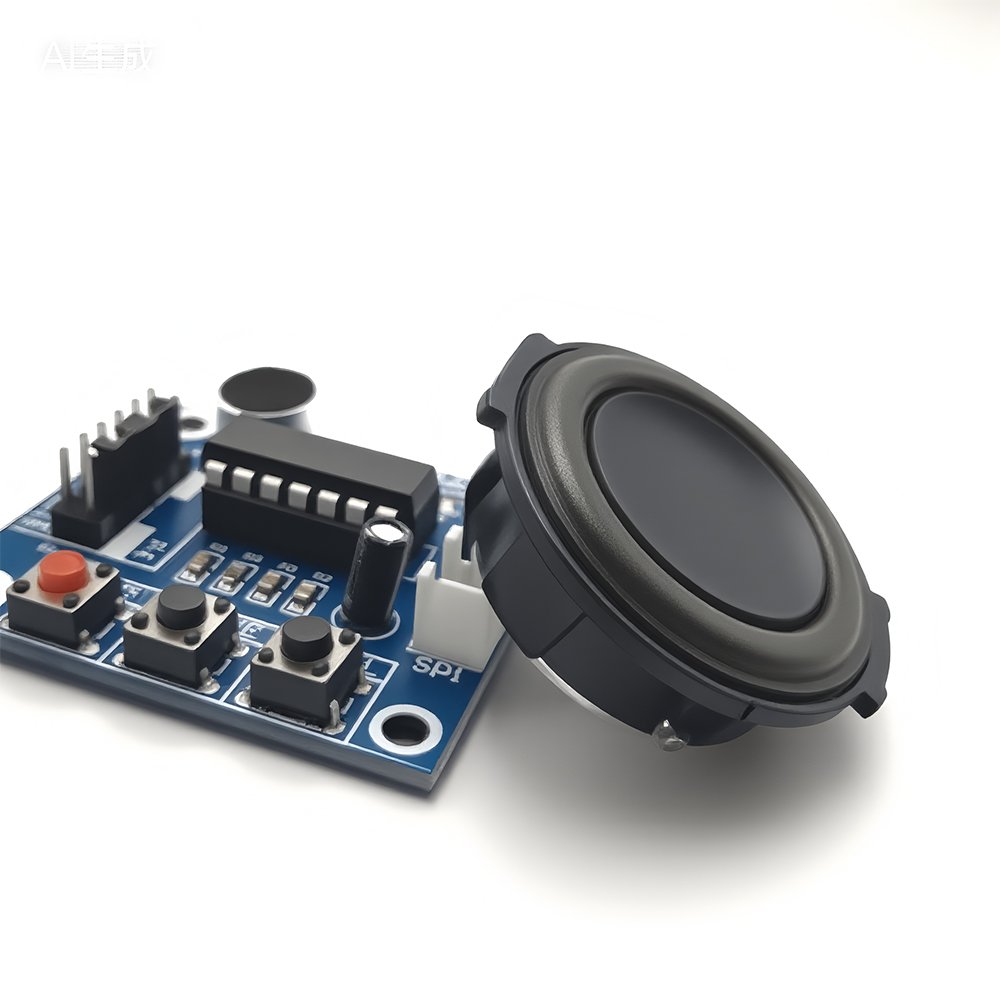
Understanding the Basics: What is Speaker Impedance?
Speaker impedance, measured in ohms (Ω), is one of the most fundamental yet misunderstood specifications in audio. At its core, impedance represents the total opposition a speaker presents to the alternating current (AC) supplied by an amplifier. It’s not a simple fixed resistance like in a direct current (DC) circuit but a complex combination of DC resistance (Re), inductive reactance (from the voice coil), and capacitive reactance (influenced by the driver’s design and crossover).
The nominal impedance you see on a speaker’s label—typically 4Ω, 6Ω, or 8Ω—is a simplified average. A typical 8Ω bookshelf speaker might dip to 5Ω at its bass resonance, soar to 20Ω or higher in the midrange, and present a different load entirely in the treble. This dynamic nature is where the interaction with your amplifier begins and where sound quality can be won or lost.
The creation of this impedance curve is a dance of physics. The voice coil’s inductance causes impedance to rise with frequency. The driver’s mechanical resonance in the bass causes a significant peak. The crossover network—the circuit that divides frequencies between drivers—introduces its own complex impedance interactions.
The Critical Partnership: Impedance and Amplifier Interaction
A speaker doesn’t exist in isolation; it forms a circuit with your amplifier. Most amplifiers are designed as voltage sources, meaning they try to deliver a constant voltage regardless of load. This simple relationship has profound implications.
When a speaker’s impedance dips to a low value—a common scenario with complex crossovers or multiple drivers—the amplifier must deliver significantly more current to maintain the same output voltage. If the amplifier’s power supply or output stage cannot sustain this current, it leads to current clipping . This isn’t the typical voltage clipping (flat, distorted waveform) but a compressed, dynamically lifeless sound, often with increased harmonic distortion in the mid-bass, where many impedance dips occur.
The damping factor, derived from the amplifier’s output impedance and the speaker’s impedance, is another critical interaction. A high damping factor (low amplifier output impedance relative to speaker impedance) gives the amplifier greater control over the speaker driver, especially the bass. It acts as an electromagnetic brake, reducing unwanted cone movement after the signal stops. This typically results in tighter, more articulate bass. However, some argue an excessively high damping factor can lead to an overdamped, “sterile” sound, which is why some tube amplifiers (with higher output impedance) are prized for their “loose” but musically pleasing bass character.
Table 1: Amplifier Output Power vs. Speaker Impedance (for a hypothetical high-current 100W @ 8Ω amplifier)
| Speaker Nominal Impedance | Theoretical Max Continuous Power | Key Amplifier Demand | Typical Sound Characteristic with Adequate Amplification |
|---|---|---|---|
| 8Ω | 100 Watts | Higher Voltage, Lower Current | Stable, controlled, often with highest damping factor. |
| 4Ω | ~180-200 Watts | High Current Capability | Potentially more dynamic bass; stresses weak amplifiers. |
| 6Ω | ~130-150 Watts | Balanced Demand | A common "safe" compromise for mid-range AV receivers. |
Wiring, damping and protection
Protection has to act before the output stage latches. DC offset detection, over-current limiting and a thermal fold-back that reduces gain rather than cutting the output are the three functions that matter in a powered speaker. A limiter threshold set 3 dB above the rated power protects the driver without audible pumping on music, which has a crest factor of 10-14 dB above its average level.
The Direct Path to Your Ears: How Impedance Influences Sound Quality
The technical interactions between impedance and amplifier manifest in clearly audible ways. The most direct impact is on frequency response . Because a speaker’s impedance varies with frequency, and many amplifiers have a non-zero output impedance, the resulting voltage delivered to the driver is not flat. This is called frequency-dependent damping . For example, an impedance peak in the upper bass/lower midrange might receive less power from a tube amp, creating a perceived warmth or softness. A solid-state amp with very low output impedance will minimize this effect, striving for a more accurate response.
Distortion is heavily influenced by the impedance load. When an amplifier is asked for current it cannot provide, distortion rises sharply. This often happens precisely at the frequencies where impedance is lowest (e.g., 200-500Hz), adding grunge and congestion to vocals and fundamental instruments. A poorly designed crossover can have its carefully tuned frequency response and driver blending completely altered by the amplifier’s output impedance, leading to tonal imbalances and phase issues.
Bass performance and transient response are perhaps the most noticeable areas. A speaker with a severe impedance dip in the bass (common in ported designs at tuning frequency) can suck an underpowered amplifier into current limitation, causing flabby, one-note bass. Conversely, a stable, high-current amplifier will maintain control. Transients—the sharp, leading edges of sounds like drum strikes—require massive instantaneous current. A high-impedance speaker (e.g., 16Ω) demands less current for these transients, which can be easier for some amplifiers to deliver cleanly, potentially improving dynamic “snap.”
Navigating the Real World: Measurements, Matching, and Myths
For the critical listener, understanding impedance means going beyond the nominal rating. A savvy approach involves:
- Consulting Impedance Curves: Reviews from sources like Stereophile or Audio Science Review often publish measured impedance curves. A relatively flat curve, even at a lower nominal impedance (like 4Ω), is often easier for an amplifier to drive than an 8Ω speaker with wild swings down to 3Ω.
- Amplifier Specifications: Pay attention to an amplifier’s power rating into both 8Ω and 4Ω loads. A high-quality, high-current design will typically double or nearly double its power as impedance halves (e.g., 100W @ 8Ω → 180W+ @ 4Ω). An amplifier that only increases power by 25-50% likely has a weaker power supply.
- The “Easy to Drive” Myth: An “8Ω compatible” speaker is not necessarily easy to drive. Many classic, high-sensitivity 8Ω speakers from the 70s and 80s have benign, high impedance curves. Many modern “8Ω” speakers, however, are designed for complex, multi-driver arrays and can have punishingly low impedance dips.
Bi-wiring and Impedance: A practical note on bi-wiring: while its sonic benefits are debated, electrically, bi-wiring can slightly alter the impedance presented to the amplifier at the crossover region by separating the return paths for the woofer and tweeter. The effect is usually minor, but it underscores how every connection in the chain matters.
The Wire Gauge Factor: Speaker cable resistance is in series with the amplifier’s output impedance. Using thin, long cables adds resistance, effectively raising the output impedance seen by the speaker. This can dull dynamics and exacerbate frequency response variations. For low-impedance speakers, use thicker gauge wire (e.g., 12AWG or lower) for runs over 10-15 feet.
What the nominal figure hides
A published impedance curve is the only reliable document for matching. Read the minimum between 150 and 400 Hz first, because that is where a vented box unloads the driver and where the amplifier sees its worst case; then read the rise at resonance to see how much of the band is above nominal. A 4 ohm driver with a 3.2 ohm minimum is normal, but the amplifier rating must be quoted at 4 ohm, not at 8 ohm with a note.
FAQ
Is a 4 ohm speaker louder than an 8 ohm speaker?
At the same drive voltage it produces about 3 dB more acoustic output, because it draws twice the power. At the same input power the two are equal; sensitivity, not impedance, sets the level.
Can I connect a 4 ohm speaker to an 8 ohm rated amplifier?
Only if the amplifier's datasheet also states a 4 ohm rating. An 8 ohm-only design may overheat or trip its protection at high level; check the minimum-load specification and the thermal test condition, not the marketing wattage.
Does a higher impedance mean better sound quality?
No. Impedance changes the current the amplifier must deliver; sound quality depends on the motor, diaphragm, crossover and the enclosure. A well-designed 4 ohm system and a well-designed 8 ohm system can measure identically.
Related reading
- How We Ensure Speaker Quality Control
- Why Micro-Manufacturing Precision is Key for Small Speaker Quality
- A Guide to Selecting High-Quality LED Light Speaker Suppliers in China
More on Audio Testing.
