
An AI speaker is defined by its microphone path, not by its loudspeaker. The array has to hear a wake word at 5 m in a room with a television playing, which means 65-70 dB SNR capsules, an acoustic overload point above 120 dB SPL, and beamforming that rejects the loudspeaker's own output by 20-30 dB.
With smart device audio module supplier, the difference between a sample and a shipment is the test record, so each section below names the check that produces it.
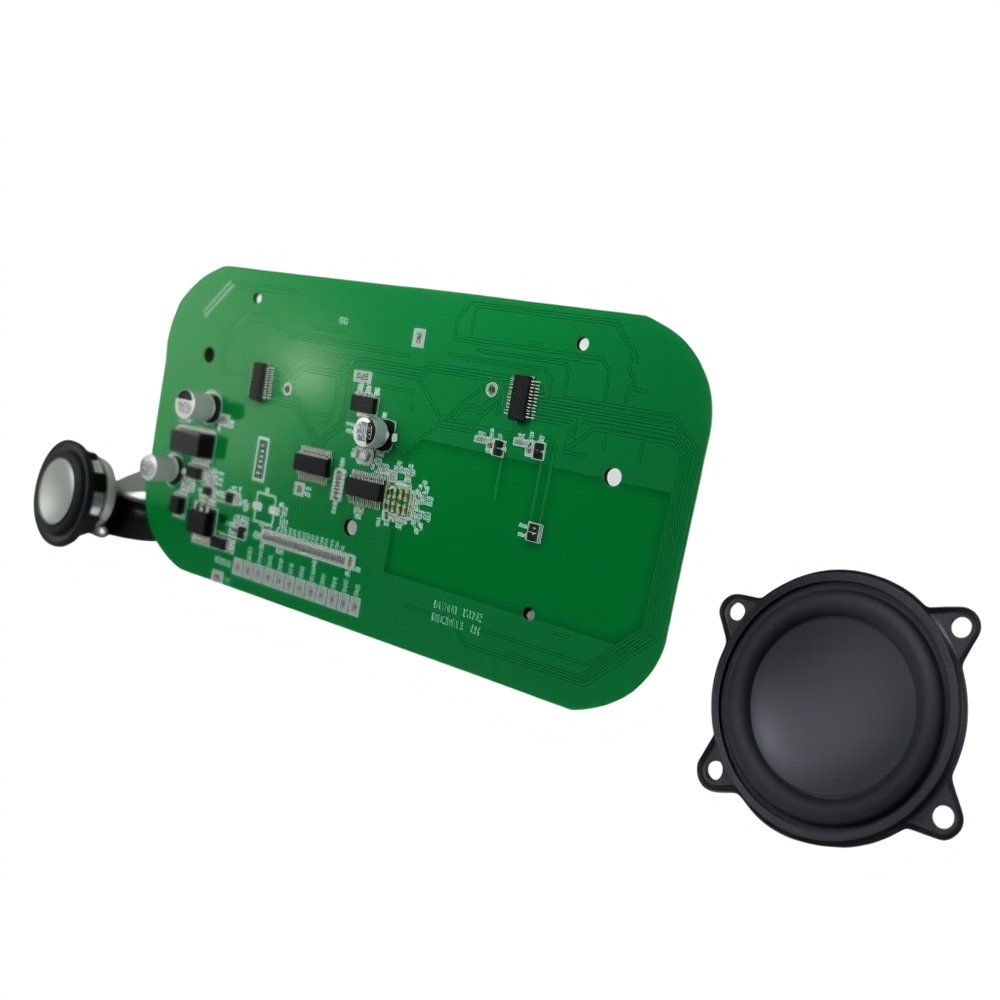
Key Considerations in Selecting Your Audio Partner
Choosing a supplier transcends a simple component procurement exercise; it is about forming a strategic partnership for the lifecycle of your product. The first and most fundamental consideration is audio quality and performance specifications . This goes beyond basic frequency response and includes critical parameters for smart devices: Signal-to-Noise Ratio (SNR) , which dictates the clarity of wanted sound against the electronic noise floor (aim for >95dB for high-end products); Total Harmonic Distortion (THD) , measuring signal purity; and acoustic echo cancellation (AEC) & beamforming algorithm efficacy , which are the deciding factor for reliable far-field voice pickup in noisy environments.
Secondly, evaluate the integration and development support ecosystem . The best audio module is useless if your team cannot integrate it. Assess the supplier’s software development kits (SDKs), availability of APIs, and the quality of their reference designs and documentation. Do they offer turnkey solutions with pre-certified modules (e.g., FCC, CE, Bluetooth SIG)? For instance, a supplier providing a complete “voice front-end” module with integrated DSP and algorithms can slash months off your development timeline.
Finally, conduct a rigorous supply chain and business viability analysis . In a post-pandemic world, resilience is key. Investigate the supplier’s manufacturing footprint, secondary sourcing options for key ICs, and their historical on-time delivery performance. Utilize tools like Bloomberg, S&P Capital IQ, or even recent market reports from Yole Développement or SAR Insight & Consulting to gauge their market position. A supplier heavily reliant on a single fab or geopolitically sensitive region introduces inherent risk.
Deep Dive: Core Technologies Shaping Audio Modules
The heart of the module is the audio processing chain . Modern modules use sophisticated Digital Signal Processors (DSPs) or dedicated audio cores within System-on-Chips (SoCs) to run algorithms for noise suppression, echo cancellation, and wake-word detection. The shift from cloud-based to on-device AI processing is significant. Suppliers like Syntiant or Ambarella are pushing neural network accelerators directly onto the audio chip, enabling always-listening functionality with ultra-low power consumption—a critical factor for battery-operated devices.
Connectivity and standards compliance form the next layer. While Wi-Fi and Bluetooth are ubiquitous, the implementation matters. Bluetooth LE Audio with the LC3 codec , finalized in 2022, is a step change, offering higher quality audio at half the bitrate, enabling multi-stream audio, and enhancing hearing aid compatibility. A forward-looking supplier should have modules sampling with LE Audio support. For whole-home audio, standards like Chromecast Built-in, Apple AirPlay 2, or Spotify Connect require specific certification and hardware integration, often locking you into a supplier’s ecosystem.
Microphone technology is the frontline sensor. The choice between Analog MEMS (Micro-Electro-Mechanical Systems) and Digital MEMS microphones involves trade-offs in noise immunity, power, and system design. More importantly, the microphone array topology —the number and physical arrangement of mics—directly enables beamforming. A supplier’s expertise in optimizing array geometry (linear, circular, distributed) and providing the matching algorithms is a key differentiator. The table below contrasts common approaches:
| Technology Aspect | Traditional Approach | Advanced/Modern Approach | Impact on Product Design |
|---|---|---|---|
| Wake-Word Processing | Cloud-dependent, higher latency, constant network drain. | On-device AI/Neural Processing (e.g., Tensilica HiFi DSP, dedicated NPU). | Enables instantaneous response, enhances privacy, drastically reduces power consumption. |
| Audio Codec (Bluetooth) | Classic Audio: SBC, AAC (higher power, lower efficiency). | LE Audio with LC3 codec (standardized 2022). | Delivers higher quality at lower bitrates (~50% saving), enables multi-stream audio, extends battery life. |
| Microphone Array | Basic 2- or 3-mic linear arrays with generic beamforming. | 4+ mic circular/3D arrays with AI-driven adaptive beamforming and noise isolation. | Superior far-field pickup in noisy, reverberant environments (e.g., smart displays in kitchens). |
| Spatial Audio | Basic virtual stereo or fixed HRTF profiles. | Dynamic head-tracking with gyroscope data integration , personalized HRTF. | Creates authentic, immersive experiences for AR/VR, gaming headsets, and personal audio. |
Microphone array and far-field performance
The port and the gasket decide whether the array works in the housing. A 0.5 mm port in front of a 4 mm capsule forms a Helmholtz resonator around 8-10 kHz; the port depth and the front cavity volume are tuned together, and a sealed rear volume is required or the capsule's low-frequency response collapses. Measure the array in the final housing, not on a breakout board.
The Supplier Ecosystem: Leaders, Challengers, and Specialists
Tier 1: Integrated Semiconductor Giants. Companies like Qualcomm (with its QCC series) , Cirrus Logic , Texas Instruments , and Realtek dominate. Their strength lies in high-volume, highly integrated SoCs that combine audio DSP, application CPU, and connectivity (Bluetooth/Wi-Fi combo). They offer extensive software suites (e.g., Qualcomm’s Voice UI Development Suite) and are the go-to for flagship smart speakers, premium earbuds, and automotive infotainment. Partnering with them provides scalability and a proven track record but may offer less customization for niche applications.
Tier 2: Specialized Audio & Module Providers. This group includes pure-play audio specialists like Knowles (MEMS mics and audio solutions) and DSP Group , as well as module makers like USI , Quectel , and Lingsen . These suppliers can be more flexible and offer superior technical support for specific, demanding audio applications in industrial or medical IoT.
This is where much of the disruptive innovation occurs. Startups like Audio Analytic (now part of Arm) pioneered AI-based sound recognition software. Sonical is developing the computationally audacious Cinemersive platform for earbuds. These firms often don’t manufacture hardware but license their software or IP to chipmakers and module suppliers.
A Practical Supplier Evaluation and Procurement Checklist
Before initiating RFQ (Request for Quotation) processes, systematize your evaluation. This checklist can serve as a foundational template:
- Technical & Performance Due Diligence:
- Obtain and validate full audio performance test reports (IEC/ANSI standards).
- Request benchmark data for key algorithms (AEC, NS) in realistic, noisy environment simulations.
- Evaluate the module’s power consumption profile in all operational states (sleep, wake-word listening, active streaming).
- Audit the software SDK for clarity, modularity, and update frequency.
- Scrutinize the Bill of Materials (BOM) for single-source or long-lead-time components.
- Analyze total cost of ownership, including NRE (Non-Recurring Engineering) fees, royalty structures, and minimum order quantities (MOQs).
- Require a detailed multi-year product longevity and obsolescence roadmap.
- Verify environmental and industry-specific certifications (RoHS, REACH, IPC standards).
- Request case studies or references from clients with similar scale and technical challenges.
- Define clear escalation paths and local FAE (Field Application Engineer) support availability.
- Discuss joint roadmapping possibilities and their process for integrating customer feedback.
Future Trends: What’s Next for Smart Device Audio?
The trajectory points towards more intelligent, contextual, and immersive experiences. AI/ML integration will move beyond wake-words to full on-device conversational AI and context-aware audio adjustment (e.g., a module that automatically adjusts EQ based on the acoustic environment or user activity). Ultrasound sensing capabilities embedded in audio modules will enable proximity detection, gesture control, and even necessary sign monitoring, changing speakers and earbuds into true health and ambient intelligence sensors.
Using head-tracking and individualized Head-Related Transfer Function (HRTF) profiles, audio modules will create precise, 3D soundscapes for metaverse applications and advanced gaming. Sustainability is also becoming a key differentiator; suppliers will be evaluated on their use of recycled materials, energy-efficient designs, and repairability of modules. The winning suppliers of 2025 and beyond will be those who master the convergence of ultra-low-power silicon, sophisticated AI algorithms, and durable, developer-friendly software platforms.
Echo cancellation, noise suppression and privacy
Echo cancellation needs a reference of what the speaker is playing. Take the reference from the amplifier input, not from the microphone, and align it in time to within one sample; a 1 ms misalignment reduces the cancellation by 10-15 dB. The result should be measured as echo return loss enhancement at several volumes, not asserted.
FAQ
How many microphones does an AI speaker need?
Two are enough for a near-field product; four to six are typical for a 5 m far-field device that must reject its own output. The geometry and the port design matter more than the count.
What SNR should the microphones have?
65-70 dB for a far-field array, with an acoustic overload point above 120 dB SPL so that the capsule does not clip when the speaker is playing.
Can wake-word detection run on the main processor?
It can, but the standby power is 10-50 times higher. A dedicated low-power DSP that wakes the SoC keeps standby in the milliwatt range, which matters for battery products.
Related reading
- Future of Smart Audio Devices
- Innovation in Wireless Audio Products
- Top Emerging Markets for Smart AI Speaker Exports
More on Bluetooth Audio.
