
In the fast-paced world of audio hardware, the journey from concept to finished speaker product hinges on one critical metric: lead time. For brands, startups, and companies leveraging Original Equipment Manufacturer (OEM) partnerships, mastering the complexities of production timelines is not just about planning—it’s about competitive advantage, market responsiveness, and cost efficiency. This deep-dive analysis explores the multifaceted nature of lead times in speaker OEM production, providing data-driven insights and actionable strategies for 2024 and beyond.
Understanding the Components of Speaker OEM Lead Time
Lead time in OEM production is the total duration from order confirmation to final delivery of ready-to-ship products. It is not a single interval but a cascade of interconnected phases, each with its own variables and potential bottlenecks.
Pre-Production Phase (4-10 Weeks): This foundational stage often dictates the stability of the entire timeline. It encompasses finalizing design specifications, approving acoustic prototypes (often requiring multiple iterations), and sourcing all components. A critical sub-phase is the Tooling and Mold Development for custom speaker drivers, enclosures, and grilles. For injection-molded plastic or composite cabinets, creating high-precision molds alone can take 5-8 weeks. Concurrently, the Component Sourcing process begins. Key components like dynamic drivers, amplifier modules, DSP chips, and specialized connectors are often subject to global supply chain dynamics. In 2024, while some semiconductor shortages have eased, procurement for specific, high-performance audio DSPs and Class-D amplifier ICs can still see extended waits of 8-12 weeks.
Production and Assembly Phase (3-6 Weeks): Upon receipt of all components and approval of pre-production samples, mass production commences. This phase involves:
- Driver Manufacturing: Coiling voice coils, assembling magnets and baskets, and integrating cones/surrounds.
- Enclosure Fabrication: Cutting, molding, finishing, and painting of cabinets.
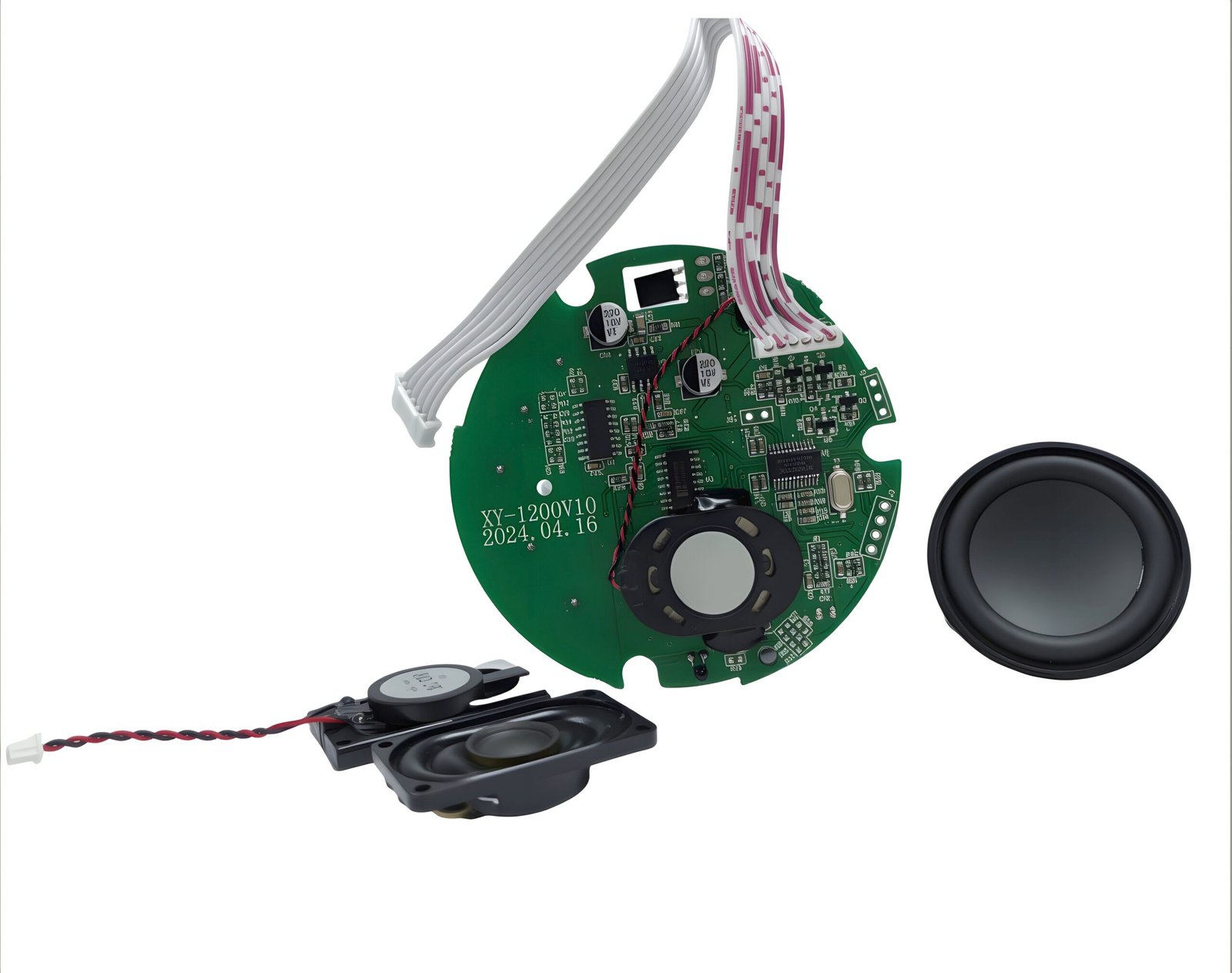
- PCB Assembly (PCBA): Populating and soldering amplifier and control boards, often using SMT (Surface-Mount Technology) lines.
- Final Assembly and Calibration: Integrating all sub-assemblies, conducting basic functional tests, and performing acoustic tuning or DSP profile loading.
Post-Production Phase (2-4 Weeks): This includes comprehensive quality assurance (QA) testing, branding/packaging, and logistics. Rigorous QA involves frequency response tests, distortion analysis, and stress testing, with a standard AQL (Acceptable Quality Level) of 1.5% for consumer electronics. Finally, Shipping and Customs Clearance add variable time. Sea freight from major manufacturing hubs in Asia to North America or Europe typically takes 4-5 weeks, while air freight reduces transit to 5-7 days at a significantly higher cost.
Table: Representative Lead Time Breakdown for a Mid-Fidelity Bluetooth Speaker (Order Qty: 5,000 Units)
| Phase | Sub-Phase | Estimated Duration (Weeks) | Key Dependencies |
| :— | :— | :— | :— |
| Pre-Production | Design Finalization & Prototyping | 2-4 | Client feedback speed, acoustic goals |
| | Tooling Creation | 5-8 | Complexity of enclosure design |
| | Component Sourcing & Procurement | 6-10 | Driver custom specs, IC availability |
| Production | Pilot Run & Sample Approval | 2 | Quality of initial samples |
| | Mass Production & Assembly | 3-5 | Factory capacity, workforce availability |
| Post-Production | QA/QC & Certification | 1-2 | Defect rate, compliance standards (FCC, CE) |
| | Packaging & Logistics | 2-4 | Shipping method, port congestion |
| | TOTAL ESTIMATED LEAD TIME | 21 – 43 Weeks | |
Key Factors Influencing and Disrupting Production Timelines in 2024
The baseline lead time can be dramatically extended by a confluence of internal and external factors. Proactive brands must account for these variables in their go-to-market strategy.
Supply Chain Volatility: Real-time data from global logistics platforms like Flexport indicates that while container shipping rates have stabilized from pandemic peaks, geopolitical tensions and climate-related port closures (e.g., in Southeast Asia) introduce sporadic delays. More critically, the sourcing of specialized audio components remains a pinch point. According to industry analyses from Supply Chain Dive, lead times for certain multilayer ceramic capacitors (MLCCs) and amplifier ICs, while improved, are still 20-30% longer than pre-pandemic benchmarks.
Design Complexity and Customization: A standard, off-the-shelf driver in a rectangular MDF box will have a shorter lead time than a product requiring:
- Custom Driver Design: Neodymium magnet arrays, non-standard diaphragm materials (e.g., beryllium, cellulose), or coaxial designs.
- Complex Enclosure Geometry: Curved cabinets, unusual porting (e.g., labyrinth designs), or multi-material construction (wood, metal, fabric).
- Advanced Software Integration: Proprietary app control, multi-room audio protocols (like Chromecast or AirPlay 2 certification), and adaptive sound algorithms.
Regulatory Compliance and Testing: Each target market has mandatory certifications. FCC (USA), CE/UKCA (Europe), ISED (Canada), and others require rigorous testing for electromagnetic compatibility and safety. Unforeseen failures in compliance testing can trigger design revisions, adding weeks to the timeline. The rise of sustainability directives, like the EU’s proposed Ecodesign for Sustainable Products Regulation (ESPR), may soon require deeper material disclosures, impacting pre-production.
OEM Partner Capacity and Expertise: Not all OEMs are equal. A factory’s existing order book, its vertical integration (e.g., in-house vs. outsourced driver production), and its experience with similar product categories significantly affect efficiency. A partner experienced in waterproof portable speakers may struggle with the precision required for high-end bookshelf monitors.
Strategies for Optimizing and Managing Lead Time Effectively
Mitigating lead time risks requires a strategic, collaborative approach with your OEM partner.
Adopt Digital Prototyping and DFM: Leverage 3D modeling and finite element analysis (FEA) for acoustic simulation to minimize physical prototype iterations. Implement Design for Manufacturability (DFM) reviews early, where the factory engineers provide input to simplify assembly, reduce part count, and standardize components.
Strategic Sourcing and Inventory Hedging: Work with your OEM to dual-source critical components like amplifier chips or wireless modules where possible. For established products, consider a managed inventory program where the OEM holds a safety stock of long-lead items against your forecast, often through a consignment agreement.
Phased Ordering and Modular Design: Instead of a single, massive order, explore phased rolling forecasts that allow the factory to plan capacity. Employ a modular product architecture, where a core platform can be configured with different drivers or finishes, allowing for more flexible production scheduling.
Transparent Communication and Joint Planning: Establish a shared project management platform (e.g., using Asana, Jira, or the OEM’s proprietary system) for real-time tracking. Schedule regular cross-functional syncs involving your engineering, procurement, and the OEM’s project management team.
The Future of Lead Times: Automation, Nearshoring, and AI
Looking ahead, several trends are poised to reshape lead time dynamics:
- Advanced Automation: Increased use of AI-driven visual inspection and robotic assembly in speaker factories reduces human error and speeds up production cycles, potentially shrinking the assembly phase by 15-25% over the next five years.
- Nearshoring and Regionalization: Driven by geopolitical shifts and the need for resilience, some brands are exploring OEM partners in Eastern Europe, Mexico, or Southeast Asia for nearer-shore production, trading slightly higher unit costs for significantly reduced and more predictable logistics lead times.
- AI in Supply Chain Forecasting: Predictive AI tools are becoming integral, analyzing vast datasets to forecast component shortages and suggest alternatives before they cause delays, transforming reactive supply chain management into a proactive function.
Professional Q&A on Speaker OEM Lead Times
Q1: What is the single most effective step a brand can take to reduce lead time on a new speaker project?
UN: Invest extensively in the pre-production design and prototyping phase with full OEM involvement. Rushing this stage to “save time” almost guarantees costly revisions, tooling reworks, and component changes later, which can double the total lead time. A comprehensive DFM review and a fully validated prototype are non-negotiable for timeline efficiency.
Q2: How are current global trade policies and tariffs impacting lead times for speakers manufactured in Asia and shipped to the US or EU?
UN: As of 2024, trade policies add layers of administrative lead time. For the US, Section 301 tariffs on Chinese-origin goods (including many audio components) necessitate careful supply chain documentation to avoid customs delays. For the EU, the new Import Control System 2 (ICS2) mandates advanced cargo data submission, with non-compliance leading to hold-ups. Factoring in an additional 1-2 weeks for thorough customs preparation is now a best practice. Some OEMs are establishing final assembly lines in Vietnam or Malaysia to mitigate tariff impacts, though this requires new supply chain validation.
Q3: For a startup with a limited budget, is it better to prioritize lower unit cost or a shorter, more reliable lead time?
UN: For most hardware startups, reliable lead time should often take precedence, especially for a first product. Shorter, predictable cycles improve cash flow, allow for faster iteration based on early user feedback, and reduce the risk of launching with outdated technology or missing a key market window. While unit cost is vital for margins, the existential risk for a startup is tied to execution speed and market learning. Partnering with a mid-sized, communicative OEM that offers good-enough pricing and high reliability is typically a wiser strategy than chasing the absolute lowest cost at a high-risk, over-capacity mega-factory.
Q4: How can we build realistic buffer time into our project plan without over-inflating the timeline?
UN: Implement a risk-weighted buffering strategy. Instead of adding a flat percentage to each phase, perform a “Delay Factor Analysis” with your OEM. Assign a probability (e.g., Low=10%, Medium=30%, High=50%) to known risks (component delay, sample rejection, port strike) and calculate a probable delay. Add this calculated buffer primarily to the most volatile phases—typically component sourcing (2-3 week buffer) and logistics (1-2 week buffer). This creates a more resilient and credible schedule.