
Navigating the journey from a spark of an idea to a functional, market-ready speaker prototype is a complex yet exhilarating process. In today’s competitive audio market, where consumers demand superior sound, seamless connectivity, and elegant design, a structured development guide is not just helpful—it’s essential. This comprehensive guide walks you through the critical stages of speaker prototype development, integrating real-world data and proven strategies to de-risk your project and accelerate your path to launch.
Phase 1: Conceptualization and Acoustic Design Foundation
Every great speaker begins with a clear vision and a solid acoustic blueprint. This phase is about translating a market need or a novel idea into a set of engineering specifications.
Start by defining your Target User Profile and Unique Value Proposition (UVP). Are you building a compact, portable Bluetooth speaker for outdoor enthusiasts, a high-fidelity smart speaker for home automation integration, or a professional monitor for studio engineers? This decision cascades into every technical choice. For instance, the portable speaker market is projected to grow at a CAGR of 12.5% from 2024 to 2030, driven by demand for rugged, waterproof designs with long battery life (source: Grand View Research, 2024).
Next, establish your Key Performance Indicators (KPIs). These are measurable acoustic and electrical goals:
- Frequency Response: The target range (e.g., 60Hz – 20kHz ±3dB) dictates driver size and enclosure design.
- Sensitivity and SPL: How loud the speaker gets with a given input power.
- Total Harmonic Distortion (THD): Aim for <1% at typical listening levels for high fidelity.
- Battery Life (if portable): A key purchasing factor; 10+ hours is now a market standard.
- Wireless Connectivity: Bluetooth 5.3 (with LE Audio/LC3 codec support) is the 2024 benchmark, offering improved range and efficiency. Wi-Fi integration for multi-room audio (like Chromecast built-in or Apple AirPlay 2) is critical for home speakers.
The core acoustic design involves Driver Selection (woofers, tweeters, passive radiators) and Enclosure Simulation. Engineers use software like LEAP or COMSOL Multiphysics to model cabinet geometry, internal volume, port tuning (for bass-reflex designs), and damping materials to achieve the desired low-frequency extension and minimize unwanted resonances. A common mistake in early prototyping is underestimating the importance of the enclosure; it is as crucial as the drivers themselves.
Phase 2: Prototype Fabrication: From Digital to Physical
With a validated digital model, the hands-on creation begins. This stage involves iterative builds, often moving from rough proof-of-concept models to refined “looks-like, works-like” prototypes.
1. Breadboarding and Proof-of-Concept (POC):
This is a functional but non-form-factor test. Components are assembled on a bench to verify the core audio chain: Digital Signal Processor (DSP), amplifier IC, drivers, and power management. The goal is to test core signal processing algorithms (e.g., EQ curves, crossover filters) and basic functionality. For a smart speaker, this is where initial wake-word detection and voice assistant (Google Assistant, Alexa) integrations are first tested.
2. 3D Printing and CNC Machining:
For the enclosure, rapid prototyping is indispensable. Fused Deposition Modeling (FDM) 3D printers using ABS or PETG are perfect for initial form-factor checks. For more accurate acoustic prototypes that better simulate final material properties, CNC machining of medium-density fibreboard (MDF) is the industry standard. MDF is acoustically inert, allowing for precise testing of the enclosure’s acoustic behavior before investing in injection molding tools. In 2024, advancements in composite resin 3D printing now allow for prototypes that closely mimic the density and stiffness of production plastics.
3. Electronics Integration:
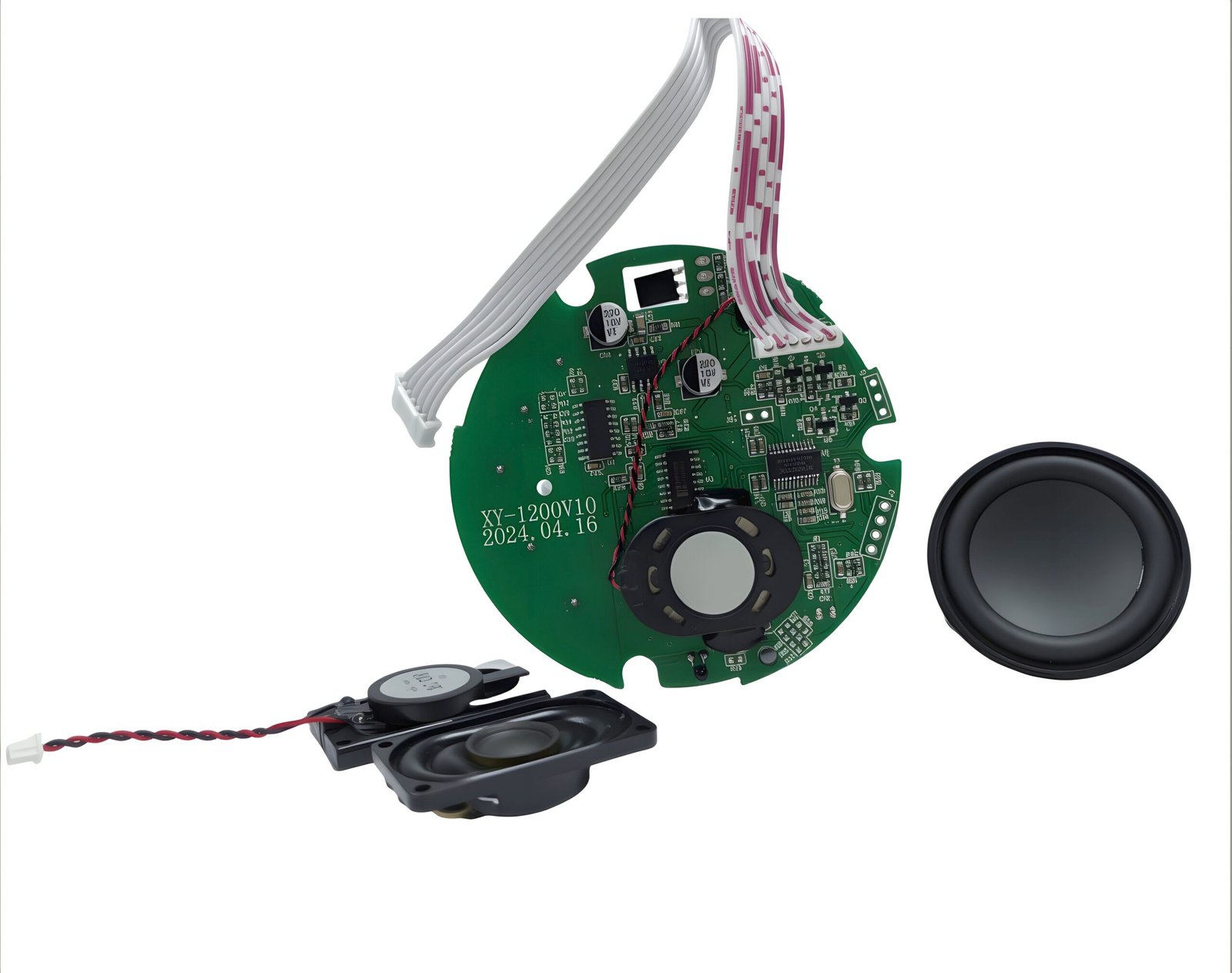
A custom Printed Circuit Board (PCB) is designed, integrating the main processor, amplifier, wireless modules, sensors, and power supply. For early prototypes, stripboard or multilayer PCB prototypes (ordered from services like JLCPCB) are used. Careful PCB layout is critical for audio quality—poor layout can introduce ground loop hum and noise. This stage also includes firmware development for system control, DSP tuning, and connectivity.
Phase 3: Testing, Validation, and Refinement
A prototype isn’t complete until it’s rigorously tested. This phase transforms a working model into a validated product ready for manufacturing.
Acoustic Testing is performed in an anechoic chamber (for free-field measurements) and a listening room (for subjective evaluation). Key tests include:
- Frequency Response & Directivity
- Harmonic and Intermodulation Distortion
- Maximum SPL and Compression
- Rub & Buzz Detection (using a swept sine wave)
Electrical and Compliance Testing ensures safety and regulatory readiness:
- Safety: IEC 62368-1 (Audio/Video Standard)
- EMC: FCC Part 15 (US), CE (EU) for radio frequency interference.
- Wireless: Bluetooth SIG qualification, Wi-Fi Alliance certification.
- Battery Safety: UN 38.3 for transportation, IEC 62133 for cell safety.
User Experience (UX) & Environmental Testing:
- Real-world usage tests for button feel, app connectivity, and voice assistant responsiveness.
- Durability tests: Drop tests, IP rating validation for water/dust resistance (e.g., IPX7), and climate chamber testing for temperature/humidity extremes.
The data from these tests feed back into the design in an iterative loop. DSP tuning is adjusted, mechanical fits are modified, and firmware is updated. This cycle may repeat several times until all KPIs are met.
Phase 4: Design for Manufacture (DFM) and Pre-Production
Once the prototype meets all specifications, the focus shifts to making it manufacturable at scale and acceptable cost. This is where Design for Manufacturability (DFM) and Design for Assembly (DFA) principles are applied.
Engineers work with manufacturing partners to:
- Simplify part count and assembly steps.
- Modify wall thicknesses and draft angles for injection molding.
- Select final materials (e.g., moving from prototype MDF to production-grade plastic or aluminum).
- Finalize the Bill of Materials (BOM) and source components for long-term availability.
A final Engineering Validation Test (EVT) run is conducted using units assembled from production-intent tools and processes. This confirms the design is ready for the Design Verification Test (DVT), which uses units from the actual production line.
Speaker Prototype Development Cost Breakdown (Estimated)
| Phase | Key Activities | Typical Cost Range (USD) | Duration |
|---|---|---|---|
| Concept & Design | Market Research, Acoustic Simulation, ID/Mechanical Design | $5,000 – $25,000+ | 4-10 weeks |
| Prototype Fabrication | 3D Printing, CNC Enclosures, Custom PCB Assembly, Component Sourcing | $10,000 – $50,000+ | 6-12 weeks |
| Testing & Certification | Acoustic Lab Rental, Compliance Testing (FCC, CE, Bluetooth), Durability Testing | $15,000 – $40,000+ | 8-12 weeks |
| DFM & Pre-Production | Tooling Design (Molds), Pilot Production Run, Final DVT | $30,000 – $100,000+ (Tooling) | 12-20 weeks |
Note: Costs are highly variable based on speaker complexity, features (e.g., smart vs. dumb), and geographic location of partners. Tooling is a major upfront capital cost.
Professional Q&A
Q: What is the single most common mistake companies make during speaker prototype development?
A: Skipping proper acoustic simulation and enclosure modeling in the digital phase. Many teams rush to 3D print a cool-looking case and drop in off-the-shelf drivers, only to find the sound is thin, boomy, or distorted. Investing time in tools like VituixCAD or working with an acoustic engineer to simulate performance saves countless expensive and time-consuming prototype iterations later.
Q: How critical is DSP in modern speaker development, and when should it be implemented?
A: DSP is non-negotiable for a competitive product. It’s used for speaker protection, precise crossover filtering, EQ correction for room/placement, and enhancing perceived bass. Implementation should start in the Proof-of-Concept phase. The choice between a dedicated DSP chip (like Analog Devices’ SHARC) or a processor with integrated DSP cores depends on complexity. For smart speakers, the wake-word processing and beamforming for microphone arrays are entirely DSP-driven.
Q: With the rise of sustainable materials, how is this impacting prototype development?
A: Sustainability is moving from a niche requirement to a core design spec. In 2024, we’re seeing more prototypes using bio-based plastics (e.g., PLA for non-structural parts), recycled aluminum, and fabric grilles from recycled ocean plastic. This affects prototyping as material properties (density, stiffness) differ. It requires early testing for acoustic performance and durability. Furthermore, modular design for repairability is being prototyped to extend product life, impacting how enclosures are assembled and fastened.